Table of Contents
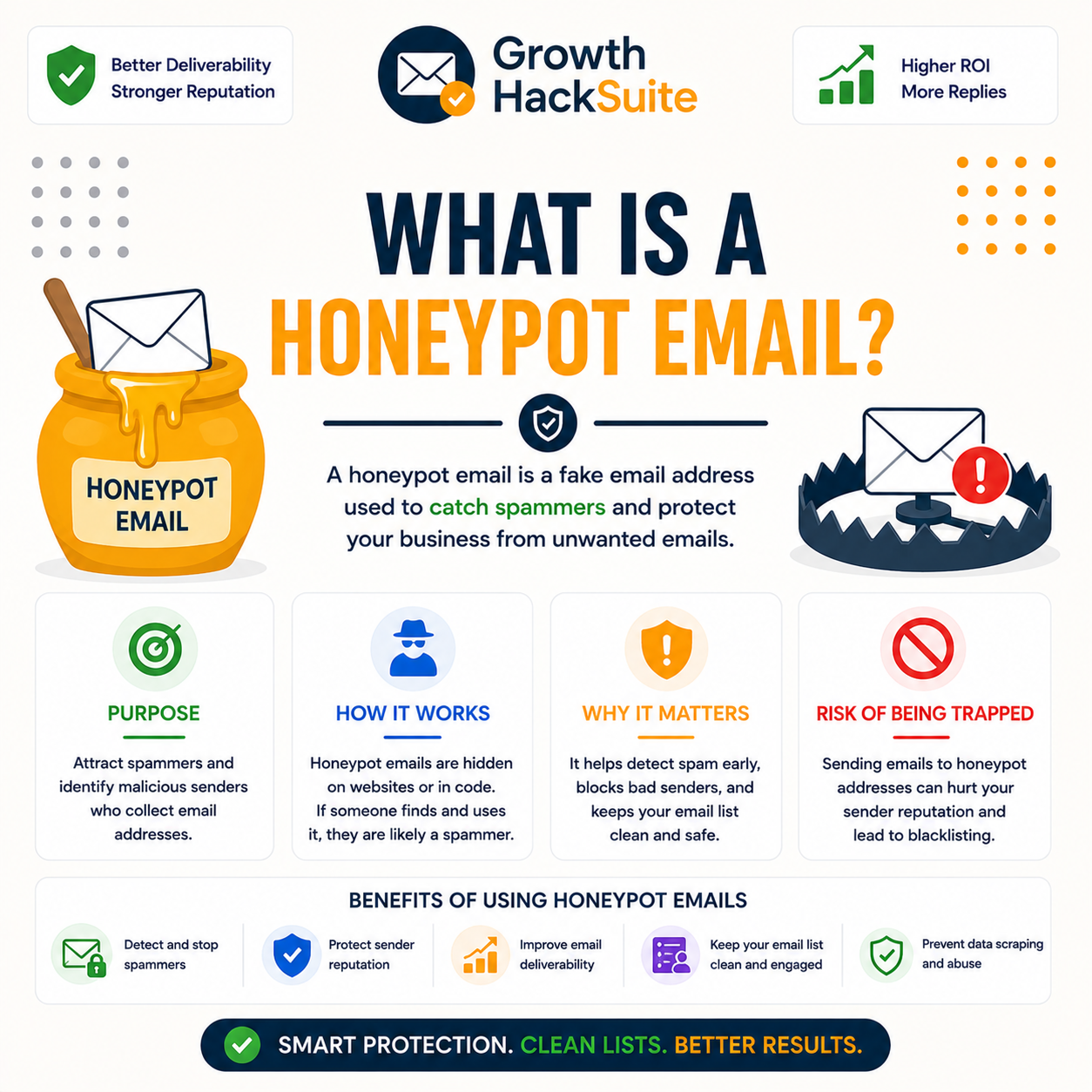
What is a honeypot email? It is a hidden address planted to catch spammers and bots. In one form it is a spam-trap address seeded online; in another it is an invisible form field that only bots fill in. Both expose senders or scrapers that harvest addresses without permission. This guide explains what a honeypot email is, the two forms it takes, and how to stay clear of one.
Avoid honeypots — verify your list free before the next send.
Verify Your List Free →Free plan included · No credit card · Full status and scoring
What Is a Honeypot Email Address?
A honeypot email is an address deliberately planted to catch spammers and bots. It is never used by a real person and never opts in, so any mail to it, or any bot that submits it, exposes harvesting or careless sending. A honeypot email is a deliberate trap, not a real contact, and that single trait drives everything it does.
- Planted decoy: A honeypot email is seeded on purpose in a place a human never visits, existing only to attract automated harvesters and the spam that follows them, never to receive a real message from a genuine correspondent.
- No real owner: No person reads or opts the address in, so every message arriving counts as unsolicited by definition, giving anti-spam operators a clean signal untainted by legitimate correspondence or accidental human contact.
- Exposes harvesting: Any sender hitting the address proves the data came from scraping or purchase rather than permission, marking the sending domain as one that mails addresses it never earned consent to contact.
- Hidden from humans: The address lives in markup, stale pages or code comments that browsers never render visibly, ensuring only an automated crawler reading raw HTML ever encounters and collects the planted string for later misuse.
- Feeds blocklists: Every recorded hit becomes evidence for anti-spam systems, so a single message to the decoy can ripple outward and degrade delivery for a whole sending program rather than one isolated address.
A honeypot email is bait. It exists only to expose those who harvest addresses or email unverified data, which is why it never touches a real inbox.
How Does a Honeypot Email Work?
A honeypot address is published where only an automated scraper would find it, such as hidden in page code or buried on a stale page. When a scraper harvests it and a sender mails it, the operator records the hit as proof of bad practice, tying the event to the sending domain and IP for filtering.
- Hidden placement: The address sits in markup or pages invisible to human visitors, reachable only by an automated crawler reading raw HTML, ensuring no genuine person ever sees or chooses to write to it.
- Scraper harvests: An address-harvesting bot collects the hidden string along with thousands of others, folding the honeypot into a list later sold or used for unsolicited bulk mail without any consent.
- Sender mails it: Whoever later buys or uses that harvested list sends a campaign to the seeded address, unaware it is a trap, and that single delivery becomes the trigger event the operator was waiting to record.
- Hit recorded: The moment a message lands, the operator logs the sender IP, headers and content, feeding blocklists and anti-spam systems that then act on the proven harvesting and careless sending behaviour.
- Reputation acted on: Downstream filters and mailbox providers consume the recorded signal, throttling or blocking the offending domain so future messages to real subscribers face delays, spam folders or outright rejection.
Honeypots sit where only scrapers reach, so emailing one proves the address came from harvesting rather than a genuine signup or earned permission.
What Are the Two Forms of Email Honeypot?
There are two forms. A trap honeypot is a seeded email address that catches scrapers and spammers, like a spam trap. A form honeypot is an invisible field on a signup form that humans never see but bots fill in, catching automated fake signups. Both forms protect against bad actors in different layers.
Source: en.wikipedia.org/wiki/Spamtrap and common anti-spam form-honeypot practice, reviewed 2026-06-29. Definitions describe how each honeypot form is deployed in practice.
Two honeypots, two jobs: a seeded trap address catches scrapers and spam senders, while an invisible form field catches bots at signup before they enter a list.
Why Are Honeypots Used?
Operators use honeypots because they catch bad actors with near-zero false positives: a real person never reaches a hidden address or fills an invisible field. That precision makes the honeypot a trusted signal for blocklists and a clean way to block bot signups without burdening genuine visitors with puzzles or checks.
- Near-zero false positives: Because no human ever touches a hidden address or invisible field, almost every hit comes from a bot or a harvester, making the captured signal exceptionally clean compared with content-based spam scoring alone.
- Trusted signal: Blocklist operators weight honeypot hits heavily, since the trap removes ambiguity about intent, letting anti-spam systems act confidently on the sending domain rather than guessing from message content or volume patterns.
A honeypot is a trap that lures bots into revealing themselves through hidden fields humans never see.
— Hunter, on verification and data hygiene
Honeypots catch bad actors cleanly. No real person trips one, so the signal stays trusted by the blocklists and filters that depend on it.
What Happens If You Hit an Email Honeypot?
Hitting a trap honeypot can blocklist a sending domain, just like any spam trap, because it proves harvested data was emailed. Triggering a form honeypot simply blocks that single bot signup with no reputation cost. The serious risk is the trap address, which can damage deliverability across an entire program.
- Trap honeypot blocklisting: A message to a seeded trap address can land the sending domain or IP on a blocklist, throttling or blocking delivery to real subscribers and undoing months of carefully built sender reputation.
- Form honeypot blocked signup: An invisible field tripped by a bot only rejects that one fake submission, protecting the list at the door without touching sender reputation or causing any deliverability harm to genuine mail.
A trap honeypot can blocklist a sender, while a form honeypot just blocks a bot. The trap address is the form that carries real deliverability danger.
How Do You Avoid Email Honeypots?
Avoid trap honeypots by never scraping or buying addresses and by verifying lists before sending, the same practices that avoid ordinary spam traps. Deploy form honeypots yourself to block bot signups at the source. Permission-based list building plus verification keeps a program clear of the dangerous trap kind.
- Never scrape or buy: Building lists only from people who actively opted in removes the harvesting path that feeds trap addresses into a database, cutting honeypot exposure at the root before any send happens.
- Verify before sending: Running a list through a verifier removes invalid, disposable and scraped-looking addresses, shrinking the pool of unverified data where seeded trap addresses tend to hide undetected among real contacts.
- Honour opt-outs fast: Promptly removing unsubscribes and hard bounces keeps a list current, since recycled and abandoned addresses are exactly the inactive mailboxes spam-trap operators repurpose into seeded honeypot traps over time.
- Warm the domain: Sending gradually from a new domain and maintaining steady volume builds reputation that survives the occasional bad address, reducing the blast radius if a trap slips through despite careful list hygiene.
- Use form honeypots: Adding an invisible field to a signup form catches bots that auto-fill every input, blocking automated fake registrations before they pollute a list or inflate fake subscriber counts.
Cut honeypot risk — verify your list free before the next campaign.
Verify Your List Free →Free plan · No credit card · Full status and scoring
Avoiding trap honeypots works exactly like avoiding spam traps: permission plus verification, never scraping. The form kind is something to deploy, not dodge.
How Do Verifiers Help With Honeypot Risk?
Verifiers cannot identify a hidden honeypot by name, since a trap address looks ordinary. But by removing scraped, invalid and disposable addresses they cut the unverified data honeypots hide in. Cleaning the list that harvesting produced is the practical way to lower honeypot exposure before a send.
- Removes risky data: A verifier strips invalid, disposable and malformed addresses from a list, reducing the volume of unverified entries where seeded trap addresses tend to sit unnoticed among genuine contacts.
- Honest limitation: No verifier can flag a honeypot by name, because a well-built trap address is indistinguishable from a normal mailbox, so cleaning data lowers but never fully eliminates the risk.
Verifying a list before the first send is the cheapest way to protect a sending domain from trap-related damage.
— Growth Hack Suite, pre-send verification workflow
Verification cleans the harvested data honeypots hide in. It is the practical way to cut exposure, even though no tool can name a trap address outright.
Honeypot vs Spam Trap: What Is the Difference?
The terms overlap. A trap honeypot is essentially a spam trap, while a form honeypot is a bot-blocking technique with no email-reputation effect. So all trap honeypots are spam traps, but not all honeypots are spam traps. The table clarifies how the two ideas relate and where they diverge.
Source: en.wikipedia.org/wiki/Spamtrap, reviewed 2026-06-29. A spamtrap is defined as a honeypot used to collect spam; the form honeypot is a distinct anti-bot technique.
A trap honeypot is a spam trap; a form honeypot just stops bots. Same word, two roles, with only the trap address carrying reputation risk.
How Should You Protect Your Forms and Lists?
Protect lists by verifying before sending and building with permission, and protect forms by adding an invisible honeypot field plus real-time email verification. The two honeypot ideas, one to avoid and one to use, both come back to keeping clean, verified data flowing into a database.
- Verify lists: Running every list through a verifier before a send removes invalid and disposable addresses, shrinking the unverified pool where seeded trap addresses hide and lowering the chance of a blocklisting hit.
- Add a form honeypot: Placing an invisible field on a signup form catches bots that fill every input, rejecting automated fake registrations at the door before they ever reach the subscriber database.
- Verify signups: Checking each new address in real time at the point of submission blocks malformed and disposable entries, keeping a list clean as it grows rather than waiting for a periodic bulk clean.
- Require double opt-in: Asking new subscribers to confirm via a click filters out mistyped and bot-submitted addresses, ensuring only mailboxes a real owner controls and wants enter the list in the first place.
- Monitor engagement: Watching open and reply patterns surfaces dormant or never-active addresses that may be recycled traps, so suppressing them before the next campaign keeps the seeded-honeypot risk continuously low across sends.
Protect your list at the source — verify free with Hunter.
Verify Your List Free →Free plan · No credit card · Real-time and bulk checks
Avoid trap honeypots and deploy form honeypots. Both paths lead to the same destination: clean, verified, permission-based data entering the list.
What Tools Reduce Honeypot Risk?
A verifier reduces trap-honeypot risk by cleaning harvested data, while form-builder honeypot fields block bot signups at entry. Hunter covers the verification side with a recurring free tier. The table compares verifier capabilities relevant to cutting honeypot-adjacent risk across a sending program.
Source: vendor verification documentation (hunter.io, zerobounce.net, neverbounce.com) and standard form-honeypot practice, reviewed 2026-06-29. Confirm current free-tier terms on each provider’s site before relying on them.
A verifier cuts trap-honeypot risk by cleaning data, while a form honeypot blocks the bots at entry. The two together cover both layers of exposure.
Two Honeypot Forms, Two Defences
Verdict: Staying Clear of Email Honeypots
A honeypot email is bait, either a seeded trap address that can blocklist a sender or an invisible form field that blocks bots. Avoid the trap kind by never scraping and verifying before sending, and deploy the form kind to protect signups. Clean, verified, permission-based data is the throughline across both.
Verdict: A honeypot email is bait. The trap form is a seeded spam-trap address that can blocklist a sending domain; the form field simply blocks bots with no reputation cost. Avoid the trap kind by never scraping and verifying before every send, and deploy the form kind on signups.
A spamtrap is a honeypot used to collect spam.
— Wikipedia, Spamtrap
Verify your list free and avoid honeypot traps before the next send.
Verify Your List Free →Free plan · No credit card · Results before you send
Related Tools in the Hunter Stack
Honeypots are a form of trap, so the same data hygiene that avoids them powers the wider verification workflow. The Hunter verifier review covers data cleaning, and the email finder review covers building lists worth verifying in the first place on one connected platform.
- Hunter Email Verifier: The validation layer that cleans harvested and risky data, explained in depth — start with what the Hunter Email Verifier is.
- Hunter Email Finder: The permission-friendly sourcing side of the stack — read the Hunter.io email finder review for how lists are built.
Honeypot Email: Frequently Asked Questions
The 12 most-asked questions about honeypot email addresses.
What is a honeypot email address?
A honeypot email is an address planted deliberately to catch spammers and bots. It is never used by a real person and never opts in, so any mail to it exposes harvesting or careless sending. One form is a seeded trap address; another is an invisible signup-form field.
How does a honeypot email work?
A trap honeypot address is published where only an automated scraper would find it, such as hidden in page code. When a scraper harvests it and a sender mails it, the operator logs the hit as proof of bad practice and feeds it to blocklists tied to the sending domain.
What are the two forms of email honeypot?
A trap honeypot is a seeded email address that catches scrapers and spammers, behaving like a spam trap. A form honeypot is an invisible field on a signup form that humans never see but bots fill in, catching automated fake signups. Both protect against bad actors in different layers.
Why are honeypots used?
Honeypots catch bad actors with near-zero false positives, because a real person never reaches a hidden address or fills an invisible field. That precision makes the signal trusted by blocklists for spam detection and a clean way to block bot signups without burdening genuine visitors with puzzles.
What happens if I hit a honeypot?
Hitting a trap honeypot can blocklist a sending domain, just like any spam trap, because it proves harvested data was emailed. Triggering a form honeypot simply blocks that single bot signup with no reputation cost. The serious risk is the trap address, which damages deliverability across a program.
How do I avoid email honeypots?
Avoid trap honeypots by never scraping or buying addresses and by verifying lists before sending, the same practices that avoid spam traps. Deploy form honeypots to block bot signups at the source. Permission-based building plus verification keeps a program clear of the dangerous trap kind.
How do verifiers help with honeypot risk?
Verifiers cannot name a hidden honeypot, since a trap address looks ordinary. But by removing scraped, invalid and disposable addresses they cut the unverified data honeypots hide in. Cleaning the list that harvesting produced is the practical way to lower honeypot exposure before a send.
Honeypot vs spam trap, what is the difference?
A trap honeypot is essentially a spam trap, while a form honeypot is a bot-blocking technique with no email-reputation effect. So all trap honeypots are spam traps, but not all honeypots are spam traps. The overlap sits entirely in the seeded-address form, not the form field.
How do I protect my forms?
Protect forms by adding an invisible honeypot field that bots fill but humans never see, plus real-time email verification at submission. The hidden field rejects automated fake signups, while verification blocks malformed and disposable entries, keeping a list clean as it grows rather than after a bulk clean.
What tools reduce honeypot risk?
A verifier reduces trap-honeypot risk by cleaning harvested data, while form-builder honeypot fields block bot signups at entry. Hunter covers verification with a recurring free tier and confidence scoring. Combining a verifier on lists with a hidden field on forms covers both layers of exposure.
Is a honeypot the same as a spam trap?
Not entirely. A trap honeypot email is a spam trap, but a form honeypot is a hidden signup field unrelated to email reputation. The terms overlap only in the seeded-address sense. Wikipedia describes a spamtrap as a honeypot used to collect spam, which captures the trap-address form precisely.
Can verification detect honeypots?
No verifier can flag a honeypot by name, because a well-built trap address is indistinguishable from a normal mailbox. Verification instead removes invalid, disposable and scraped-looking addresses, shrinking the unverified pool where trap addresses hide. It lowers risk substantially but cannot guarantee a list is honeypot-free.