Table of Contents
Single vs double opt-in is a trade-off between list size and list quality. Single opt-in adds a subscriber the moment they submit a signup form, while double opt-in requires them to confirm through a follow-up email first. Double opt-in builds a cleaner, more engaged list but grows it more slowly. This guide explains single vs double opt-in and which one builds a cleaner list.
Whichever opt-in you use, verify the list free first.
Verify Your List Free →Free plan included · No credit card · Catches typos and invalids
Single vs Double Opt-In: Which Builds a Cleaner List?
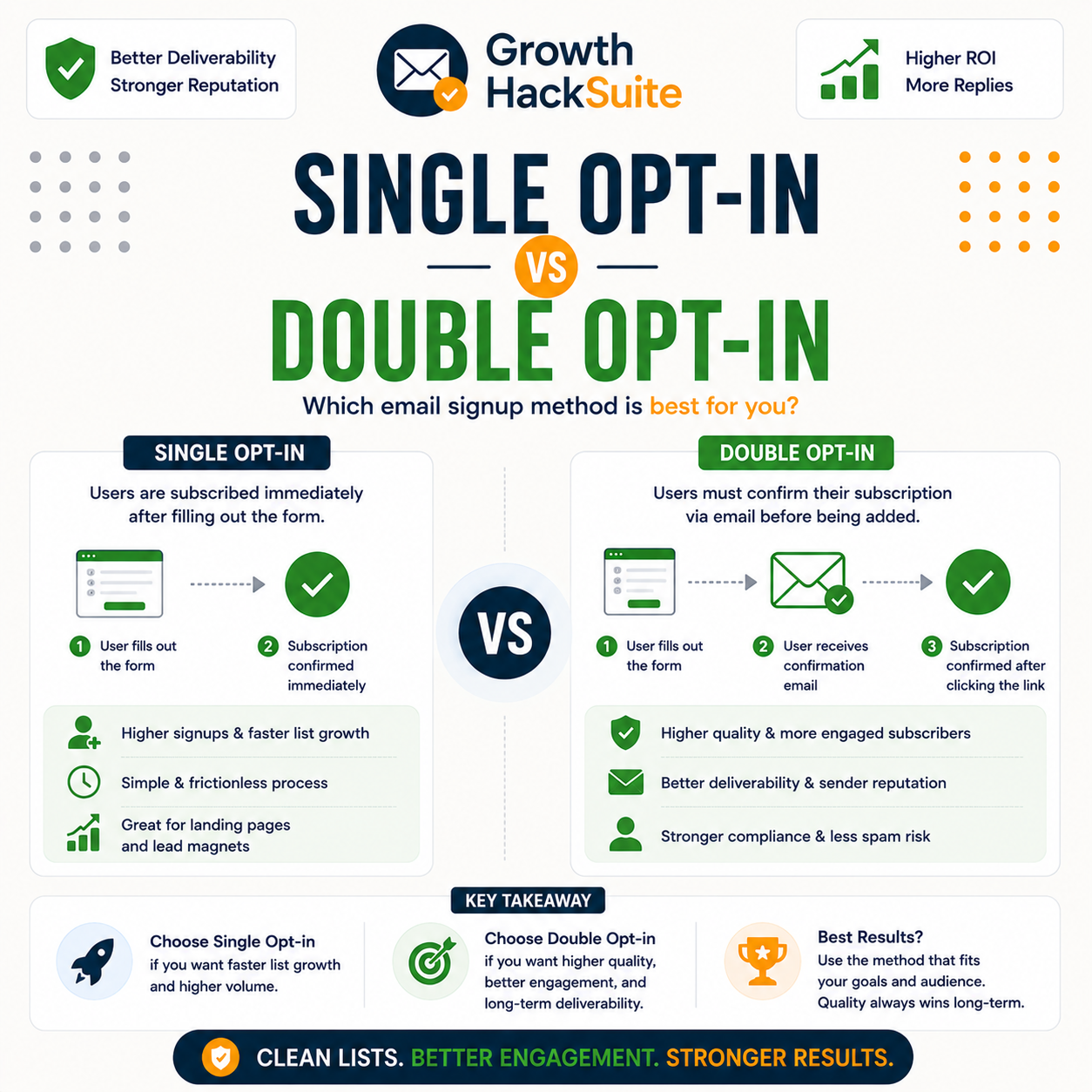
Double opt-in builds the cleaner list. Single opt-in adds a subscriber the instant they submit a form, while double opt-in requires them to confirm through a follow-up email first. The confirmation step filters typos, bots and disposable signups, so double opt-in trades some growth speed for a higher-quality, more engaged list of subscribers who proved real intent.
- Single opt-in — instant add: A subscriber joins the list the moment a form is submitted, with no confirmation step. The method maximizes signup volume and removes friction, but admits typos, bot entries and disposable addresses that never prove genuine intent to receive mail.
- Double opt-in — confirm first: A subscriber joins only after clicking a confirmation link in a follow-up email. The extra step proves the address works and the person wants the mail, producing a smaller list with far fewer invalids and stronger engagement.
- Cleaner list defined: A cleaner list means fewer invalid addresses, lower bounce rates and higher engagement per subscriber. Double opt-in delivers this because confirmation removes mistyped and fake entries before they ever count toward the active sending audience.
- Growth speed trade-off: Single opt-in reports faster list growth because every submission becomes a subscriber instantly, while double opt-in grows slower as unconfirmed signups drop off. The decision weighs headline list size against the quality of who actually remains.
- Consent strength signal: Double opt-in produces stronger consent evidence, since a confirmation click records a deliberate choice. That signal matters for strict-market compliance and for inbox providers reading engagement when deciding placement for future campaigns.
Double opt-in builds the cleaner list because the confirmation step filters typos, bots and disposables before they ever count as subscribers.
What Is Single Opt-In?
Single opt-in adds a subscriber to the list the moment they submit the signup form, with no confirmation step. It maximizes signup volume and reduces friction, which suits top-of-funnel growth. The cost is that it also lets in typos, fake entries and disposable addresses that never confirm any real intent to receive mail.
- No confirmation step: The address enters the list immediately on form submission, without a verifying email. Nothing checks whether the mailbox exists or the person typed their own address, so unverified data flows straight into the sending list from the start.
- Maximizes signup volume: Removing the confirmation hurdle captures every visitor who clicks submit, including those who would abandon a second step. The approach favours raw list size and frictionless growth over the certainty that each entry represents a willing subscriber.
- Lower friction at entry: Visitors complete the signup in a single action, which lifts form conversion rates and suits lead-magnet or top-of-funnel campaigns where capturing the contact quickly matters more than confirming long-term intent right away.
- Higher bounce exposure: Typos and dead mailboxes enter the list unchecked, so the first campaign can hit elevated bounce rates. That exposure threatens sender reputation unless a verification layer rejects invalid addresses before any message sends.
- Weaker consent record: A single submission offers thinner proof of intent than a confirmation click, which can matter in strict-consent regions. The lighter record trades compliance assurance for the speed and simplicity single opt-in is chosen for.
Single opt-in is frictionless and fast to grow, but it admits typos and fake signups unchecked from the very first form submission.
What Is Double Opt-In?
Double opt-in adds a subscriber only after they click a confirmation link in a follow-up email. This proves the address is real and the person genuinely wants the mail, producing a smaller but markedly cleaner and more engaged list. The method is also called confirmed opt-in, since the second step confirms both deliverability and intent.
- Email confirmation step: A follow-up message asks the new signup to click a link before joining the list. The click verifies the mailbox actually receives mail, filtering out mistyped addresses and bots that can never complete the confirmation action.
- Proven subscriber intent: Completing the confirmation signals a deliberate choice to receive future emails, not an accidental or coerced signup. The resulting list carries stronger consent evidence and higher baseline engagement than one built on unconfirmed submissions alone.
- Self-cleaning by design: A mistyped address never receives the confirmation email, a bot cannot click the link, and an unwanted signup simply ignores it. The mechanism removes bad entries automatically before they reach the active sending list.
- Confirmed opt-in synonym: Double opt-in is also called confirmed opt-in, since the second step confirms both deliverability and willingness. The terms describe the same two-stage process used by most email service providers for compliant list building.
- Stronger reputation signal: Lists built this way show higher engagement, which inbox providers read as a positive trust signal. That reputation lift improves inbox placement for later campaigns compared with lists carrying unconfirmed, low-intent addresses.
A list where every address is confirmed valid is the cheapest deliverability insurance a sender can buy.
— Growth Hack Suite, pre-send verification workflow
Double opt-in confirms both a real address and real intent, yielding a smaller list with much higher quality than single opt-in.
What Are the Pros and Cons of Single Opt-In?
Single opt-in grows lists fastest and removes friction, which suits top-of-funnel and high-volume goals. The cost is quality: more invalids, bots and disposables, higher bounce risk, and lower average engagement. It favours quantity over reliability, so it works best when paired with aggressive ongoing verification and cleaning.
- Pro — fastest growth: Every form submission becomes a subscriber instantly, so list size climbs at the maximum possible rate. The absence of a confirmation hurdle captures hesitant visitors who would drop off, making single opt-in ideal for pure top-of-funnel volume.
- Con — lower data quality: Unconfirmed entries carry more typos, bots and disposable addresses, raising bounce risk and depressing average engagement. The list starts dirtier and demands heavier verification and cleaning to reach the health a confirmed list has by default.
Single opt-in wins on growth speed but loses on quality, bringing more invalids and lower engagement that must be cleaned out later.
What Are the Pros and Cons of Double Opt-In?
Double opt-in produces a clean, engaged, low-bounce list and stronger consent, which protects deliverability and suits regions with strict consent rules. The cost is slower growth, since some real subscribers never complete the confirmation step. It favours quality over quantity, trading raw list size for measurably better performance.
- Pro — clean and engaged: Every confirmed subscriber holds a working address and demonstrated intent, so lists show lower bounces, fewer complaints and higher open and click rates. The confirmation step also strengthens consent evidence for strict-market compliance.
- Con — slower growth: A share of genuine signups never click the confirmation link, lost to inbox delays, filtering or simple inattention. The confirmation drop-off shrinks reported list size even though the subscribers who remain are higher quality.
Hunter’s verification API returns a deliverability status and confidence score for each address before it is mailed.
— Hunter API documentation
Double opt-in wins on quality and consent but loses some real subscribers to unconfirmed signups, trading size for engagement.
How Does Each Affect List Quality?
Double opt-in yields lower bounce rates, fewer complaints and higher engagement, because every subscriber confirmed a working address and real interest. Single opt-in lists carry more decay and bad data from the start, needing more aggressive cleaning to stay healthy. One widely cited study found double opt-in cut bounces by roughly 48% versus single.
Source: Mailchimp study of ~30,000 users comparing double vs single opt-in (+72.2% unique opens, +114% clicks, -48.3% bounces), reported by Litmus and Sender, 2024–2026. Figures are study averages; results vary by list and industry.
Double opt-in starts cleaner; single opt-in needs heavier ongoing cleaning to match it. For the mechanics, see how to reduce your email bounce rate.
How Does Each Affect List Growth?
Single opt-in grows faster because every submission counts; double opt-in grows slower because unconfirmed signups are dropped. The gap is the confirmation drop-off, where studies find roughly a fifth or more of signups never complete the second step. Whether faster growth is worth lower quality depends on goals and how the list is monetized.
- Single — faster headline growth: Counting every form submission inflates list size quickly and reports strong top-line numbers. The speed suits campaigns chasing reach or lead volume, though a portion of that growth is invalid or disengaged data padding the totals.
- Double — confirmation drop-off: Requiring a click discards signups who never confirm, slowing reported growth. The lost contacts include some genuine subscribers, but the remaining list is denser with engaged, deliverable addresses that perform better per message sent.
Single grows faster, double drops the unconfirmed: the trade is raw speed against the quality of who actually remains on the list.
How Does Verification Complement Opt-In?
Verification works with either method: it catches typos and invalids that single opt-in would admit, and confirms deliverability before a double opt-in confirmation email is even sent. Pairing real-time verification with a chosen opt-in flow gives the cleanest result, since neither opt-in method alone catches every bad address at the form.
- Fixes single opt-in gaps: Real-time verification at the form rejects typos, invalids and disposable domains before they enter a single opt-in list, restoring much of the quality that skipping confirmation would otherwise sacrifice on a high-volume signup flow.
- Supports double opt-in delivery: Verifying an address before the confirmation email sends ensures that message actually lands, preventing a valid subscriber from being lost simply because the confirmation hit a typo or an unreachable mailbox.
Verification complements either opt-in, catching the invalids single misses and ensuring the double opt-in confirmation email lands. Learn what email verification is for the full process.
Single vs Double Opt-In: Side-by-Side
Single opt-in maximizes growth and friction-free signups; double opt-in maximizes quality, engagement and consent. The choice is a deliberate trade-off, not a clear winner for everyone. The table below contrasts growth speed, list quality, consent strength and setup effort so the right pick is easy to read at a glance.
Source: Synthesized from Litmus, Sender and Mailchimp opt-in studies; GDPR consent guidance per iubenda and TermsFeed, verified 2026-06. Consent rules vary by jurisdiction; confirm local requirements.
Single favours growth, double favours quality and consent: a deliberate trade, not a universal winner for every list or goal.
How Do You Choose Between Them?
Choose double opt-in when quality, engagement and consent matter most, such as strict-consent regions or high-value nurture. Choose single opt-in for top-of-funnel volume where lists are verified and cleaned aggressively. Either way, add real-time verification to close the quality gap that no opt-in method fully covers on its own.
- Pick double for quality and consent: Choose the confirmed flow when engagement, deliverability and provable consent outweigh raw growth, especially for nurture lists or markets like Germany where confirmed opt-in is the practical expectation for compliant email sending.
- Pick single for volume: Choose the instant flow when top-of-funnel reach and signup count matter most, accepting that the list starts dirtier and depends on consistent verification and cleaning to keep bounce rates and complaints under control.
- Add verification either way: Layer real-time verification onto whichever opt-in flow is chosen, since it rejects typos and invalids at the form and protects deliverability regardless of whether a confirmation step exists in the signup process.
- Check the consent jurisdiction: Confirm whether the target audience sits in a strict-consent market where confirmed opt-in is the safer default. Regions like Germany and Austria treat double opt-in as the practical norm for demonstrating lawful email consent.
- Match the funnel stage: Align the method to the campaign goal, using single opt-in for high-volume lead capture and double opt-in for high-value nurture sequences. The funnel stage decides whether speed or quality carries more weight here.
Verify your list free, whichever opt-in you use.
Verify Your List Free →Free plan · No credit card · Real-time and bulk checks
Pick by goal: double for quality, single for volume, and verify either way to close the gap neither opt-in fully covers alone.
What Tools Support Clean Opt-In?
A real-time verifier supports either opt-in by catching invalids at the form, and an email service provider handles the double opt-in confirmation flow. Hunter provides verification with a recurring free tier, while ESPs like Mailchimp run the confirmation email. The table compares verification options for building a clean opt-in list.
Source: hunter.io/api-documentation/v2 and provider feature pages, verified 2026-06. Hunter free tier is recurring monthly; confirm current allowances on each provider’s site before relying on them.
A real-time verifier makes either opt-in cleaner, while the ESP runs the confirmation flow for double. See the Hunter Email Verifier accuracy benchmark for verification depth.
The Trade-Off in One View
Verdict: Single vs Double Opt-In
Double opt-in builds the cleaner, more engaged list and stronger consent, at the cost of slower growth; single opt-in grows faster but admits more bad data. Choose by goals, and pair either with real-time verification to catch the invalids and typos that neither opt-in method alone fully stops at the signup form.
Verdict: Double opt-in is the cleaner list — studies show ~48% fewer bounces and ~72% higher opens — at the cost of slower growth and confirmation drop-off. Single opt-in grows faster but admits more bad data. Verify either way to close the gap.
Double opt-in is a process for subscribing to email by confirming the request twice.
— Wikipedia, Double opt-in
Verify your list free, whatever opt-in you choose.
Verify Your List Free →Free plan · No credit card · Cleaner list either way
Related Tools in the Hunter Stack
Opt-in choice ties directly to signup verification and list hygiene. The Hunter verifier review covers how validation works, and the email finder review covers building the lists worth verifying, both on one connected platform and credit pool.
- Hunter Email Verifier: The validation layer that catches invalids at the form or in bulk — read the guide to what the Hunter Email Verifier is for how it scores addresses.
- Hunter Email Finder: The list-building half of the bundle that shares the same credit pool — see the Hunter.io email finder review for sourcing costs.
Single vs Double Opt-In: Frequently Asked Questions
The 12 most-asked questions about single vs double opt-in.
Single vs double opt-in — which is cleaner?
Double opt-in is cleaner. The confirmation step filters typos, bots and disposable addresses before they count as subscribers, so the list is self-cleaning by design. Single opt-in admits every submission unchecked, including invalids that raise bounce risk and lower engagement from the first send.
What is single opt-in?
Single opt-in adds a subscriber to the list the moment they submit a signup form, with no confirmation step. It maximizes signup volume and removes friction, which suits fast top-of-funnel growth, but it also admits typos, bots and disposable addresses that never prove real intent to receive mail.
What is double opt-in?
Double opt-in, also called confirmed opt-in, adds a subscriber only after they click a confirmation link in a follow-up email. The second step proves the address is real and the person genuinely wants the mail, producing a smaller but markedly cleaner and more engaged list with stronger consent evidence.
What are the pros and cons of single opt-in?
The pro is fastest growth with no friction, capturing every form submission as a subscriber. The con is lower quality: more invalids, bots and disposables, higher bounce risk and weaker consent proof. Single opt-in favours quantity, so it needs aggressive verification and cleaning to stay healthy.
What are the pros and cons of double opt-in?
The pro is a clean, engaged, low-bounce list with strong consent that protects deliverability. The con is slower growth, since some genuine subscribers never complete the confirmation step. Double opt-in favours quality over quantity, trading raw list size for measurably better engagement per message.
How does each affect list quality?
Double opt-in produces lower bounce rates, fewer complaints and higher engagement, because every subscriber confirmed a working address and real interest. One widely cited study found double opt-in cut bounces by roughly 48% versus single. Single opt-in lists start dirtier and need heavier ongoing cleaning to match that health.
How does each affect list growth?
Single opt-in grows faster because every submission counts; double opt-in grows slower because unconfirmed signups are dropped. Studies find roughly a fifth or more of signups never complete the second step. The faster growth of single opt-in includes invalid data, while double opt-in keeps a denser, engaged list.
How does verification complement opt-in?
Verification catches typos and invalids that single opt-in would admit, and confirms deliverability before a double opt-in confirmation email is sent. Pairing real-time verification with either opt-in flow gives the cleanest result, since neither opt-in method alone rejects every bad address at the signup form.
Single vs double opt-in side by side?
Single opt-in wins on growth speed and setup simplicity; double opt-in wins on list quality, engagement and consent strength. Single needs minimal setup with no email step, while double requires a confirmation email. The split is a deliberate trade-off rather than a universal winner for every list.
How do I choose between them?
Choose double opt-in when quality, engagement and consent matter most, including strict-consent regions and high-value nurture. Choose single opt-in for top-of-funnel volume where lists are verified and cleaned aggressively. Adding real-time verification to either flow closes the quality gap that no opt-in method covers alone.
What tools support clean opt-in?
A real-time verifier catches invalids at the signup form, and an email service provider runs the double opt-in confirmation flow. Hunter offers verification with a recurring free tier through CSV and API, while ESPs like Mailchimp handle the confirmation email. The two roles combine for the cleanest opt-in list.
Does double opt-in improve deliverability?
Yes. Confirmed subscribers hold working addresses and engage more, which sends positive signals to inbox providers and lowers bounce and complaint rates. Studies report double opt-in lists with markedly higher opens and far fewer bounces, both factors that strengthen sender reputation and inbox placement over time.