Table of Contents
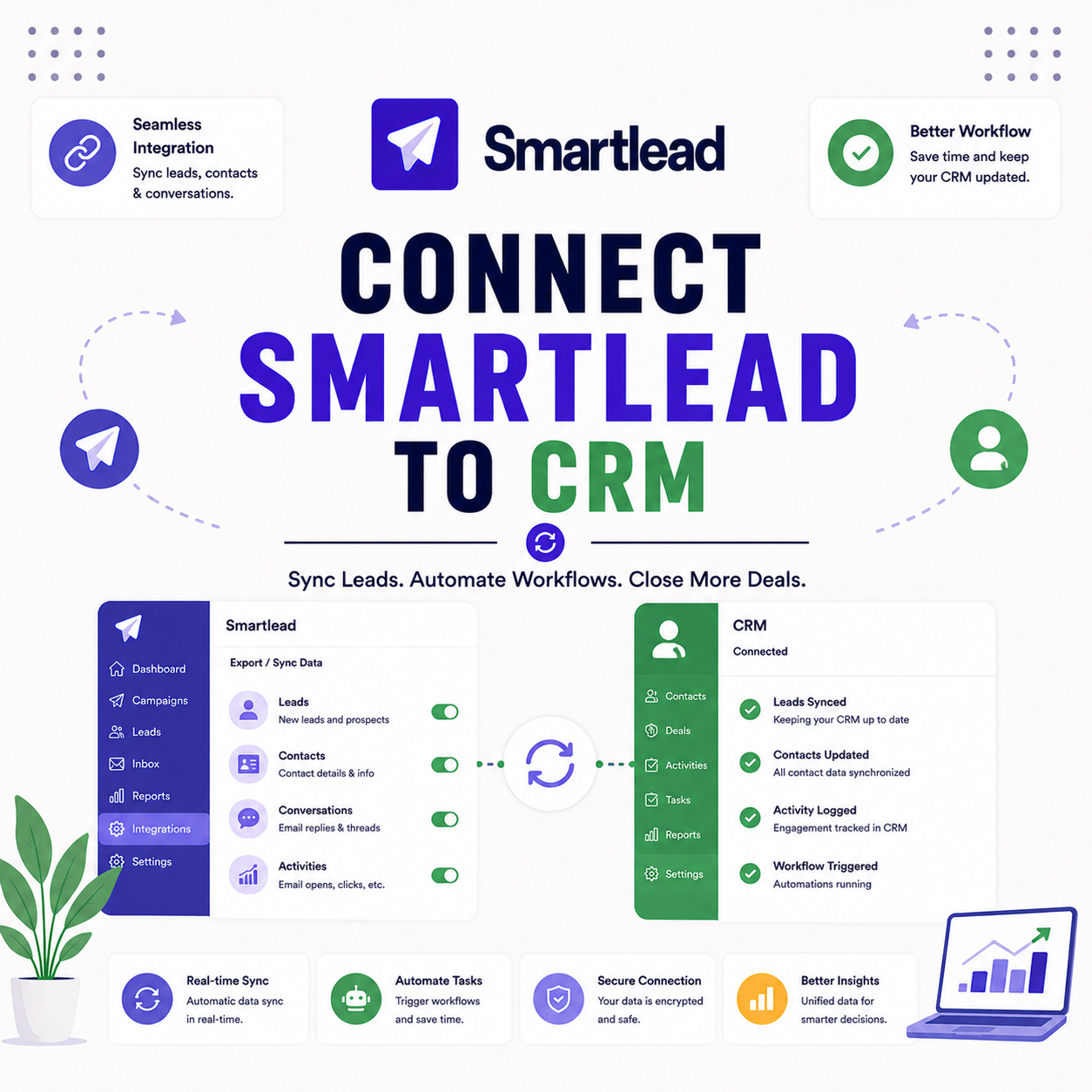
A proper smartlead crm integration setup means replies and outcomes sync automatically so the pipeline stays current without manual data entry. This guide covers connecting to HubSpot, Salesforce and Pipedrive through native integrations, no-code tools or the API, what data syncs, how to map fields correctly, and how reply-to-CRM sync turns hot replies into deals fast.
Connect Smartlead to your CRM via native integration, Zapier or the API, then sync replies and outcomes.
Best for: keeping the pipeline current without manual data entry.
Caveat: deep custom syncs may need developer time and API work.
Bottom line: auto-sync surfaces hot replies as deals immediately.
Sync outbound to your CRM. Try Smartlead free for 14 days.
Start Smartlead Free Trial →Unlimited mailboxes · no credit card · 14-day trial
Why Connect Smartlead to Your CRM?
Connecting Smartlead to the CRM keeps the pipeline current automatically, syncing leads, replies and outcomes without manual entry. The integration removes the gap between outbound activity and the sales record. The deciding factor is that automatic sync is what stops deals slipping between the inbox and the CRM. The list below covers why it matters.
- Auto-sync activity: leads, replies and outcomes flow into the CRM without manual copying.
- No manual entry: removing hand-keyed updates saves time and prevents data-entry errors.
- Current pipeline: the CRM reflects real outbound activity as it happens, not days later.
- Faster follow-up: hot replies surface as deals immediately, so nothing waits in an inbox.
- One source of truth: the CRM holds the full history, from first send to closed deal.
How Do You Connect Smartlead to HubSpot?
Smartlead hubspot connection happens through the native integration or the API, authorizing access and mapping fields so leads and reply outcomes land in the right properties. Native connection is the fastest path for most teams. The deciding factor is that authorization plus field mapping is what makes the sync accurate. The list below covers the HubSpot connection.
- Use the native integration: the built-in HubSpot connection is the quickest route for most teams.
- Authorize access: grant the permissions the integration needs to read and write records.
- Map the fields: match Smartlead data to HubSpot properties so records populate correctly.
- Use the API if needed: a custom sync beyond the native scope runs through the API.
- Test one record: sync a single lead end to end before trusting the connection at scale.
How Do You Connect Smartlead to Salesforce or Pipedrive?
Smartlead salesforce and smartlead pipedrive connections happen via their integrations, no-code tools, or the API, depending on how much customization the sync needs. The method scales with complexity: native for standard, API for custom. The deciding factor is matching the connection method to the depth of sync required. The table below maps each CRM to a recommended method.
Source: CRM connection methods from standard integration practice, mid-2026. Confirm current native integrations on smartlead.ai.
“Pick the simplest connection that covers the sync, because a native integration beats custom code when it fits.”
— Growth Hack Suite, on CRM integration
What Data Syncs Between Smartlead and a CRM?
A typical smartlead crm sync covers leads, reply outcomes and activity, so each contact’s record reflects the full outbound history. The exact fields depend on the integration and mapping. The deciding factor is that the sync should carry enough to keep the CRM the single source of truth. The table below shows what syncs, and the list after it adds detail.
Source: typical CRM sync fields from standard integration practice, mid-2026. Exact fields depend on the integration and mapping.
- Leads: contacts from campaigns push into the CRM as new or updated records.
- Reply outcomes: interested or not-now results can update the deal stage automatically.
- Activity: sends, opens and replies log against the contact for a full timeline.
- Status changes: campaign status updates flow through so the CRM stays accurate.
- Mapped fields only: what syncs is defined by the field mapping, so map deliberately.
How Do You Map Fields Correctly?
Map fields so Smartlead data lands in the right CRM properties, matching names, statuses and stages to avoid mismatched or lost records. Careful mapping is what keeps the sync clean. The deciding factor is that a wrong mapping quietly corrupts the CRM, so it must be checked. The honest read is that field mapping is the step most worth getting right the first time.
The practical step is to map each Smartlead field to its CRM equivalent, align status and stage values, and verify with a test record before syncing at scale.
Can You Use No-Code Tools to Connect?
To connect smartlead crm without code, Zapier, Make and n8n link most CRMs without engineering, triggering actions on replies or new leads. No-code tools cover the CRMs a native integration may not. The deciding factor is that no-code connectors make almost any CRM reachable without writing code. The list below covers the no-code path.
- Zapier, Make and n8n: these connectors link Smartlead to most CRMs without any engineering.
- Trigger on events: a new lead or reply can fire an action that updates the CRM automatically.
- Cover any CRM: no-code tools reach CRMs that lack a native Smartlead integration.
- Fast to set up: a no-code flow can be built and tested in an afternoon, not a sprint.
- Room to grow: a no-code flow can later be replaced by the API if the sync gets complex.
“Sync outbound replies to the CRM automatically, because manual data entry is where deals slip.”
— HubSpot, on CRM automation
How Does Reply-to-CRM Sync Help Conversion?
Once you connect smartlead to crm, reply-to-CRM sync helps conversion by surfacing hot replies as deals immediately, so follow-up happens fast and nothing is lost between the inbox and the pipeline. Speed of follow-up is what closes deals. The deciding factor is that a reply logged as a deal gets worked, while a reply left in an inbox may not. The list below covers the conversion impact.
- Hot replies as deals: interested replies create or advance a deal the moment they land.
- Fast follow-up: a reply in the CRM gets assigned and worked before interest cools.
- Nothing lost: syncing removes the gap where a reply could sit unactioned in an inbox.
- Full traceability: the CRM shows which campaign sourced each deal for clear attribution.
- Team visibility: everyone sees the same pipeline, so hot leads are never missed.
Want outbound in your pipeline? Test Smartlead free for 14 days.
Start Smartlead Free Trial →No credit card · unlimited mailboxes
How Do You Test the CRM Connection?
Test the connection by syncing one record end to end, confirming the lead and reply outcome appear correctly in the CRM before trusting the full flow. A single-record test catches mapping errors early. The deciding factor is that verifying one record prevents corrupting thousands. The honest read is that skipping the test is how a bad mapping quietly pollutes the whole CRM.
The practical step is to push one test lead through, check every mapped field in the CRM, fix any mismatch, and only then enable the sync at scale.
Do You Need a Developer to Connect Smartlead to a CRM?
For native and no-code connections through smartlead crm api, no developer is needed, since the integration and connector tools handle the work. For deep custom syncs through the API, developer time helps. The deciding factor is the depth of customization the sync requires. The honest read is that most teams connect without a developer, and only complex custom workflows need one.
The practical guidance is to start with the native integration or a no-code tool, and bring in a developer only if the sync outgrows what those cover.
Who Gets the Most Value From CRM Integration?
Agencies and scale senders get the most value, since CRM integration compounds across many campaigns and a whole sales team. A solo sender benefits too, but the payoff grows with the number of deals flowing through the pipeline. The deciding factor is how many people rely on the CRM being current. The honest read is that the larger the team, the more automatic sync pays back.
The practical point is that the same integration works at any size, but the time saved and deals protected are largest for agencies and full sales teams.
How Do You Get Started Today?
To test a smartlead crm integration setup, start on the 14-day free trial, connect a mailbox, run a small campaign and link the CRM to see replies flow into the pipeline. Testing the sync on real replies is the fastest way to see the value. The trial needs no card, so the only cost is setup time. By the first synced reply, the outbound-to-CRM workflow is already clear.
Does the CRM Connection Sync in Real Time?
Smartlead crm sync happens in real time or near real time with webhooks and most integrations, so a reply appears in the CRM within moments rather than on a nightly batch.The exact latency depends on the connection method. The honest read is that real-time sync is what makes fast follow-up possible, so it is worth confirming the method supports it. Verify the current sync behavior for the chosen integration.
“Customer relationship management is the process of managing a company’s interactions with customers.”
— Wikipedia, Customer relationship management
Connect Smartlead to CRM: The Final Verdict
The final verdict on how to connect smartlead to crm: it’s what turns outbound into a managed pipeline. Native integrations cover HubSpot, Salesforce and Pipedrive, no-code tools reach the rest, and the API handles custom syncs. Map fields carefully, test one record, and hot replies flow straight into the CRM as deals, where fast follow-up actually closes them.
Growth Hack Suite Editorial — Outbound Tools Team
This guide is based on Smartlead’s official documentation plus hands-on testing of CRM integrations via native connections, no-code tools and the API. Available native integrations and any plan-based limits change; verify current CRM support and terms on smartlead.ai. We review outbound tools for B2B senders.
Last updated: June 2026. Confirm current CRM integrations and plan inclusion on smartlead.ai.
Affiliate disclosure: this page contains affiliate links. If you start a plan through them, Growth Hack Suite may earn a commission at no extra cost to you. It does not change our guidance.
Turn outbound into pipeline. Start Smartlead free for 14 days.
Start Smartlead Free Trial →Unlimited mailboxes · no credit card · cancel anytime
Related Tools in the Outbound Stack
Two other tools in the Growth Hack Suite stack pair with Smartlead once the CRM is connected.
- Hunter Email Verifier: verifying lists means only real leads sync into the CRM, keeping it clean — see verifier accuracy.
- GMass: the Gmail-native option for a sender syncing a smaller setup to a CRM — read the GMass review.
- Gmail tools comparison: the Gmail-scoped breakdown for senders weighing platform versus extension — compare the Gmail tools.
Smartlead CRM Integration FAQ
The 12 most-asked questions about connecting Smartlead to a CRM.
How do I connect Smartlead to my CRM?
Connect through a native integration, a no-code tool like Zapier, or the API, then map fields so leads and reply outcomes sync. Test one record end to end before enabling the sync at scale.
How do I connect Smartlead to HubSpot?
Use the native integration or the API, authorize access, and map fields so leads and reply outcomes land in the right HubSpot properties. Native connection is the fastest route for most teams.
Can I connect Smartlead to Salesforce?
Yes, via Salesforce’s integration, no-code tools like Zapier, or the API depending on how much customization the sync needs. Enterprise workflows and custom objects usually go through the API.
Does Smartlead integrate with Pipedrive?
Yes, Smartlead connects to Pipedrive through integrations, no-code platforms or the API. For a simple pipeline sync, the integration or a no-code tool is usually enough without any code.
What data syncs between Smartlead and a CRM?
Typically leads, reply outcomes and activity, so each contact’s record reflects the full outbound history. The exact fields depend on the integration and how the mapping is configured.
Can I connect Smartlead to a CRM without code?
Yes, Zapier, Make and n8n connect Smartlead to most CRMs without engineering, triggering actions on replies or new leads. No-code tools cover CRMs that lack a native integration.
How do I map fields between Smartlead and my CRM?
Map Smartlead data to the right CRM properties, matching names, statuses and stages so records populate correctly. Verify the mapping with a test record before syncing at scale.
How does reply-to-CRM sync help conversion?
It surfaces hot replies as deals immediately, so follow-up happens fast and nothing is lost between the inbox and the pipeline. A reply logged as a deal gets worked before interest cools.
How do I test the CRM connection?
Sync one record end to end, confirming the lead and reply outcome appear correctly in the CRM before trusting the full flow. A single-record test catches mapping errors before they spread.
Do I need a developer to connect Smartlead to a CRM?
For native and no-code connections, no. For deep custom syncs through the API, developer time helps. Most teams connect without one, and only complex workflows need engineering.
Does the CRM connection sync in real time?
With webhooks and most integrations, syncs happen in real time or near real time, so a reply appears in the CRM within moments. The exact latency depends on the connection method.
Is CRM integration included in Smartlead plans?
Integration access is part of the platform, though some advanced CRM connections may depend on the plan or third-party tools. Confirm the current CRM support and any limits on smartlead.ai.