Table of Contents
Cold email reply rate is the percentage of delivered emails that get a response, and a good cold email reply rate for B2B outreach is commonly cited in the two-to-five-percent range, though it varies widely by targeting and industry. This guide explains what reply rate is, what counts as good, why it beats open rate, what affects it, how to improve it, and how follow-ups change the numbers.
A good B2B cold email reply rate is commonly cited around two to five percent. Replies beat open rate as a metric.
Best for: senders judging campaigns on replies, not unreliable opens.
Caveat: benchmarks vary widely, so measure against your own baseline.
Bottom line: targeting, deliverability and follow-ups drive reply rate.
Put this into practice. Try Smartlead free for 14 days.
Start Smartlead Free Trial →Unlimited mailboxes · no credit card · 14-day trial
What Is Cold Email Reply Rate?
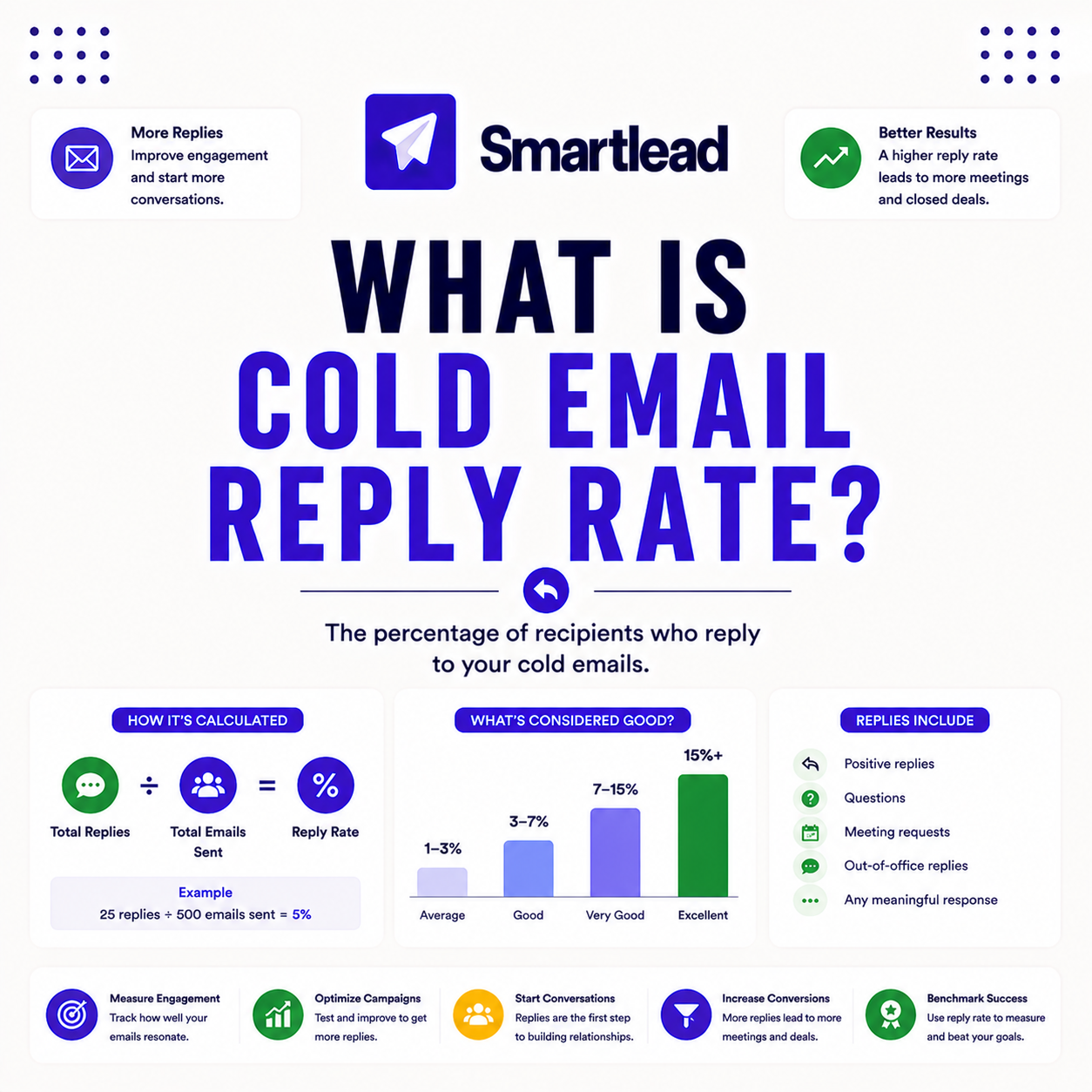
Cold email reply rate is the percentage of delivered emails that receive a response, calculated by dividing replies by delivered emails. It is the most reliable cold email metric because it ties to real engagement. The deciding factor is that a reply is a signal that cannot be faked the way an open can. The list below covers the basics.
- Replies over delivered: the formula divides responses by delivered emails.
- Real signal: a reply ties directly to genuine engagement and pipeline.
- More reliable than opens: replies cannot be inflated by tracking pixels.
- Delivered, not sent: using delivered emails gives a fairer denominator.
- Ties to revenue: the metric maps to conversations that can become deals.
“Replies are the metric that ties cold outreach directly to pipeline, unlike easily inflated opens.”
— Growth Hack Suite, on cold email tools
What Is a Good Cold Email Reply Rate?
A good B2B cold email reply rate is commonly cited around two to five percent, with well-targeted, personalized campaigns reaching higher. Around one percent or below usually signals a targeting, deliverability or offer problem. The deciding factor is that benchmarks are directional, so the right target is beating your own baseline. The table below shows common benchmark bands.
Source: commonly cited B2B cold email benchmark ranges, mid-2026. Directional only — measure against your own campaign data.
Why Is Reply Rate Better Than Open Rate?
Reply rate is better because open tracking has become unreliable: privacy features pre-fetch tracking pixels and inflate reported opens. Replies cannot be faked the same way, so they give a truer read on performance. The deciding factor is that a reply reflects a real decision to respond. The list below covers why.
- Inflated opens: privacy pixels pre-fetch images and overstate open counts.
- Replies are real: a response reflects a deliberate action, not a background load.
- Ties to pipeline: replies map to conversations that can convert to deals.
- Harder to game: reply rate resists the distortion that hits open tracking.
- Better decisions: a reliable metric leads to better campaign choices.
“Privacy changes have made open rates far less reliable as a measure of engagement.”
— HubSpot, on open tracking
What Affects Cold Email Reply Rate?
Reply rate is driven by targeting, personalization, offer, deliverability and follow-ups. A precise list and relevant message lift replies, while poor deliverability caps them by keeping emails out of the inbox. The deciding factor is that the weakest link sets the ceiling. The list below covers the main drivers.
- Targeting: a tight ideal-customer profile means the message fits the reader.
- Personalization and offer: relevance to the prospect earns the reply.
- Deliverability: emails must reach the inbox before they can be answered.
- Follow-ups: most replies come from later touches, not the first email.
- Weakest link caps it: the poorest of these factors sets the reply ceiling.
How Do You Improve Reply Rate?
Improve reply rate by tightening the ICP, personalizing the opener and offer, sending paced follow-ups, and protecting deliverability. Testing subject lines and CTAs compounds the gains. The ordered steps below make improvement repeatable.
- Tighten the ICP: narrow the list so the message fits each prospect.
- Personalize: tailor the opener and offer to the prospect’s situation.
- Add follow-ups: send paced later touches where most replies come from.
- Protect deliverability: warm mailboxes and verify lists to reach inboxes.
- Test and iterate: A/B test subject lines and CTAs to compound gains.
Want higher reply rates? Test Smartlead free for 14 days.
Start Smartlead Free Trial →No credit card · unlimited mailboxes
How Do Follow-Ups Affect Reply Rate?
Follow-ups raise reply rate substantially, since most replies come from the second or third touch rather than the first email. A sequence with paced follow-ups can multiply total replies over a single send. The deciding factor is that persistence, done politely, catches prospects at a better moment. The honest read is that skipping follow-ups leaves most of the available replies on the table.
The practical point is that a short, well-spaced follow-up sequence is the single biggest lever on reply rate for most campaigns.
What Is a Positive Reply Rate?
Positive reply rate is the share of replies that show genuine interest, which matters more than total replies. A high total with mostly negative responses is worse than a lower rate of interested ones. The deciding factor is that quality of replies, not just quantity, ties to revenue. The table below positions the feature against a typical rival.
Source: vendor sites plus internal review, mid-2026. Verify current features on smartlead.ai.
How Does Smartlead Help Reply Rate?
Smartlead helps reply rate by protecting deliverability so emails reach the inbox, automating follow-ups where most replies occur, and surfacing replies fast in the master inbox. Better placement plus persistence lifts the number of responses. The deciding factor is that the platform addresses the two biggest levers, deliverability and follow-ups, at once. The honest read is that tooling supports reply rate, but targeting and offer still matter most.
The practical point is to pair Smartlead’s deliverability and follow-up automation with a tight list and relevant offer. Verify current features on smartlead.ai.
Who Gets the Most Value From Tracking Reply Rate?
Agencies and scale senders get the most value, since reply rate guides optimization across many mailboxes and clients. Low-volume senders still benefit but have smaller samples to read. The deciding factor is that reply rate becomes more actionable as volume grows. The honest read is that the more a sender sends, the more reliably reply rate points to what to fix.
The practical point is that a high-volume sender can act on reply rate confidently, while a low-volume sender should read it as a rough guide.
How Do You Get Started Today?
Start on the 14-day free trial, connect a mailbox, warm it, verify a small list and run a campaign while tracking reply rate. Measuring on your own domains before committing is the lowest-risk way to begin. The trial needs no card, so the only cost is setup time. By launch, reply rate becomes the number that guides every change.
How Do You Calculate Reply Rate?
Divide the number of replies by the number of delivered emails, then multiply by 100. Using delivered rather than sent gives a fairer picture, since bounced emails never had a chance to earn a reply. The deciding factor is that the denominator should be emails that actually landed. The honest read is that a delivered-based reply rate is the cleanest way to compare campaigns.
The practical point is to always calculate reply rate on delivered emails, so bounces do not distort the comparison between campaigns.
Should You Track Replies or Meetings?
Track both: reply rate shows engagement, while booked meetings show conversion. Positive reply rate and meeting rate tie most directly to revenue, so they are the metrics that matter for pipeline. The deciding factor is that engagement and conversion answer different questions. The honest read is that reply rate diagnoses the top of the funnel while meetings prove the bottom.
“Email marketing is sending a commercial message to a group using email.”
— Wikipedia, Email marketing
Cold Email Reply Rate: The Final Verdict
The final verdict is that cold email reply rate, replies divided by delivered emails, is the most reliable metric in outreach, and a good B2B figure is commonly cited around two to five percent. Treat benchmarks as directional, judge campaigns against your own baseline, and lift the number through tighter targeting, better deliverability and paced follow-ups.
Growth Hack Suite Editorial — Outbound Tools Team
This guide explains cold email reply rate based on standard outreach practice plus hands-on testing of Smartlead. Benchmarks are directional and vary widely; measure against your own data and verify current features on smartlead.ai.
Last updated: June 2026. Reply-rate ranges are commonly cited industry figures, not guarantees.
Affiliate disclosure: this page contains affiliate links. If you start a plan through them, Growth Hack Suite may earn a commission at no extra cost to you. It does not change our guidance.
Lift your reply rate. Start Smartlead free for 14 days.
Start Smartlead Free Trial →Unlimited mailboxes · no credit card · cancel anytime
Related Tools in the Outbound Stack
Two other tools in the Growth Hack Suite stack pair with tracking reply rate.
- Hunter Email Verifier: verifying the list cuts bounces so reply rate is measured on delivered mail — see verifier accuracy.
- GMass: the Gmail-native option for a sender tracking replies from Gmail — read the GMass review.
- Gmail tools comparison: the Gmail-scoped breakdown for senders weighing platform versus extension — compare the Gmail tools.
Cold Email Reply Rate FAQ
The 12 most-asked questions about cold email reply rate.
What is cold email reply rate?
Cold email reply rate is the percentage of delivered emails that receive a response, calculated by dividing replies by delivered emails. It is the most reliable cold email metric because it ties to real engagement.
What is a good cold email reply rate?
A good B2B reply rate is commonly cited around two to five percent, with well-targeted, personalized campaigns reaching higher. Below one percent usually signals a targeting, deliverability or offer problem. Treat these as directional and measure against your own baseline.
Why is reply rate better than open rate?
Open tracking has become unreliable, since privacy features pre-fetch tracking pixels and inflate reported opens. Replies cannot be faked the same way, so they give a truer read on performance.
What affects cold email reply rate?
Targeting, personalization, offer, deliverability and follow-ups. A precise list and relevant message lift replies, while poor deliverability caps them by keeping emails out of the inbox.
How do I improve my cold email reply rate?
Tighten the ICP, personalize the opener and offer, send paced follow-ups, and protect deliverability. Testing subject lines and CTAs compounds the gains, since most replies come from later touches.
How do follow-ups affect reply rate?
Follow-ups raise reply rate substantially, since most replies come from the second or third touch rather than the first email. A sequence with paced follow-ups can multiply total replies.
What is a positive reply rate?
Positive reply rate is the share of replies showing genuine interest, which matters more than total replies. A high total with mostly negative responses is worse than a lower rate of interested ones.
How does Smartlead help reply rate?
By protecting deliverability so emails reach the inbox, automating follow-ups where most replies occur, and surfacing replies fast in the master inbox. Better placement plus persistence lifts responses.
Is a 1% reply rate bad?
Around one percent or below usually signals a problem with targeting, deliverability or offer rather than just bad luck. Strong B2B campaigns are commonly cited in the two-to-five-percent range.
How do I calculate reply rate?
Divide the number of replies by the number of delivered emails, then multiply by 100. Using delivered rather than sent gives a fairer picture, since bounced emails never had a chance to earn a reply.
Does deliverability affect reply rate?
Yes, heavily. Emails in the spam folder cannot be replied to, so poor deliverability caps reply rate regardless of copy. Protecting placement with warmup and clean lists is essential.
Should I track replies or meetings?
Track both: reply rate shows engagement, while booked meetings show conversion. Positive reply rate and meeting rate tie most directly to revenue, so they are the metrics that matter most.