
Table of Contents
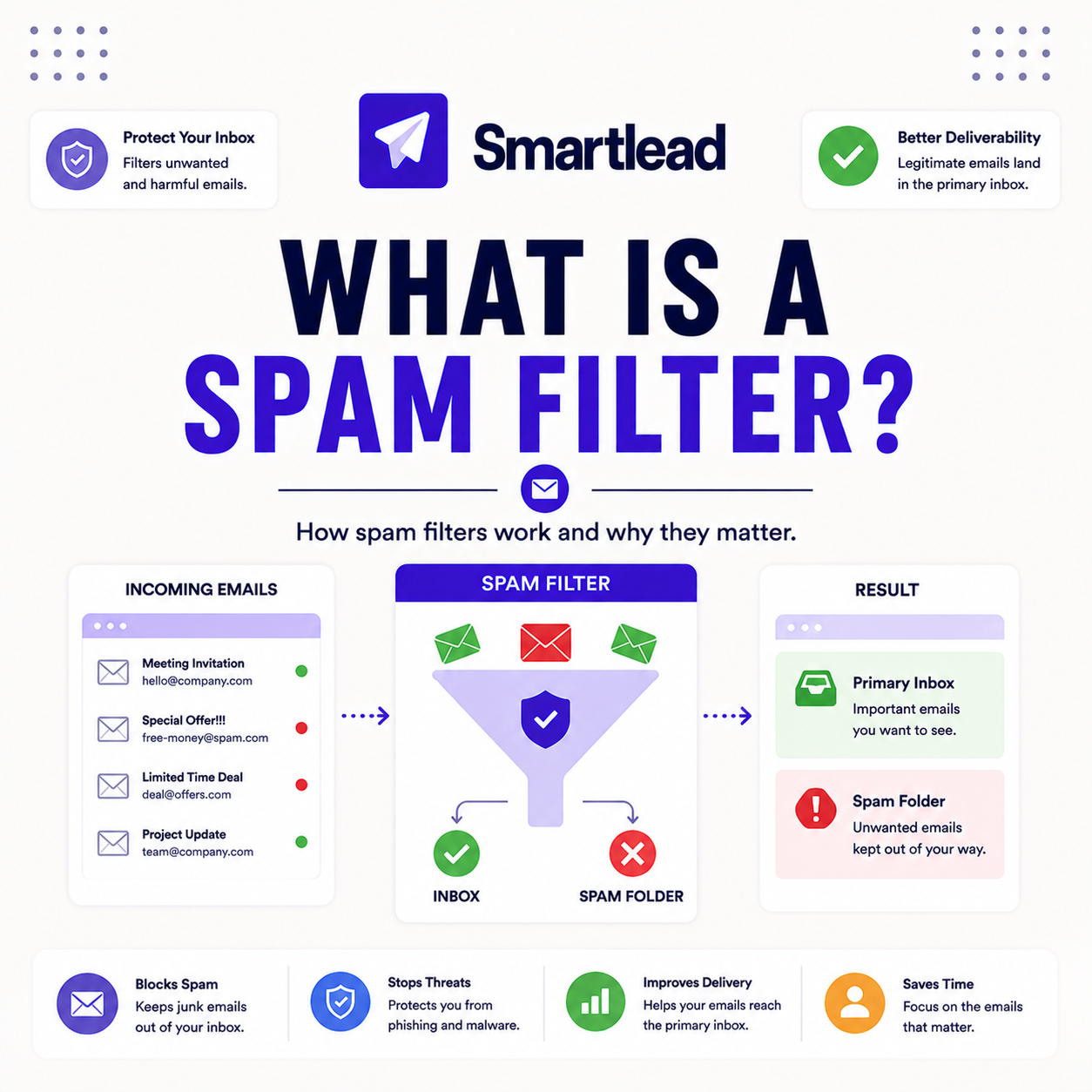
A spam filter is the system mailbox providers use to decide whether an email reaches the inbox, the spam folder or is blocked, scoring each message on sender reputation, authentication, content and engagement. This guide explains what a spam filter is, how it works, what triggers it in cold email, why reputation matters more than copy, and how to send mail that clears it.
A spam filter scores each email on sender reputation, authentication, content and engagement to decide inbox versus spam.
Best for: understanding why cold email lands in inbox or spam.
Caveat: good copy alone will not pass a weak-reputation domain.
Bottom line: reputation and authentication decide most of the score.
Put this into practice. Try Smartlead free for 14 days.
Start Smartlead Free Trial →Unlimited mailboxes · no credit card · 14-day trial
What Is a Spam Filter?
A spam filter is the system a mailbox provider uses to evaluate every incoming email and decide whether it reaches the inbox, the spam folder or is blocked outright. It weighs many signals at once. The deciding factor is that the filter, not the sender, controls where mail lands. The list below covers the main signals it reads.
- Sender reputation: the trust score on the sending domain and IP is the heaviest signal.
- Authentication: SPF, DKIM and DMARC confirm the mail is legitimately from the domain.
- Content signals: trigger words, excessive links and spammy formatting raise the score.
- Engagement: how recipients react, from opens to complaints, feeds back into the filter.
- Routes the message: the combined score decides inbox, spam or an outright block.
“A spam filter scores reputation and authentication first, so those, not copy, decide most of the outcome.”
— Growth Hack Suite
How Do Spam Filters Work?
Spam filters combine many signals into a score, then route the message based on thresholds: inbox below a limit, spam above it, block at the extreme. Reputation and authentication carry the most weight. The deciding factor is the total score, not any single signal. The list below covers how the scoring works.
- Combine signals: reputation, authentication, content and engagement roll into one score.
- Weight by importance: reputation and authentication weigh more than content alone.
- Apply thresholds: the score routes the mail to inbox, spam or a block.
- Learn from behavior: filters adapt as recipients open, reply to or report messages.
- Vary by provider: each provider tunes its own thresholds and rules differently.
“Sender reputation, not copy, is what most decides whether email clears the spam filter.”
— Validity, on spam filtering
What Triggers a Spam Filter in Cold Email?
Cold email triggers filters through poor sender reputation, missing authentication, spammy content and high bounce or complaint rates. Each raises the score toward the spam threshold. The deciding factor is that most triggers trace back to reputation and list quality, not just words. The list below covers the common triggers.
- Poor reputation: cold or previously burned domains score badly from the start.
- Missing authentication: mail without SPF, DKIM and DMARC fails the trust check.
- Spammy content: trigger words, many links and heavy formatting push the score up.
- High bounce: sending to invalid addresses signals a dirty, unverified list.
- Complaints: recipients marking mail as spam is one of the strongest negative signals.
How Does Sender Reputation Affect the Filter?
Sender reputation is the heaviest filter signal: a trusted domain and IP pass easily, while a poor reputation lands even clean copy in spam. Reputation sets the baseline the rest of the score builds on. The deciding factor is that a weak reputation cannot be overcome by good content. The table below weighs reputation against the other signals.
Source: relative signal weighting from standard cold email practice, mid-2026. Directional, not a measured ranking.
Does Content Alone Decide Spam Filtering?
No, content is one factor, not the whole decision. Clean copy helps, but a strong reputation and authentication matter far more, and a poor-reputation domain lands in spam even with perfect copy. The deciding factor is that content is a tiebreaker, not the verdict. The honest read is that rewriting copy rarely fixes a deliverability problem rooted in reputation.
Source: deliverability-tooling positioning, mid-2026. Verify current features on smartlead.ai.
How Do You Pass Spam Filters?
Pass spam filters by authenticating your domain, warming mailboxes, verifying lists, keeping copy clean and ramping volume gradually. Each step lowers the score the filter assigns. The ordered steps below make passing the filter repeatable.
- Authenticate: publish SPF, DKIM and DMARC so mail clears the trust check.
- Warm up: build the sender reputation the filter weighs most heavily.
- Verify lists: clean every list so bounce and complaints stay low.
- Keep copy clean: avoid trigger words, limit links and keep formatting simple.
- Ramp gradually: increase volume slowly so sending never looks like a sudden blast.
Want to clear the filter? Test Smartlead free for 14 days.
Start Smartlead Free Trial →No credit card · unlimited mailboxes
What Is the Difference Between a Spam Filter and a Blocklist?
A spam filter scores and routes individual messages, while a blocklist flags an entire domain or IP as a known bad sender. Landing on a blocklist is more severe than a single filtered message. The deciding factor is scope: the filter judges each email, the blocklist condemns the sender. The honest read is that a blocklisting requires active remediation, not just better copy.
The practical point is to monitor both: watch placement to catch filtering, and check blocklists to catch a domain or IP being flagged outright.
Can Spam Filters Change Over Time?
Yes, spam filters evolve, with providers tightening rules such as requiring DMARC for bulk senders and weighting engagement more heavily. What passed last year may not pass now. The deciding factor is that the fundamentals still win: reputation, authentication and clean lists age well. The honest read is that keeping up with provider rules is part of staying deliverable.
The practical point is to follow provider guidance and keep authentication current, since the rules only tighten and the fundamentals only matter more.
Who Gets the Most Value From Understanding Spam Filters?
Agencies and scale senders get the most value from understanding spam filters, since the same rules apply across every mailbox and client they run. A solo sender benefits too, but the payoff grows with volume. The deciding factor is how much sending depends on clearing the filter. The honest read is that the more a sender scales, the more filter discipline pays back.
The practical point is that the same filter rules apply at any size, but getting them right matters most for agencies protecting many client campaigns.
How Do You Get Started Today?
Start on the 14-day free trial, connect a mailbox, authenticate the domain, warm it and verify a small list, so mail clears the filter from the first send. Doing the reputation work first is what keeps campaigns out of spam. The trial needs no card, so the only cost is setup time. By launch, the deliverability fundamentals are already doing the work.
Why Do Emails Go to Spam Even With Good Copy?
Emails go to spam even with good copy usually because of reputation or authentication, not the words. A cold or unauthenticated domain fails the filter’s heaviest checks before content is even weighed. The deciding factor is that copy is a minor signal next to reputation. The honest read is that when good copy still lands in spam, the fix is almost always warmup, authentication or list quality.
The practical point is to check reputation and authentication first whenever mail lands in spam, rather than endlessly rewriting the email.
Does Warmup Help With Spam Filters?
Yes, warmup builds the sender reputation that spam filters weigh most heavily, so a warmed mailbox clears the filter where a cold one fails. Warmup directly improves the score’s biggest input. The deciding factor is that reputation is the filter’s top signal, and warmup is how it is built. The honest read is that warmup is the single most effective step for passing spam filters.
“Email filtering is the processing of email to organize it according to specified criteria.”
— Wikipedia, Email filtering
Spam Filters: The Final Verdict
The final verdict is that a spam filter is a scoring system that weighs sender reputation and authentication most heavily, with content a minor factor on top. Cold email clears it through warmup, authentication, clean lists and gradual sending, not clever copy. Get the fundamentals right, and the filter routes mail to the inbox where it belongs.
Growth Hack Suite Editorial — Outbound Tools Team
This guide explains spam filters based on standard cold email deliverability practice plus hands-on testing of Smartlead’s warmup and authentication support. Filter behavior varies by provider and changes over time; verify current features on smartlead.ai. We review outbound tools for B2B senders.
Last updated: June 2026. Confirm current features on smartlead.ai.
Affiliate disclosure: this page contains affiliate links. If you start a plan through them, Growth Hack Suite may earn a commission at no extra cost to you. It does not change our guidance.
Clear the spam filter, reach the inbox. Start Smartlead free for 14 days.
Start Smartlead Free Trial →Unlimited mailboxes · no credit card · cancel anytime
Related Tools in the Outbound Stack
Two other tools in the Growth Hack Suite stack help mail clear the spam filter.
- Hunter Email Verifier: verifying lists keeps bounce and complaints low, a key filter signal — see verifier accuracy.
- GMass: the Gmail-native option for a sender managing filters from a single Gmail mailbox — read the GMass review.
- Gmail tools comparison: the Gmail-scoped breakdown for senders weighing platform versus extension — compare the Gmail tools.
Spam Filter FAQ
The 12 most-asked questions about spam filters.
What is a spam filter?
A spam filter is the system a mailbox provider uses to decide whether an email reaches the inbox, the spam folder or is blocked. It scores each message on reputation, authentication, content and engagement.
How do spam filters work?
They combine many signals into a score, then route the message by thresholds. Reputation and authentication carry the most weight, and filters adapt as recipients open, reply or report mail.
What triggers a spam filter in cold email?
Poor sender reputation, missing authentication, spammy words and links, high bounce and spam complaints. Most triggers trace back to reputation and list quality rather than copy alone.
How does sender reputation affect spam filtering?
It is the heaviest signal: a trusted domain and IP pass easily, while a poor reputation lands even clean copy in spam. Reputation sets the baseline the rest of the score builds on.
Does email content decide spam filtering?
No, content is one factor, not the whole decision. A strong reputation and authentication matter far more, and a poor-reputation domain lands in spam even with perfect copy.
How do I pass spam filters?
Authenticate your domain, warm mailboxes, verify lists, keep copy clean and low-link, and ramp volume gradually. Each step lowers the score the filter assigns to your mail.
What is the difference between a spam filter and a blocklist?
A spam filter scores and routes individual messages, while a blocklist flags an entire domain or IP as a known bad sender. A blocklisting is more severe and requires active remediation.
Can spam filters change over time?
Yes, providers tighten rules, such as requiring DMARC for bulk senders and weighting engagement more heavily. Staying current on authentication and fundamentals is part of staying deliverable.
Why do my emails go to spam even with good copy?
Usually because of reputation or authentication, not copy. A cold or unauthenticated domain fails the filter’s heaviest checks before content is even weighed, so check those first.
Do spam filters read every word?
Filters analyze content including words, links and formatting, but they weigh reputation and authentication more heavily. Clean copy helps at the margin but cannot rescue a weak reputation.
How do I know if a spam filter caught my email?
Use seed-inbox placement tests across providers to see where your mail lands. Regular placement checks catch a filtering problem before it quietly costs you replies.
Does warmup help with spam filters?
Yes, warmup builds the sender reputation that spam filters weigh most heavily, so a warmed mailbox clears the filter where a cold one fails. It is the single most effective step for passing filters.