Table of Contents
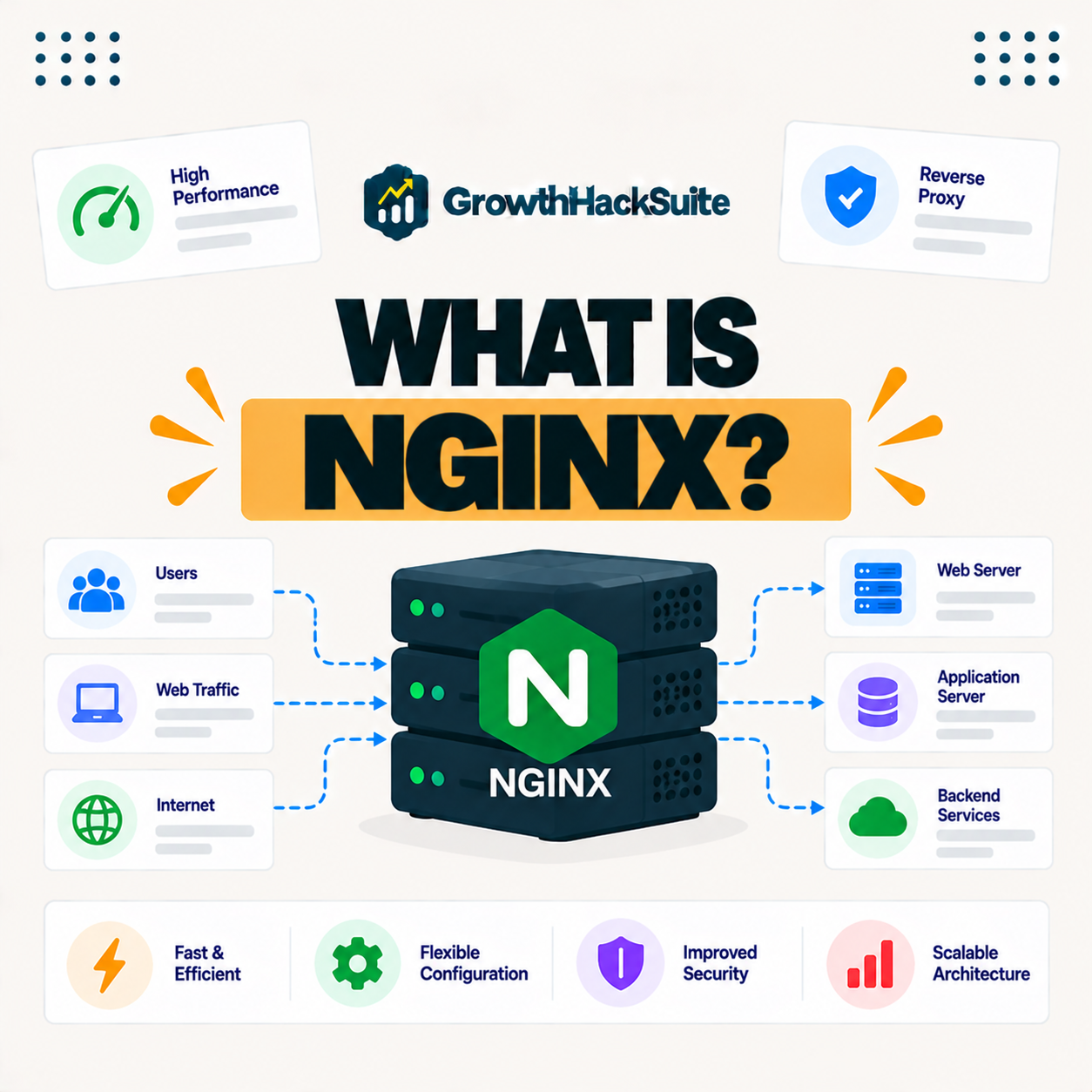
Nginx is a high-performance web server and reverse proxy known for efficiently handling many simultaneous connections. Many hosts use it to serve websites quickly and handle high traffic, and because it excels at serving static content and managing concurrency, it is a common choice for fast WordPress hosting. This guide explains how it works, how it compares to Apache, and why it helps WordPress.
Last updated: August 2026. Written by the Growth Hack Suite editorial team, with details cross-checked against provider documentation. This page carries affiliate links to Kinsta.
What Is Nginx?
Nginx is a high-performance, open-source web server and reverse proxy designed to serve web content efficiently and handle many simultaneous connections. This is why many hosts use it to deliver websites quickly and manage high traffic, especially for busy, performance-sensitive sites.
“Nginx is a web server that can also be a reverse proxy.”
— Wikipedia, Nginx
In hosting terms, it is the software that sits in front of your site, receiving requests and returning pages as fast as the stack allows.
How Does Nginx Work?
It works using an event-driven architecture that handles many connections within a small, fixed number of processes. Instead of creating a new process per request, it efficiently manages concurrency, which keeps it fast and light under heavy load where other designs would run out of memory.
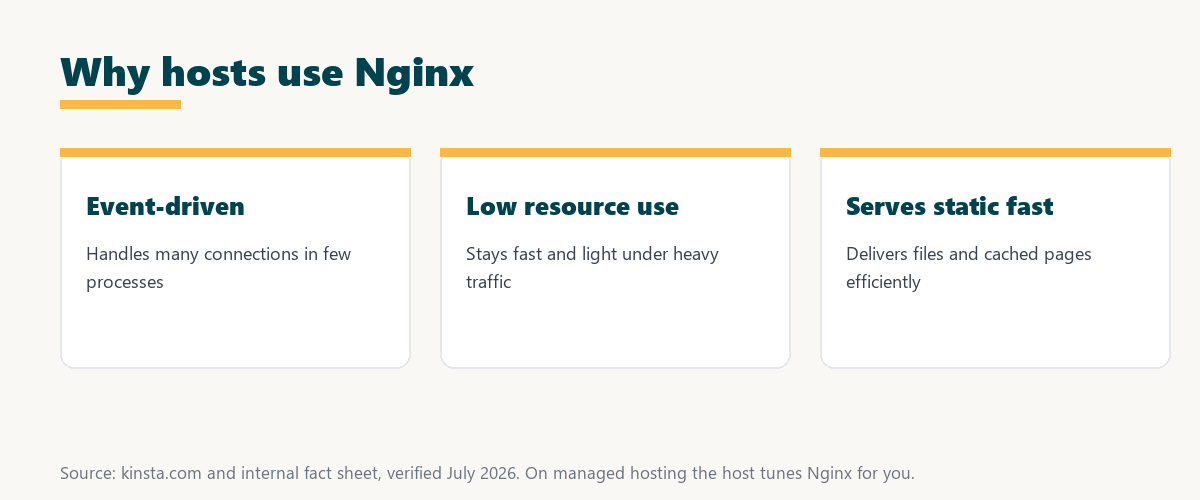
The key mechanism is the event loop: a few worker processes juggle thousands of connections, which is what makes it efficient under concurrency.
What Is a Web Server’s Job?
A web server’s job is to receive requests from browsers and return the requested web pages and files. Web server software sits between visitors and your site’s files, delivering content and coordinating with the application that generates dynamic pages, such as PHP for WordPress.
The practical point is that the web server is the front door, so how efficiently it works shapes how fast every visitor is served.
Nginx vs Apache
Nginx and Apache are both popular web servers, but the newer, event-driven design of the two typically handles high concurrency and static content more efficiently, while Apache is highly flexible. Many performance-focused hosts favor the event-driven option for serving busy sites, though both can run WordPress well.
Source: provider documentation, verified August 2026. Both are capable; the event-driven server leads on concurrency.
Comparing architecture, concurrency and flexibility shows the event-driven server excels at handling many connections efficiently, while Apache offers deep per-directory flexibility, which is why hosts pick based on their priorities.
See how Kinsta’s web server stack runs on Google Cloud
Try Kinsta →A tuned web server stack, with a 30-day money-back guarantee.
Why This Web Server Handles High Traffic Well
This web server is good for high traffic because its event-driven model handles thousands of simultaneous connections with low resource use. It stays fast and stable under load where a process-per-connection server would consume far more memory, which is why busy sites rely on it.
- Event-driven model: A few worker processes handle many connections at once, avoiding the overhead of one process per request.
- Low memory use: Efficient concurrency keeps memory consumption stable even as connection counts climb.
- Static serving: Files and cached pages are delivered directly and quickly without invoking the application.
- Reverse proxy: It can sit in front of application servers, balancing and forwarding requests efficiently.
- Stable under load: Predictable resource use means the server stays responsive during traffic spikes.
The honest takeaway is that it wins on concurrency and static delivery, which are exactly the pressures a high-traffic site puts on a web server.
Why WordPress Hosts Choose This Web Server
Hosts use Nginx for WordPress because it serves static files and cached pages very efficiently and handles concurrency well. It pairs with caching to deliver WordPress pages quickly, especially on busy sites, where serving cached HTML directly avoids the cost of running PHP for every request.
“The first five seconds of page-load time have the highest impact on conversion rates.”
— HubSpot, page load time and conversion rates
Because the server delivers cached pages so quickly under load, it helps protect those early seconds exactly when a WordPress site is busiest.
Does Nginx Improve Site Speed?
This web server improves site speed by serving static content and cached pages efficiently and by handling many connections with low overhead. As part of a tuned stack it helps pages load quickly and keeps the server responsive under load, though caching and application performance also matter.
The honest qualifier is that the web server is one component, so it helps most when paired with good caching and an optimized application.
Do You Need to Manage the Web Server Yourself?
You do not need to manage the web server yourself on managed hosting, since the host configures and tunes it for you. You get its performance benefits without editing server configuration files or maintaining the software, which is one reason managed hosting is popular for WordPress.
Source: provider documentation, verified August 2026. On managed hosting the host tunes all of this for you.
Listing concurrency, static serving and caching efficiency shows why it suits WordPress hosting. Because a host is a long-term commitment, it is worth reading our note on SaaS vendor lock-in before choosing.
How Kinsta Runs Its Web Server Stack
Kinsta uses Nginx as part of its optimized hosting stack on Google Cloud, combining it with server-level caching and compute-optimized machines. WordPress sites are served quickly and handle traffic without you touching server configuration, since Kinsta tunes the web server for you.
Run your site on a tuned web server stack
Start With Kinsta →Free migration and a 30-day money-back guarantee.
Getting Web Server Speed Without the Complexity
You get this performance without the complexity by choosing managed hosting that runs and tunes the web server for you. Your site benefits from an efficient web server while you focus on content rather than server administration, so you gain the speed without the maintenance burden.
“A tool is only worth its premium when the hours or revenue it protects exceed the invoice.”
— Growth Hack Suite, on tool ROI
Applied to hosting, a managed web server stack earns its cost when the speed, stability and saved admin time it delivers exceed the price of the plan.
How the Web Server and Caching Work Together
The web server and caching work together because it can serve cached pages directly and efficiently. A caching setup on this kind of host delivers most requests without invoking PHP, keeping the site fast under traffic, since the heaviest work is skipped for cached visitors.
The practical result is that this server plus caching serves the bulk of traffic from cache, which is what keeps a busy WordPress site quick.
Choosing a Host With a Tuned Web Server Stack
You choose the right host by favoring managed WordPress hosting that runs a tuned web server with server-level caching and compute-optimized machines. That combination delivers these concurrency and static-serving strengths without you configuring anything, so the site stays fast as traffic grows.
The honest summary is that the value of the web server comes through a well-tuned managed stack, so the host that runs it matters as much as the server itself.
Try Kinsta risk-free for a faster site
Try Kinsta Risk-Free →Tuned Nginx and free migration, with a 30-day money-back guarantee.
Frequently Asked Questions About This Web Server
The 12 most-asked questions about Nginx.
What is Nginx in simple terms?
Nginx is a high-performance web server and reverse proxy that serves web content efficiently and handles many simultaneous connections, which is why many hosts use it for fast, high-traffic sites.
How does Nginx work?
Nginx works with an event-driven architecture that handles many connections within a small, fixed number of processes, so it manages concurrency efficiently and stays fast and light under load.
What is the difference between Nginx and Apache?
Nginx’s event-driven design typically handles high concurrency and static content more efficiently, while Apache is highly flexible, so performance-focused hosts often favor Nginx for busy sites.
Why do hosts use Nginx for WordPress?
Hosts use Nginx for WordPress because it serves static files and cached pages efficiently and handles concurrency well, so it pairs with caching to deliver WordPress pages quickly.
Is Nginx faster than Apache?
Nginx often performs better under high concurrency and for static content due to its event-driven model, though real-world speed also depends on configuration, caching and the overall stack.
Why is Nginx good for high traffic?
Nginx is good for high traffic because its event-driven model handles thousands of simultaneous connections with low resource use, staying fast and stable where other servers use more memory.
Does Nginx improve site speed?
Nginx improves speed by serving static and cached content efficiently and handling many connections with low overhead, so as part of a tuned stack it helps pages load quickly.
Do I need to configure Nginx myself?
On managed hosting you do not configure Nginx yourself, since the host tunes it for you, so you get its performance benefits without editing server configuration files.
Does Nginx work with caching?
Yes, Nginx works well with caching, because it can serve cached pages directly and efficiently, so most requests are delivered without invoking PHP, keeping the site fast under load.
Is Nginx free?
Yes, Nginx is free and open-source, and hosts include it as part of their infrastructure, so you benefit from it through your hosting without a separate cost.
Does WordPress run on Nginx?
Yes, WordPress runs well on Nginx, and many performance-focused hosts use Nginx to serve WordPress efficiently, especially when paired with server-level caching.
How does Kinsta use Nginx?
Kinsta uses Nginx in its optimized Google Cloud stack alongside server-level caching and compute-optimized machines, so WordPress sites are served quickly without you touching server configuration.
About this guide
Written by the Growth Hack Suite editorial team, drawing on hands-on experience running WordPress sites. Details were cross-checked against provider documentation. This page carries affiliate links to Kinsta, so the position is stated plainly: Nginx is an efficient event-driven web server, it excels at concurrency and serving static and cached content, and on managed hosting the host tunes it for you. Kinsta uses Nginx in its Google Cloud stack alongside server-level caching and compute-optimized machines.