Table of Contents
Object caching stores the results of database queries in fast memory so that repeated queries are answered from the cache instead of hitting the database again. Often powered by Redis, it speeds up dynamic, uncacheable pages like carts, dashboards and search, making it especially valuable for WooCommerce stores and membership sites. This guide explains how it works and when you need it.
Last updated: August 2026. Written by the Growth Hack Suite editorial team, with details cross-checked against provider documentation. This page carries affiliate links to Kinsta.
What Is Object Caching?
Object caching stores the results of database queries in fast memory, so that when the same query is needed again, the result is served from the cache instead of querying the database. This speeds up the dynamic parts of a site, where the same data is often fetched repeatedly.
“In computing, a cache stores data so future requests are served faster.”
— Wikipedia, Cache (computing)
This approach applies that idea to database results, holding them in memory so the same query does not hit the database twice.
How Does Object Caching Work?
Object caching works by saving query results in a memory store, so when WordPress needs the same data again, it retrieves it from the cache in memory rather than repeating the database query. This reduces database load and speeds page generation for dynamic content.
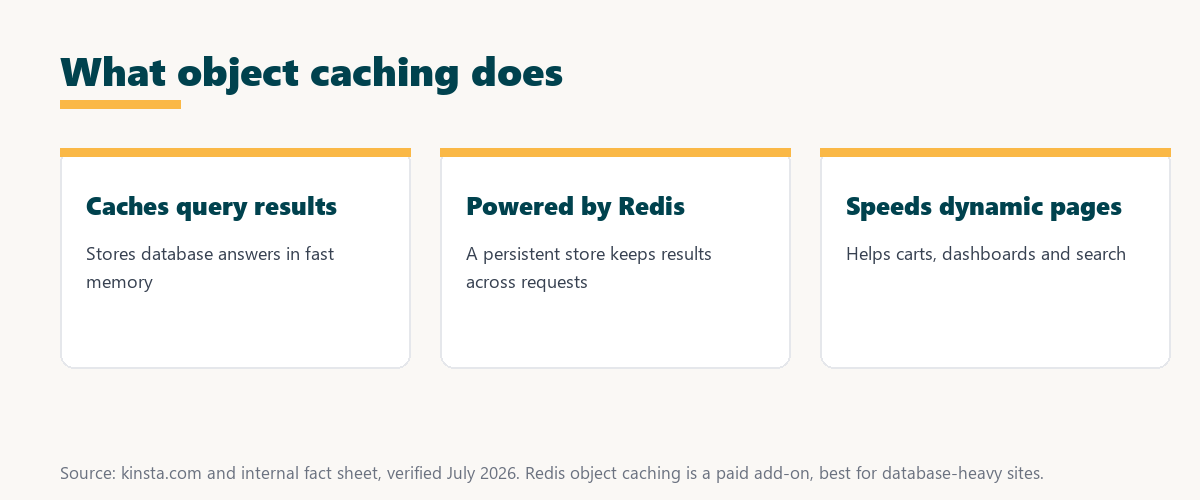
The key idea is reuse: a query runs once, its result sits in memory, and later requests read the memory instead of the database.
What Is Redis and Why Is It Used?
Redis is an in-memory data store commonly used for persistent object caching, so it holds query results across requests. This makes it more effective than the default non-persistent cache that WordPress clears at the end of each page load, since the cache survives between visits.
The practical point is that Redis makes it persistent, which is what turns it from a per-page trick into a real, lasting speed gain.
Object Caching vs Page Caching
Object caching stores individual database query results, while page caching stores whole rendered pages. It speeds the dynamic queries behind pages that cannot be fully cached, complementing rather than replacing page caching, so the two handle different parts of a site’s load.
Source: provider documentation, verified August 2026. The two caches complement each other.
Comparing what each stores and speeds shows it handles dynamic database queries, while page caching handles whole public pages, so the two work best together.
See how Kinsta offers Redis caching
Try Kinsta →Redis available as an add-on, with a 30-day money-back guarantee.
Persistent vs Non-Persistent Caching
A non-persistent object cache lasts only for a single page load, while a persistent cache like Redis keeps results across requests. Persistent caching provides far greater benefit for repeated queries on dynamic sites, since the cached results are still there for the next visitor.
The distinction that matters is lifespan: non-persistent caching forgets after each page, while persistent caching remembers across requests.
When Do You Need This Kind of Caching?
You need object caching when your site is dynamic and database-heavy, such as a WooCommerce store, membership site or forum. These run many uncacheable queries where caching results in memory noticeably speeds up performance, so the benefit scales with how database-driven the site is.
“The first five seconds of page-load time have the highest impact on conversion rates.”
— HubSpot, page load time and conversion rates
Because a store’s dynamic pages are often its slowest, it protects those early seconds exactly where page caching cannot reach.
How Caching Query Results Helps Dynamic Sites
It helps dynamic sites by speeding the database queries behind carts, dashboards and search that page caching cannot cache. The uncacheable parts of a store or membership site respond faster under load, so the whole experience feels quicker, not just the public pages.
The practical benefit is that it targets the dynamic work directly, which is where database-heavy sites feel slow.
How to Add This Cache to WordPress
You add this cache to WordPress by enabling Redis or a similar store, usually through your host. The persistent cache then holds query results across requests, which is far more effective than the default temporary cache, so a host that offers Redis is the simplest route.
Source: provider documentation, verified August 2026. Persistent caching is what makes it worthwhile.
Comparing lifespan and benefit shows a persistent Redis cache helps dynamic sites far more than the default non-persistent cache. Because a host is a long-term commitment, it is worth reading our note on SaaS vendor lock-in before choosing.
How Kinsta Offers Redis Caching
Kinsta offers Redis-based persistent caching as a paid add-on, so dynamic, database-heavy sites like stores can cache query results in memory. It speeds up the uncacheable operations that page caching cannot cover, though because it is an add-on, it suits sites that genuinely run many database queries.
Add Redis caching to a database-heavy site
Start With Kinsta →Free migration and a 30-day money-back guarantee.
Speeding Up Your Dynamic WordPress Site
You speed up a dynamic WordPress site by combining page caching for public pages with Redis caching for dynamic queries. Both the cacheable and uncacheable parts of your store or membership site then perform well, so speed does not stop at the public pages.
“A tool is only worth its premium when the hours or revenue it protects exceed the invoice.”
— Growth Hack Suite, on tool ROI
Applied to this cache, the paid Redis add-on earns its cost when the faster dynamic pages and higher store conversions it delivers exceed the add-on fee.
Query Caching and Overall Performance
It contributes to overall performance alongside page and edge caching. While page caching handles public pages, this layer accelerates the dynamic database work, and together they cover a site’s full range of requests, from static content to live queries.
The honest point is that this is one layer, most valuable on database-heavy sites, and it works best beside page and edge caching.
Choosing Whether Your Site Needs It
You choose this cache for your site when it runs many database queries, such as a store, membership site or forum, and you use a host that offers a persistent Redis cache. For a simple, well-cached blog the gain is small, so the choice depends on how dynamic your site really is.
The honest summary is that it pays off on database-heavy sites, so match the add-on to the workload rather than adding it by default.
Try Kinsta risk-free for your dynamic site
Try Kinsta Risk-Free →Redis add-on and free migration, with a 30-day money-back guarantee.
Object Caching: Frequently Asked Questions
The 12 most-asked questions about object caching.
What is object caching in simple terms?
Object caching stores database query results in fast memory, so repeated queries are served from the cache instead of hitting the database again, speeding up the dynamic parts of a site.
How does object caching work?
Object caching works by saving query results in a memory store, so when WordPress needs the same data again, it retrieves it from memory instead of repeating the database query.
What is Redis object caching?
Redis is an in-memory data store used for persistent object caching, holding query results across requests, which is more effective than WordPress’s default cache that clears each page load.
What is the difference between object and page caching?
Object caching stores individual query results, while page caching stores whole rendered pages, so object caching speeds dynamic queries and page caching speeds full public pages.
When do I need object caching?
You need object caching for dynamic, database-heavy sites like WooCommerce stores, membership sites or forums, which run many uncacheable queries that caching in memory speeds up.
What is a persistent object cache?
A persistent object cache like Redis keeps query results across requests, while a non-persistent cache lasts only one page load, so persistent caching helps far more on dynamic sites.
Does object caching help WooCommerce?
Yes, object caching helps WooCommerce by speeding the database queries behind carts, accounts and search that page caching cannot cache, improving store performance under load.
Is object caching the same as page caching?
No, object caching stores query results while page caching stores whole pages, so they are complementary, with object caching handling dynamic queries page caching cannot cover.
Do I need object caching for a simple blog?
A simple, well-cached blog usually gains little from object caching, since most pages are served from page cache, while dynamic, database-heavy sites benefit the most.
How do I enable object caching in WordPress?
You enable object caching by turning on Redis or a similar store, usually through your host, so the persistent cache holds query results across requests for a real performance gain.
Does object caching reduce database load?
Yes, object caching reduces database load by answering repeated queries from memory, so the database does less work, which helps dynamic sites stay fast under heavy traffic.
Does Kinsta offer object caching?
Kinsta offers Redis-based persistent object caching as a paid add-on, so dynamic, database-heavy sites can cache query results in memory, speeding the operations page caching cannot cover.
About this guide
Written by the Growth Hack Suite editorial team, drawing on hands-on experience running WordPress sites. Details were cross-checked against provider documentation. This page carries affiliate links to Kinsta, so the position is stated plainly: caching stores database query results in memory, Redis makes it persistent, and it pays off most on database-heavy sites like stores. On Kinsta, Redis persistent caching is a paid add-on, best matched to genuinely dynamic workloads.