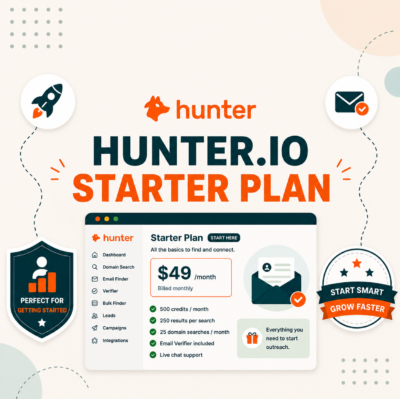
A SaaS Starter plan is the lowest paid tier above the free plan, built for individuals or small teams who have outgrown free limits but do not yet need mid-tier capacity. It typically unlocks core features at the cheapest price point, with credit or usage caps sized for steady solo work. Hunter.io’s Starter plan at $34 monthly annual fits the pattern with 2,000 credits and three connected accounts.
What Is a Starter Plan in SaaS?
A Starter plan in SaaS is the entry-level paid tier above a free or freemium plan. It unlocks core product features at the cheapest price point, with usage limits sized for individuals or small teams who consistently exceed free-plan capacity. The tier exists to convert satisfied free users into paid customers at the lowest commitment level.
- Lowest paid price point: Starter sits at the bottom of the paid ladder, designed as the minimum financial commitment that unlocks meaningful capacity beyond the free tier.
- Core feature access: Most platform features become available on Starter, with throughput and quantity restrictions rather than feature lockouts the main differentiation from higher tiers.
- Sized for solo or small teams: Usage limits match what one user or a small group consumes in a month, so Starter capacity matches the buyer profile naturally.
- Conversion bridge from free: The tier provides the cheapest path from free to paid, lowering the friction of the upgrade decision for users who have validated value.
- Foundation for upsell: Buyers who outgrow Starter become mid-tier prospects, with the natural upgrade path producing predictable account growth over time.
Starter is less about depth and more about volume; the features stay similar to higher tiers while the ceilings shrink.
How Does a Starter Plan Fit a Pricing Ladder?
A standard SaaS pricing ladder runs Free, Starter, Mid (often Growth), High (often Scale), and Enterprise. Starter sits as the second rung, immediately above free and below the operational mid tier. Each step up the ladder unlocks more capacity and a few additional features, with the largest pricing jump usually happening between Starter and mid-tier rather than between free and Starter.
The ladder shape rewards matching tier to actual usage; Starter is the right step for steady, predictable small-scale work.
Why Do SaaS Tools Offer a Starter Tier?
SaaS tools include Starter tiers because they convert free users to paid at the lowest psychological commitment, generating revenue that funds product development while keeping buyer risk low. The tier also produces the first paying-customer relationship, which is more valuable than the immediate revenue for long-term account growth.
For buyers, Starter is the cheapest way to get production-level capacity beyond a freemium cap; for sellers, it is the cheapest way to start a real customer relationship.
How Does Hunter.io Implement Starter?
Hunter.io’s Starter plan costs $49 per month or $34 monthly annual and includes 2,000 monthly credits, three connected sending accounts, and 2,500 recipients per campaign. It unlocks the full Email Finder and Verifier workflow with auto-verification and the AI writing assistant, which makes it a complete production tier for solo prospecting rather than an artificially limited demo.
Source: hunter.io/pricing verified June 2026.
Hunter’s Starter is a textbook implementation of the SaaS pattern: lowest paid price, core features, sized for solo use, designed as the bridge from free to operational.
Starter vs Free vs Mid Tier: What’s the Difference?
Free is sized for testing and occasional use, Starter for steady solo work, and mid tier for team or weekly cadence operations. The price step from free to Starter unlocks meaningful production capacity; the step from Starter to mid unlocks team-scale capacity at a more significant price jump.
Source: industry SaaS tiering patterns; Hunter.io uses this structure with Free, Starter, Growth, Scale, Enterprise.
- Free tier purpose: Risk-free testing of accuracy and workflow fit, sized for occasional lookups rather than ongoing production outreach.
- Starter tier purpose: Lowest paid production capacity for solo operators, with credits and accounts sized for one consistent user.
- Mid tier purpose: Team-scale weekly outreach capacity with higher credits, multiple accounts, and full bulk processing speed.
- Price step shape: Free to Starter is the smaller jump for capacity unlock; Starter to mid is the larger jump tied to team workflow needs.
- Right-pick signal: Match the tier to actual current workload rather than future ambition, since unused credits expire monthly without rolling over.
Pick the tier that matches the buyer profile, not the one that matches future ambition; Starter exists specifically for steady current work.
When Is a Starter Plan Enough?
A Starter plan is enough when monthly usage stays within the tier’s credit or limit cap, the team is solo or small, and the workflow is steady rather than scaling fast. For Hunter.io specifically, Starter covers users consuming up to 2,000 credits a month with three or fewer connected accounts, which fits most founders and freelancers running early outbound.
Starter stays the right pick longer than buyers expect, especially when the workflow stabilizes after early experimentation.
What Are Common Mistakes Choosing a Starter Plan?
Two opposite mistakes hit Starter plan choice: undersizing produces credit shortages that force pack purchases, while overbuying wastes capacity that would have gone unused. Both come from skipping the usage measurement step on the free plan before committing to paid.
- Undersizing volume: Buying Starter for a workflow that actually needs mid-tier capacity triggers credit shortages and pack purchases that quickly exceed the next tier’s price.
- Overbuying beyond Starter: Jumping to mid-tier when Starter would cover the workload wastes capacity that expires unused, since credits do not roll over between cycles.
- Skipping free-plan testing: Choosing Starter without first running the free tier produces a guess about volume rather than a measurement, which leads to either of the above errors.
- Choosing monthly when committed: Buyers certain about continued use lose the 30 percent annual discount by defaulting to monthly billing without weighing the commitment tradeoff.
- Ignoring credit rollover: Treating unused Starter credits as banked future capacity wastes money, since the no-rollover rule expires unused allowance at cycle end.
Both mistakes come from skipping measurement; spending a month on the free plan first avoids almost every Starter sizing error.
How Does a Starter Tier Affect Cost Per Lead?
Cost per lead on Starter depends on credit utilization. When the 2,000 monthly Hunter.io credits get fully spent, cost per verified email lands at about $0.017 on annual billing. Half-utilization doubles the effective cost per lead, since the plan price is fixed but usable output is not. Right-sizing the tier to actual usage is the cleanest cost-control lever.
The right Hunter.io tier is the one whose credit ceiling sits just above real monthly usage, and Starter is that tier for steady solo prospecting.
Growth Hack Suite, Hunter.io pricing guide
Full utilization turns Starter into the lowest per-credit cost on Hunter; underuse makes it more expensive per lead than higher tiers used to capacity.
How Do You Decide If Starter Is Right for You?
The decision rests on three measurements: monthly volume estimate, account count needed, and commitment confidence. Volume under 2,000 credits with three or fewer accounts and uncertain commitment all point to Starter; higher volume or team needs point to Growth; six-plus months of certainty points to annual billing on whichever tier wins.
- Estimate monthly credit volume: Multiply expected monthly prospects by about 1.5 to cover both finder lookups and verifications at half a credit each.
- Count required sender accounts: Identify how many separate sending inboxes the workflow needs, since Starter caps at three connected accounts.
- Project commitment horizon: Estimate how confident the team is about continued use over six or more months, which informs the annual versus monthly billing decision.
- Match against the Starter cap: Compare projected volume plus a small buffer against Starter’s 2,000-credit ceiling and three-account limit to confirm fit.
- Plan the upgrade trigger: Define what monthly usage signal will trigger an upgrade to Growth, so the team upgrades on data rather than on instinct.
The three-measurement check usually settles the Starter question within five minutes, which beats months of overspending on the wrong tier.
How a Starter Plan Shapes Your Hunter Choice
Starter shapes the Hunter.io plan choice by anchoring the volume-based decision framework. Buyers who fit Starter benefit most from the lowest paid tier; buyers who exceed Starter capacity benefit from moving to Growth immediately rather than stretching the smaller plan with pack purchases. The Starter ceiling is the cleanest signal of which tier delivers better value.
Start free, then pick Starter when you’re ready.
Try Hunter.io Free →50 free credits a month, no card required
The free tier is the diagnostic; Starter is the destination for buyers whose diagnostic confirms solo-scale usage.
Starter Plan Checklist Before You Buy
A clean Starter purchase rests on five confirmations: real monthly volume measured, mid-tier compared, annual billing evaluated, account count confirmed, and free-plan accuracy test completed. Working through the checklist usually surfaces the right tier choice and avoids both common sizing mistakes.
- Measured monthly volume on free: Tracked actual credit consumption during a free-plan testing month, producing a real projection rather than a guess.
- Compared against Growth: Reviewed mid-tier credit pricing to confirm Starter beats Growth on cost for the specific projected volume.
- Evaluated annual billing: Weighed the 30 percent annual discount against commitment confidence over the next six months.
- Confirmed account count: Verified that three or fewer connected accounts cover the team’s sending workflow without requiring mid-tier capacity.
- Tested accuracy on free: Validated Hunter’s accuracy on real prospects before committing paid budget to a Starter subscription.
Run the checklist, then commit to Starter with confidence.
Start Hunter.io Free →Validate before paying
Five confirmations protect against both common Starter mistakes and produce a decision the team can defend at any review.
Related: Tier and Pricing Guides
The Starter tier question connects to credit math, mid-tier comparison, and annual versus monthly billing. The related Hunter.io pricing guides cover the connected decisions that almost always emerge alongside the Starter question.
Software as a service is a software licensing and delivery model in which software is licensed on a subscription basis and is centrally hosted.
Wikipedia, Software as a service
The most common SaaS tier ladders use Free, Starter, Growth, Scale, and Enterprise tiers, sized for distinct user populations rather than artificial differentiation.
HubSpot, HubSpot SaaS pricing models
Hunter.io fits the standard pattern, with Starter occupying the cheapest paid step exactly as the SaaS pricing literature describes.
SaaS Starter Plan: Frequently Asked Questions
What is a Starter plan in SaaS?
The lowest paid tier above the free plan, offering core features at the cheapest price for individuals or small teams who have outgrown the free cap.
What does Hunter.io’s Starter plan include?
$49 monthly (or $34 annual) for 2,000 credits, three connected accounts, and 2,500 recipients per campaign. The full feature set is unlocked at lower throughput.
How is a Starter plan different from free?
Starter unlocks more credits, more connected accounts, and paid-tier features; free is sized for testing and stays capped at minimal monthly usage.
Who should choose a Starter plan?
Solo users or small teams with steady, low monthly volume who have outgrown the free plan but do not yet need mid-tier capacity.
When should I move past a Starter plan?
When monthly usage regularly exceeds the credit cap or workflow needs more connected accounts than Starter allows. A mid tier like Growth then fits.
Is a Starter plan worth paying for?
Yes when its credits get used consistently. Otherwise the free plan may still be enough, since unused Starter credits expire monthly without rolling over.
Do Starter plans include support?
Usually basic email support. Priority support and SLAs are reserved for higher tiers, typically appearing on Scale or Enterprise plans.
Can I save on a Starter plan?
Often yes. Annual billing typically cuts the price; Hunter.io’s Starter drops from $49 monthly to $34 monthly when billed annually.
What is a common Starter-plan mistake?
Underestimating monthly volume and running out of credits, since the no-rollover rule means shortfalls force pack purchases or tier upgrades.
How do I know if Starter has enough credits?
Estimate monthly actions (lookups plus half a credit per verification) and compare to the Starter cap plus a small buffer. The Hunter.io pricing guide walks the math.
Is Starter or Growth better?
Starter for light solo use under 2,000 credits a month. Growth once the team sends weekly or needs more than three connected sending accounts.
Should I test on free before Starter?
Yes. Use the free plan to confirm accuracy on real prospects and measure monthly credit needs before any paid commitment.
Start Free, Then Pick the Right Tier
The cleanest path to Starter or any other Hunter.io tier is to start on the free plan, measure real workflow burn, and commit to the paid tier whose credit ceiling matches actual monthly volume with modest buffer. The free plan turns plan choice from guessing into measurement.
Start free, then pick Starter when you outgrow it.
Annual Starter at $34 saves 30 percent versus monthly.
Start Hunter.io Free →No card · See the full Hunter.io pricing breakdown
Affiliate disclosure: links to Hunter.io on this page are affiliate links. The price is the same for you, and Growth Hack Suite may earn a commission if you sign up through them.