
Table of Contents
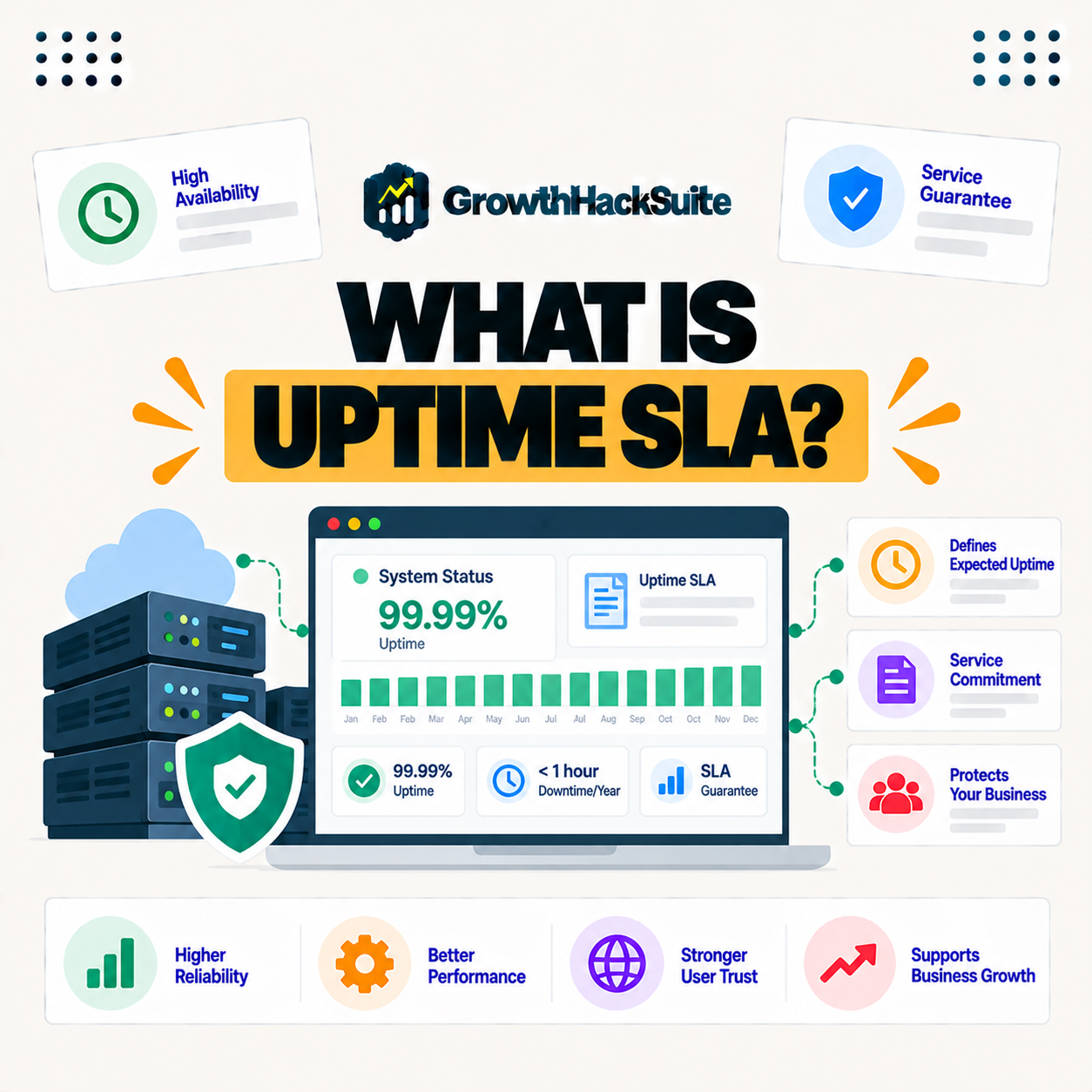
An uptime SLA, or service level agreement, is a host’s commitment to a guaranteed level of availability, usually stated as a percentage like 99.9 percent, with compensation if it is not met. Because small percentage differences translate to meaningful downtime, understanding what the numbers mean helps you judge how reliable a host really is. This guide explains uptime percentages and why the SLA matters.
Last updated: August 2026. Written by the Growth Hack Suite editorial team, with details cross-checked against provider documentation. This page carries affiliate links to Kinsta.
See how Kinsta backs its uptime on Google Cloud
Try Kinsta →A 99.9 percent uptime guarantee, with a 30-day money-back guarantee.
What Is an Uptime SLA?
An uptime SLA, or service level agreement, is a host’s formal commitment to keep your site available at a guaranteed level, usually expressed as a percentage, with compensation such as account credit if the provider fails to meet it. It turns a reliability claim into a contract.
“A service-level agreement is a commitment between a service provider and a customer.”
— Wikipedia, Service-level agreement
For hosting, that commitment is about availability: the SLA states how much uptime a host promises and what you get if it falls short.
What Do Uptime Percentages Mean?
Uptime percentages state the share of time a service is available, so 99.9 percent allows roughly nine hours of downtime a year while 99.99 percent allows under an hour, meaning each additional nine sharply reduces permitted downtime. The gap between the nines is larger than it looks.
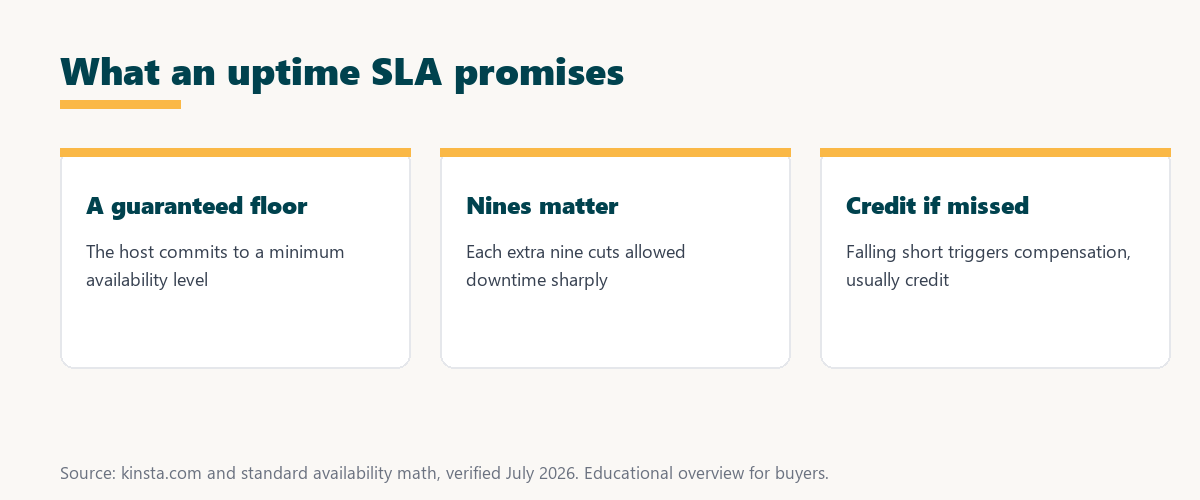
The key point is that percentages hide real hours: 99.9 percent sounds nearly perfect, yet it still permits several hours of downtime across a year.
How Is Uptime Calculated?
Uptime is calculated as the percentage of a period that a service is available, so it divides the available time by the total time, and providers monitor availability to measure it against the SLA’s guaranteed level. Monitoring is what makes the number accountable.
The takeaway is that uptime is a simple ratio, but it only means something when a host actively measures and reports it against the SLA.
What Does 99.9 Percent Uptime Allow?
99.9 percent uptime allows about 8.8 hours of downtime per year, or roughly 44 minutes a month, so while it sounds nearly perfect, it still permits noticeable downtime, which is why higher tiers target 99.99 percent or more. The last fraction of a percent is where reliability is really decided.
Source: standard availability math over a 365-day year, verified August 2026. Figures are approximate.
Reading down the table, each added nine roughly divides the allowed downtime by ten, so 99.9 percent and 99.99 percent are far apart despite looking almost identical.
What Does an SLA Actually Guarantee?
An SLA guarantees a defined availability level and specifies remedies, usually service credits, if it is missed, so it sets expectations and accountability rather than promising the site will literally never go down. It is a floor with consequences, not a promise of perfection.
The honest point is that no SLA promises zero downtime: it guarantees a minimum and defines what you are owed if the host falls below it.
Why Does an Uptime SLA Matter?
An uptime SLA matters because downtime costs sales, leads, and trust, so a strong, backed guarantee signals a host’s confidence in its reliability and gives you recourse if availability falls short. The SLA is both a signal and a safeguard.
“The first five seconds of page-load time have the highest impact on conversion rates.”
— HubSpot, page load time and conversion rates
If a slow page costs conversions, an unavailable one costs them entirely: a strong uptime SLA protects the availability those early seconds, and every sale, depend on.
What Happens If the SLA Is Missed?
If an SLA is missed, the provider typically issues compensation such as account credit according to the agreement’s terms, so the SLA turns a reliability promise into a concrete, if limited, remedy. The credit rarely covers lost revenue, but it enforces accountability.
The practical point is that the remedy is usually service credit, not full compensation, so the SLA matters most as a signal of a host’s confidence.
How to Evaluate an Uptime SLA
Evaluate an uptime SLA by checking the guaranteed percentage, what it covers, how downtime is measured, and the compensation offered, so you understand both the promise and how meaningful it is in practice. The fine print matters as much as the headline number.
Four things reveal how strong an uptime SLA really is:
- Guaranteed level: The headline percentage sets the floor, so a higher number like 99.99 percent promises far less allowed downtime than 99.9 percent.
- Coverage: The agreement defines what counts as downtime, so exclusions for maintenance or specific causes can shrink what the guarantee actually protects.
- Measurement: How and by whom uptime is monitored determines whether a breach is even detected, so independent or transparent measurement adds credibility.
- Remedies: The compensation, usually service credit, shows what a miss is worth, so clear, meaningful credit reflects a host’s real confidence.
Together these four points turn a headline percentage into a judgment about how dependable and accountable a host truly is.
Source: general overview cross-checked with public SLA documentation, verified August 2026.
Reading the table together, a strong SLA pairs a high guaranteed level with clear coverage, transparent measurement, and defined remedies.
How Kinsta Backs Its Uptime
Kinsta backs a 99.9 percent uptime guarantee with monitoring and its Google Cloud infrastructure, so availability is actively tracked and, if the guarantee is missed, addressed according to the agreement, with real-world uptime often exceeding it. The guarantee sits on premium infrastructure.
Get a backed uptime guarantee on Kinsta’s Google Cloud platform
Start Free Migration →A 99.9 percent uptime guarantee, with free migration.
Choosing a Host With Reliable Uptime
You choose a host with reliable uptime by looking for a solid SLA backed by strong infrastructure and monitoring, so a guarantee like Kinsta’s on Google Cloud reflects the availability your revenue site needs. The infrastructure behind the number matters as much as the number.
The takeaway is that a good uptime SLA is only as good as the infrastructure behind it, so judge the guarantee and the platform together. For anyone weighing a long hosting commitment, our note on SaaS vendor lock-in is worth a read.
Uptime SLA and Real-World Availability
An uptime SLA sets a minimum, but real-world availability can be higher, so a host on redundant, premium infrastructure often exceeds its guaranteed percentage, meaning the SLA is a floor rather than a ceiling. The guarantee is the worst case, not the expected case.
“A tool is only worth its premium when the hours or revenue it protects exceed the invoice.”
— Growth Hack Suite, on tool ROI
Applied to uptime, the value of a strong SLA is the downtime it prevents: for a revenue site, the sales protected by high availability far outweigh any hosting premium.
Reading the Fine Print of an SLA
Reading the fine print of an SLA means checking exclusions, how a claim is filed, and the cap on compensation, so you know exactly when the guarantee applies and what it is worth. The details decide whether a headline number is meaningful.
The honest summary is that a percentage alone tells you little: the exclusions, claim process, and credit cap are what make an SLA strong or hollow.
Try Kinsta risk-free with a backed 99.9 percent uptime guarantee
Try Kinsta Risk-Free →A backed uptime guarantee and free migration, with a 30-day money-back guarantee.
Uptime SLAs: Frequently Asked Questions
The 12 most-asked questions about uptime SLAs.
What is an uptime SLA in simple terms?
An uptime SLA is a host’s commitment to a guaranteed availability level, usually a percentage like 99.9 percent, with compensation such as credit if the provider fails to meet it.
What do uptime percentages mean?
Uptime percentages state the share of time a service is available, so 99.9 percent allows about nine hours of downtime a year and 99.99 percent under an hour.
What does 99.9 percent uptime allow?
99.9 percent uptime allows about 8.8 hours of downtime per year, or roughly 44 minutes a month, so it still permits noticeable downtime despite sounding nearly perfect.
How is uptime calculated?
Uptime is the percentage of a period that a service is available, dividing available time by total time, and providers monitor availability to measure it against the SLA.
What does an SLA actually guarantee?
An SLA guarantees a defined availability level and specifies remedies, usually service credits, if missed, so it sets expectations and accountability rather than promising zero downtime.
Why does an uptime SLA matter?
An uptime SLA matters because downtime costs sales, leads, and trust, so a strong, backed guarantee signals a host’s reliability and gives you recourse if availability falls short.
What happens if the SLA is missed?
If an SLA is missed, the provider typically issues compensation such as account credit per the agreement, so the SLA turns a reliability promise into a concrete remedy.
Is 99.9 percent uptime good?
99.9 percent uptime is solid for most sites, though revenue-critical sites may want 99.99 percent, since each additional nine sharply reduces the downtime allowed.
What uptime should I expect from a host?
For an uptime SLA, look for at least a 99.9 percent guarantee, and ideally 99.99 percent for revenue-critical sites, backed by defined compensation if the promised availability is not met.
Does an SLA mean my site will never go down?
No, an SLA guarantees a minimum availability and provides remedies if missed, rather than promising zero downtime, so it sets accountability rather than perfection.
How do I check a host’s real uptime?
You check real uptime through the host’s reporting, third-party monitoring, and reviews, so combining the SLA with independent data shows how the host performs in practice.
What uptime does Kinsta guarantee?
Kinsta backs a 99.9 percent uptime guarantee with monitoring on Google Cloud, so availability is tracked and addressed if missed, with real-world uptime often exceeding it.
About this guide
Written by the Growth Hack Suite editorial team, drawing on hands-on experience running WordPress sites. Details were cross-checked against public SLA documentation, standard availability math,. This page carries affiliate links to Kinsta. The position is stated plainly: an uptime SLA is a host’s guaranteed availability level with remedies if missed, and small percentage differences mean large differences in allowed downtime. Kinsta backs a 99.9 percent uptime guarantee on Google Cloud.