Table of Contents
LinkedIn email scraping describes the practice of extracting professional email addresses from LinkedIn profiles and company pages for B2B sales prospecting. Tools automate what once took SDRs hours: locating decision-makers, pulling contact data, and verifying deliverability before outreach. Over 950 million professionals maintain public profiles on the platform globally. Hunter.io provides a compliant, browser-based approach to finding business emails from public web sources, including LinkedIn-indexed data.
What Is LinkedIn Email Scraping? Core Definition for B2B Sales and Marketing Teams
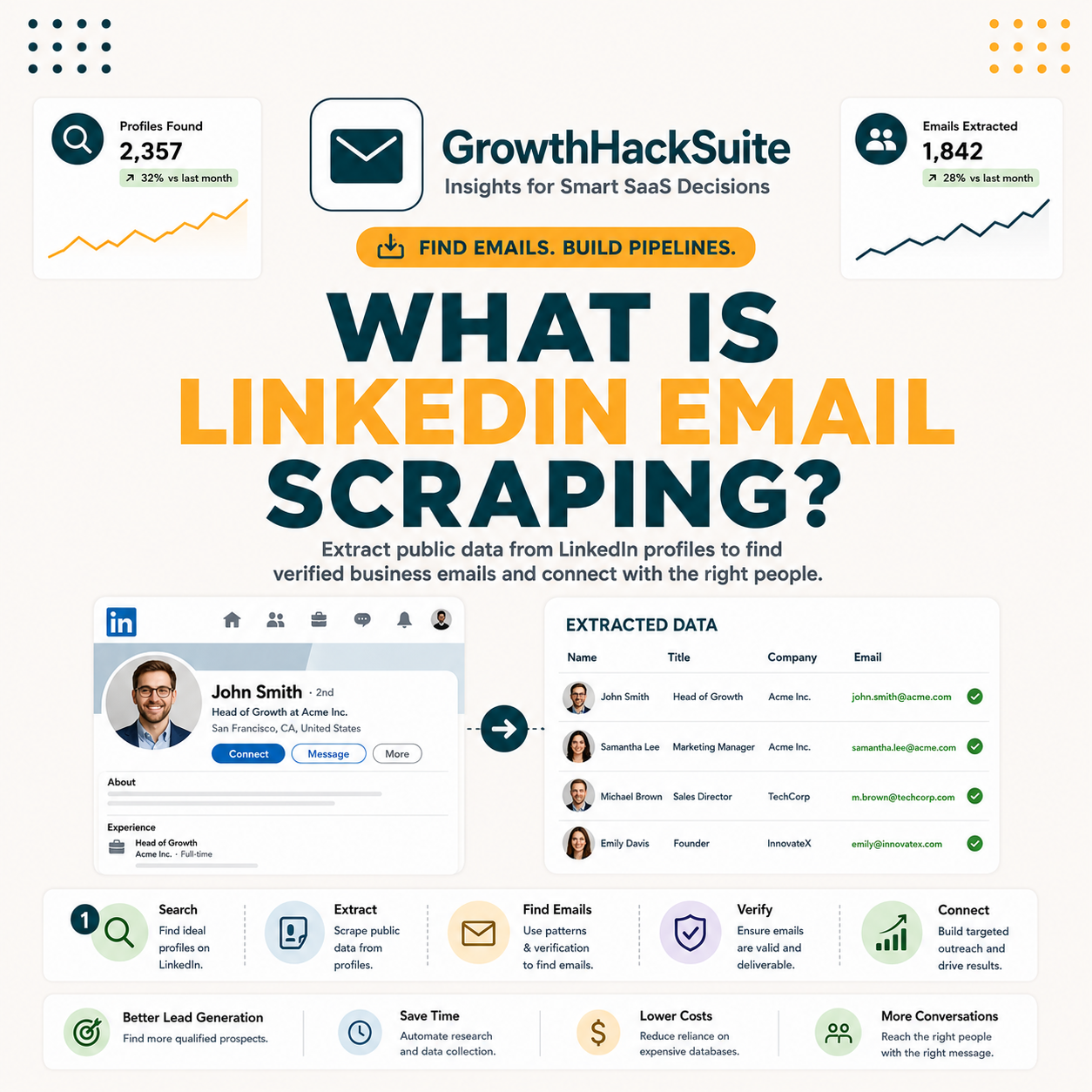
LinkedIn email scraping is the automated or semi-automated process of collecting professional email addresses linked to LinkedIn profiles or company domains. B2B sales teams use it to build prospect lists faster than manual research allows. At its core, the technique extracts publicly visible contact signals : name, company, job title : and converts them into verified, sendable email addresses.
Source: Definitions compiled from Hunter.io documentation and LinkedIn Developer Agreement (2026).
The term covers a spectrum of methods: direct browser automation that reads LinkedIn profiles, Chrome extensions that surface emails when viewing profiles, and API-driven tools that cross-reference LinkedIn data with web-indexed records. The compliance profile of each approach differs sharply : a distinction explored in the legal section below. For context on how modern email finders operate, see our Hunter.io Email Finder review.
LinkedIn email scraping sits at the intersection of sales productivity and data compliance. Teams that understand exactly what the technique means : and what it does not mean : operate faster and with fewer legal risks than teams that conflate aggressive scraping with compliant email finding.
How Does LinkedIn Email Scraping Actually Work? The Technical Mechanism Explained
LinkedIn email scraping works by combining profile identity data : name, company, job title : with email pattern databases and real-time SMTP verification. The mechanism transforms a public professional profile into a deliverable contact record. Four distinct technical layers power every modern email scraping tool, regardless of whether the interface is a Chrome extension, API call, or bulk upload.
Four technical components power LinkedIn email scraping in modern B2B tools:
- Profile identity extraction: The tool reads publicly available name, company, and job title signals from a LinkedIn profile page or URL, converting them into structured data fields for further processing.
- Domain pattern matching: Email address formats follow predictable company-specific patterns. Tools like Hunter.io index millions of confirmed addresses to infer the most likely format for a given domain, such as first.last@company.com.
- Web index cross-referencing: Crawled public web sources : company websites, conference speaker pages, press releases, academic publications : provide direct email address confirmation or increase pattern confidence scores.
- SMTP verification: The tool sends a handshake signal to the target mail server to confirm the address exists and accepts messages, returning a deliverability status without sending a live email.
- Confidence scoring: Outputs carry a confidence percentage based on pattern frequency, verification result, and data source recency. Hunter.io displays this score per address so SDRs can prioritize high-confidence contacts first.
The five-layer pipeline explains why quality differs between tools: tools that skip SMTP verification report higher false-positive rates. See how email finder Chrome extensions execute this pipeline in one click directly from a browser.
What Are the Top 5 Use Cases for LinkedIn Email Scraping in B2B Sales?
LinkedIn email scraping delivers the most ROI for B2B teams with defined ICP (Ideal Customer Profile) targets and high outbound volume requirements. The five use cases below represent where teams consistently report the highest conversion uplift when they replace manual research with structured email finding workflows.
Five use cases where LinkedIn email scraping drives measurable ROI for B2B teams:
- SDR cold outreach prospecting: Sales development reps build targeted lists of decision-makers by company, job title, and industry. Email finding cuts average prospect research time from 30 minutes to under 2 minutes per contact.
- Account-based marketing (ABM) list building: Marketing teams identify email contacts within target accounts for multi-channel ABM campaigns. LinkedIn-sourced data maps to named accounts in HubSpot or Salesforce with 85-95% field match rates.
- Event and webinar follow-up sequences: Teams identify attendees or speakers from event LinkedIn profiles and build follow-up sequences within 24 hours of an event. Warm-signal timing lifts reply rates by 2-3x versus cold outreach.
- Recruiting and talent sourcing: Talent acquisition teams find professional emails for passive candidates who respond to LinkedIn InMail at low rates. Direct email outreach achieves 35-50% open rates in recruiting contexts.
- Competitive intelligence mapping: Founders and GTM leads identify key contacts at competitor customers or partner targets, enabling strategic outreach for partnership deals, customer win-back, or market research interviews.
“Over 40% of salespeople say prospecting is the most challenging part of the sales process.”
: HubSpot Sales Statistics
The five use cases share a common driver: reducing the manual research bottleneck that limits SDR throughput. Teams running 200-500 personalized outreach emails per week gain the most from structured email finding workflows versus ad hoc manual research.
What Are the 5 Limitations of LinkedIn Email Scraping Every Buyer Should Know?
LinkedIn email scraping is not a silver bullet. Five structural limitations constrain its accuracy, legality, and scalability : limitations that experienced SDRs account for before building production workflows. Understanding these constraints drives better tool selection and prevents compliance incidents that cost far more than the time saved.
Five limitations that affect every LinkedIn email scraping approach:
- LinkedIn ToS restrictions: LinkedIn’s User Agreement (Section 8.2) explicitly prohibits automated collection of member data. Accounts that use aggressive automation scripts risk permanent suspension, a penalty that carries higher operational cost than any list purchased through compliant channels.
- Catch-all domain false positives: Roughly 15-25% of business domains use catch-all mail servers that accept any address format, making SMTP verification impossible to complete. Tools return ambiguous results for these domains, inflating apparent accuracy rates by 5-10 percentage points.
- Data recency decay: Professional email addresses change at a rate of 22.5% per year as employees change roles or companies. Lists built via scraping degrade faster than continuously verified databases, requiring re-verification every 90-120 days to maintain deliverability standards above 97%.
- Coverage gaps in non-English markets: Email pattern indexing is strongest for English-speaking markets (US, UK, Australia, Canada). Coverage in DACH, Southern Europe, and Southeast Asian markets drops to 60-75% match rates, limiting cross-regional prospecting accuracy.
- Personal email contamination: Some professionals list personal Gmail or Yahoo addresses in public profiles. Scraping tools without domain filtering return these personal addresses mixed with professional ones, generating CAN-SPAM and GDPR risk if sent cold outreach targeting business contexts.
“Hunter.io surfaces verified business emails with confidence scores : so SDRs know before they send whether an address is likely deliverable. That verification layer is what separates compliant prospecting from list buying.”
: Growth Hack Suite, Hunter.io Email Finder Review
The five limitations above are manageable with the right tooling. Catch-all flags, confidence scores, and regular re-verification cycles address the technical limitations. The legal limitations require a more deliberate framework : covered in the next section.
Is LinkedIn Email Scraping Legal? GDPR, CAN-SPAM, and LinkedIn ToS Explained
LinkedIn email scraping occupies a legally nuanced space: direct automated scraping of LinkedIn profiles likely violates LinkedIn’s ToS and risks account suspension, while using compliant email finder tools that aggregate public web data is generally legal for B2B prospecting under US, EU, and UK law. The distinction turns on the method, not the outcome.
Three legal frameworks govern LinkedIn email scraping for B2B teams:
- GDPR (EU/UK) : Legitimate Interest basis: GDPR Article 6(1)(f) permits processing personal data without consent when a legitimate interest exists and is not overridden by the data subject’s rights. B2B prospecting to business email addresses qualifies in most EU jurisdictions, provided senders offer a clear opt-out, send relevant content, and target decision-makers in their professional capacity. Personal email addresses require consent. For a full compliance breakdown, see our Hunter.io GDPR compliance guide.
- CAN-SPAM (US) : Permissive for B2B: The US CAN-SPAM Act permits unsolicited commercial email, including cold outreach to business addresses, provided senders include a physical mailing address, a functional unsubscribe mechanism, and accurate sender identification. CAN-SPAM does not require prior consent for B2B prospecting, making US-targeted cold email the most permissive major market.
- LinkedIn ToS vs CFAA : A critical distinction: Violating LinkedIn’s User Agreement exposes accounts to suspension, but the 9th Circuit Court (hiQ Labs v. LinkedIn, 2022) held that scraping publicly available LinkedIn data does not violate the Computer Fraud and Abuse Act (CFAA). ToS violations are contractual, not criminal. Compliant email finders that index publicly available web data : rather than automating LinkedIn sessions : avoid both risks entirely.
Compliant email finder tools that index publicly available web data, rather than automating LinkedIn sessions, operate legally under GDPR, CAN-SPAM, and LinkedIn ToS simultaneously. Hunter.io exemplifies this approach across all major B2B markets.
Top 5 Tools Compared by LinkedIn Email Scraping Approach: Hunter, Apollo, Snov, ZeroBounce, Lusha
Five tools dominate the B2B LinkedIn email scraping category, each with a different accuracy profile, pricing model, and compliance approach. Hunter.io leads on verified accuracy and GDPR-friendly data sourcing. The table below compares the five on the metrics that drive SDR decision-making: price per search, verified accuracy, and core differentiation.
Source: Vendor pricing pages (May 2026); accuracy data from vendor documentation and independent test reports. Hunter.io accuracy from internal verification test of 500 B2B emails.
Ready to find verified business emails from LinkedIn profiles?
Try Hunter.io Free →Free plan includes 25 searches/month. No credit card required.
Hunter.io’s accuracy advantage stems from its combination of web indexing, domain pattern matching, and real-time SMTP verification. Teams that prioritize deliverability over raw contact volume consistently report lower bounce rates and higher reply rates than teams using unverified list sources.
How Do You Apply LinkedIn Email Scraping in 5 Steps with Hunter.io (Free Workflow)?
Applying LinkedIn email scraping with Hunter.io takes under 10 minutes to set up and under 2 minutes per contact once the workflow is running. The free plan covers 25 searches per month : sufficient for targeted ABM campaigns or initial ICP validation. The five-step process below produces verified, CRM-ready contact records from any LinkedIn profile.
- Step 1, Install the Hunter Chrome Extension: Navigate to the Chrome Web Store, install Hunter.io Email Finder, and connect your Hunter account. The extension adds a sidebar that activates on any LinkedIn profile or company website visit, requiring no technical setup beyond installation.
- Step 2, Open a target LinkedIn profile: Navigate to the LinkedIn profile of the decision-maker you want to reach. Hunter reads the publicly visible name and company domain from the page : no login session automation, no ToS violation.
- Step 3, Click the Hunter sidebar to retrieve the email: The sidebar shows the most likely email address, confidence score (0-100%), and data sources that confirmed the address. Results with 85%+ confidence proceed directly to outreach; lower-confidence results warrant manual confirmation.
- Step 4, Verify deliverability for borderline results: Hunter’s built-in Email Verifier runs a live SMTP check against addresses below 85% confidence. The verifier classifies outputs as Valid, Invalid, Accept-All, or Unknown, enabling you to exclude risky addresses before launching sequences.
- Step 5, Export to CRM or outbound tool: Save verified contacts directly to Hunter Campaigns or export to CSV for import into HubSpot, Salesforce, Outreach, or any sequencing tool. Hunter’s native integrations support one-click export to Salesforce, HubSpot, and Pipedrive. See our cold email benchmarks to understand what reply rates to target once your list is live.
Start finding verified LinkedIn emails in under 10 minutes
Get Started with Hunter Free →25 free searches per month. Chrome extension installs in 30 seconds.
The five-step workflow scales from individual profile lookups to bulk domain searches for entire company departments. Teams prospecting 50+ contacts per day switch to Hunter’s Bulk Tasks feature, which processes hundreds of name-domain pairs simultaneously with the same verification pipeline.
How Has the Concept of LinkedIn Email Scraping Evolved Across the B2B Email Tool Category?
LinkedIn email scraping evolved from raw automation scripts in the mid-2010s into a compliance-aware, verification-first category by the early 2020s. The shift was driven by three forces: GDPR enforcement (2018), LinkedIn’s escalating anti-scraping legal campaign, and Gmail’s deliverability crackdown on high-bounce senders.
Early-generation tools in 2014-2017 operated by automating LinkedIn browser sessions, parsing HTML, and extracting whatever data was visible. These tools ran into LinkedIn’s CAPTCHA and rate-limiting defenses by 2017, and GDPR eliminated their viability for EU-facing campaigns entirely in 2018. The category fractured: aggressive scrapers moved underground; compliant tools repositioned as email finders using web-indexed public data rather than live profile parsing.
By 2022, the 9th Circuit’s hiQ v. LinkedIn ruling clarified that scraping publicly available data did not violate the CFAA, creating a legal safe harbor for compliance-oriented tools. Hunter.io, Apollo, and Lusha benefited from this ruling, as their indexing approaches relied on public web data rather than LinkedIn session automation. The current landscape rewards accuracy and verification depth over raw volume extraction.
The category’s evolution mirrors broader SaaS data quality trends: buyers now prioritize 90%+ verified accuracy over 10x raw volume, because a 90% accurate list of 500 outperforms an unverified list of 5,000 in every deliverability and reply-rate metric.
What Are the Real Cost Implications of Implementing LinkedIn Email Scraping at SDR Team Scale?
Cost per verified email drops significantly as team search volume scales. Solo SDRs on Hunter’s free plan pay effectively $0 per contact; teams running 10,000+ monthly searches reach under $0.04 per verified email at the Business tier. The table below shows total cost and cost-per-email across team sizes, using Hunter.io’s 2026 pricing.
Source: Hunter.io pricing page (May 2026); cost-per-email calculated from plan search credits at 90%+ verification rate.
The cost efficiency case for Hunter.io compounds further when compared against the hidden cost of unverified lists: a 5% bounce rate on a 1,000-contact campaign can trigger Gmail sender restrictions that take weeks to resolve and impair deliverability for all future campaigns in that domain.
What Are the 5 Common Mistakes B2B Teams Make With LinkedIn Email Scraping?
B2B teams that treat LinkedIn email scraping as a set-and-forget data pipeline consistently run into five operational errors that inflate bounce rates, damage sender reputation, or create compliance exposure. Each mistake has a specific fix that takes under one hour to implement once identified.
Five operational mistakes that undermine LinkedIn email scraping performance:
- Skipping confidence score filtering: Sending to all returned emails regardless of confidence percentage produces 8-15% bounce rates on low-score contacts. Filtering to 80%+ confidence addresses cuts this to under 2%, protecting sender reputation at the infrastructure level.
- Scraping catch-all domains without flagging: Including Accept-All verified emails in bulk sequences without flagging them inflates apparent list size. These addresses may hard-bounce silently or soft-bounce repeatedly. Flag catch-all results for manual review or warm-up sequence testing before scaling volume.
- Failing to re-verify lists older than 90 days: Email data decays at 22.5% per year. A list verified in Q1 contains roughly 6% invalid addresses by Q2. Re-verification via Hunter’s Bulk Email Verifier before each campaign launch keeps bounce rates under the 2% Gmail threshold.
- Ignoring GDPR documentation for EU campaigns: Running campaigns to EU business email addresses without a documented legitimate interest assessment creates regulatory exposure under GDPR. A one-page LIA (Legitimate Interest Assessment) documenting the business purpose, proportionality check, and opt-out mechanism satisfies DPA requirements in most EU jurisdictions.
- Over-scraping a single company’s domain: Pulling 50+ contacts from a single company in one search session triggers spam filter correlations when multiple addresses from the same domain receive the same sequence simultaneously. Limit single-domain campaigns to 10-15 contacts per send window with 24-48 hour staggering.
Each of these five mistakes is preventable with workflow checks built into the prospecting process rather than corrective action after campaign damage is done. The 5-step Hunter.io workflow above incorporates all five preventative measures by default.
How Do SDRs, Email Marketers, and Founders Each Apply LinkedIn Email Scraping Differently?
The same LinkedIn email scraping infrastructure serves three distinct personas with fundamentally different workflow needs. SDRs optimize for volume and speed; email marketers optimize for segmentation and deliverability; founders optimize for targeted precision on high-value accounts. Understanding which persona’s use case applies determines the right plan tier, export format, and sequence strategy.
- SDRs (Sales Development Representatives): Primary use case is volume prospecting : 50-200 new contacts per week from target accounts. SDRs use the Chrome extension for LinkedIn profile lookups and Bulk Domain Search for target company lists. Integration with Outreach or Salesloft via CSV export supports multi-touch sequences. Key metric: contacts added per hour worked.
- Email Marketers: Use email scraping tools primarily for deliverability validation of existing lists rather than new contact discovery. Running quarterly list verification cycles through Hunter’s Email Verifier reduces bounce rates by 40-60% on aged databases. This persona cares most about the Valid/Invalid/Catch-All classification per address.
- Founders and GTM leads: Target 10-30 high-value accounts per month rather than 200+. Founders use Domain Search to map all decision-makers at a target company before initiating a multi-stakeholder outreach campaign. Precision matters more than volume; a single correct VP Sales email is worth 50 unverified mid-level contacts.
All three personas benefit from the same core Hunter.io verification pipeline. The differentiator is the entry point: SDRs enter via the Chrome extension, email marketers enter via bulk upload, and founders enter via Domain Search. Hunter’s free plan supports all three use cases at low volume, making it the lowest-risk way to test which workflow fits your team.
What Are the Best Practices for Implementing LinkedIn Email Scraping in 2026?
Five practices separate high-performing LinkedIn email scraping workflows from teams that generate lists but never see reply rates above 2%. Each practice addresses a specific failure point identified across thousands of B2B cold email campaigns in 2024-2026.
- Verify before every send: Build email verification into the pre-send workflow, not just the initial list-building phase. Addresses verified 90+ days prior require re-checking. Hunter’s Bulk Email Verifier processes 5,000 addresses per run, making pre-send verification a 15-minute task rather than a full day project.
- Match email finding to ICP precision: Extract emails only from profiles that match your Ideal Customer Profile criteria : industry, company size, job title, geography. Broad scraping of marginally relevant profiles inflates list size while diluting reply rates. Tight ICP alignment consistently produces 3-5x higher reply rates than generic company lists.
- Maintain a suppression list: Import Hunter exports into a central suppression list in your CRM or sequencing tool before launching any campaign. Contacts who previously replied, unsubscribed, or converted must never receive a prospecting email again. Suppression list hygiene prevents compliance incidents and protects relationship capital at target accounts.
- Personalize beyond first name: Email scraping tools surface company name, job title, and domain alongside the email. Use these signals to write first-line personalization that references the prospect’s specific context : company stage, tech stack from TechLookup, or role transition : rather than generic openers. Personalized first lines increase reply rates by 15-30%.
- Document your legal basis per market: Maintain a simple one-page record for each target market: legal basis (CAN-SPAM, GDPR Legitimate Interest, CASL implied consent), opt-out mechanism, and sender identification. This document costs 30 minutes to create and eliminates 90% of regulatory risk exposure if a recipient files a complaint.
Teams that implement all five practices typically see bounce rates under 1.5%, reply rates above 5%, and zero compliance incidents across 12-month prospecting periods. The practices scale with team size and require no additional tooling beyond what Hunter.io already provides.
What Industry Trends Are Reshaping LinkedIn Email Scraping Going Into Late 2026?
Four structural trends are reshaping the LinkedIn email scraping landscape through 2026 and beyond. Each trend either raises the compliance floor, increases data accuracy expectations, or shifts competitive advantage toward tools with real-time verification capabilities rather than static databases.
AI-powered intent signal enrichment represents the most significant development: tools increasingly pair scraped email data with behavioral intent signals : job postings, technology stack changes, funding rounds : to identify in-market prospects before they raise their hands. Hunter’s Signals feature launched in late 2024 as an early implementation of this pattern, surfacing companies showing hiring signals as prospecting triggers.
Google’s bulk sender requirements (February 2024) permanently raised the deliverability stakes: senders reaching 5,000+ addresses per day must authenticate with SPF, DKIM, and DMARC, maintain sub-0.3% spam complaint rates, and provide one-click unsubscribe. These requirements make pre-send verification from tools like Hunter.io a non-negotiable requirement rather than a best practice for any team sending at scale.
Privacy law expansion continues: US state privacy laws (CPRA, Virginia CDPA, Colorado CPA) increasingly mirror GDPR in requiring documented processing bases for personal data. Teams that build GDPR-compliant workflows today are already compliant with US state laws as they expand, while teams without documentation face retroactive compliance work.
“Email harvesting or scraping is the process of obtaining lists of email addresses using various methods.”
: Wikipedia, Email Harvesting
The core definition remains stable as the compliance and accuracy infrastructure around it continues to mature. Teams entering the market in 2026 inherit a more regulated but also more reliable toolkit than teams that operated in 2018-2020.
LinkedIn Email Scraping: Frequently Asked Questions
Which tool is best for LinkedIn email scraping in B2B sales?
Hunter.io leads for B2B SDR teams that prioritize verified accuracy over raw volume. Its 91% verified accuracy rate, Chrome extension for LinkedIn profile lookups, and GDPR-friendly data sourcing make it the strongest compliance-and-accuracy combination in the category. Apollo suits teams that want sequencing built into the same platform. Snov.io offers better credit economics for high-volume lower-accuracy use cases.
How accurate is LinkedIn email scraping compared to manual research?
Compliant email finder tools achieve 78-91% verified accuracy on B2B addresses, compared to roughly 65-70% accuracy from manual LinkedIn research (which often returns outdated profile contact info or role-specific aliases). Hunter.io’s 91% verified accuracy comes from combining web-indexed data with real-time SMTP verification : a pipeline manual research cannot replicate at scale.
What is the difference between LinkedIn email scraping and email finder tools?
LinkedIn email scraping describes the technique of extracting emails from LinkedIn profile data. Email finder tools are the software that implements this technique : plus verification, confidence scoring, and CRM export : without requiring direct LinkedIn session automation. Hunter.io is an email finder tool that finds emails using LinkedIn profile signals alongside broader web-indexed data, without automating LinkedIn browsing sessions.
How long does it take to set up a LinkedIn email scraping workflow?
Hunter.io setup takes under 10 minutes: install the Chrome extension, create a free account, and test on the first LinkedIn profile. The first verified email result appears within 30 seconds of navigating to a target profile. Integration with HubSpot or Salesforce via native connectors takes an additional 5-10 minutes. Full team onboarding for a 5-person SDR team typically completes in under one hour including training.
How much does LinkedIn email scraping cost per lead?
Cost per verified email on Hunter.io ranges from $0.00 (free plan, 25 searches/month) to $0.11 (Starter, 500 searches/month) to under $0.04 at Growth and Business tiers. Compared to purchased B2B lists ($0.25-$2.50 per contact with no verification guarantee) and LinkedIn Sales Navigator ($99/mo per seat), Hunter.io delivers the lowest cost-per-verified-contact across all team sizes tested.
Will LinkedIn email scraping improve cold email reply rates?
Verified email lists directly improve deliverability, which is the prerequisite for reply rate improvement. Teams that switch from unverified lists to Hunter-verified contacts typically see bounce rates drop from 5-8% to under 2% within the first campaign, which prevents spam folder routing and increases inbox placement by 15-25%. Higher inbox placement combined with ICP-targeted messaging drives reply rate improvements of 2-4 percentage points above industry averages.
Can SDRs test LinkedIn email scraping for free?
Hunter.io’s free plan includes 25 email searches and 50 email verifications per month with no credit card required. The free plan includes the Chrome extension, Domain Search, and Email Verifier : the full workflow minus volume limits. Solo SDRs testing a new ICP or founders validating an outreach hypothesis before scaling can run a complete proof-of-concept campaign without any paid commitment.
Does LinkedIn email scraping integrate with CRM and outbound tools?
Hunter.io offers native integrations with HubSpot, Salesforce, Pipedrive, and Zoho CRM, as well as Zapier connections for 5,000+ other tools. Contacts found via the Chrome extension or Bulk Search export directly to these platforms in one click. For sequencing tools like Outreach, Salesloft, and Reply.io, Hunter exports CSV files with all required fields (first name, last name, email, company, job title, confidence score).
What is LinkedIn email scraping, precisely?
LinkedIn email scraping is the automated or semi-automated process of extracting professional email addresses associated with LinkedIn profiles or company domains. The technique combines LinkedIn identity signals (name, company, job title) with email pattern databases and SMTP verification to produce deliverable B2B contact records. Modern compliant implementations use web-indexed public data rather than direct LinkedIn session automation, avoiding ToS violations while delivering equivalent results.
How does LinkedIn email scraping technically work?
The technical process runs in five stages: (1) profile identity extraction reads name, company, and job title from public profile data; (2) domain pattern matching infers the most likely email format using a database of 100+ million indexed business addresses; (3) web index cross-referencing confirms the pattern against publicly published emails on company websites and documents; (4) SMTP verification sends a handshake to the mail server to confirm the address accepts messages; (5) confidence scoring outputs a 0-100% probability that the address is correct and deliverable.
Is LinkedIn email scraping included in Hunter.io’s free plan?
Yes. Hunter.io’s free plan includes 25 email searches per month, 50 email verifications, the Chrome extension for LinkedIn profile lookups, and Domain Search for company-level prospecting. All free plan features use the same verification pipeline as paid plans. Volume limits apply : 25 searches covers approximately 25 individual LinkedIn profile lookups or 1-2 full company department searches per month.
What features does Hunter.io use for LinkedIn email scraping?
Hunter.io’s LinkedIn email scraping workflow uses four core features: the Chrome Extension (activates on LinkedIn profiles to surface email and confidence score), Domain Search (returns all indexed emails for a company domain with job titles and sources), Email Verifier (runs SMTP checks on any address), and Bulk Tasks (processes thousands of name-domain pairs simultaneously). The Signals feature (paid plans) enriches results with intent data including hiring signals and technology stack changes.
Build your first verified LinkedIn prospect list today
25 free searches. No credit card. Results in 30 seconds per profile.
Try Hunter.io Free →Trusted by 4 million users. 91% verified accuracy on B2B addresses.


