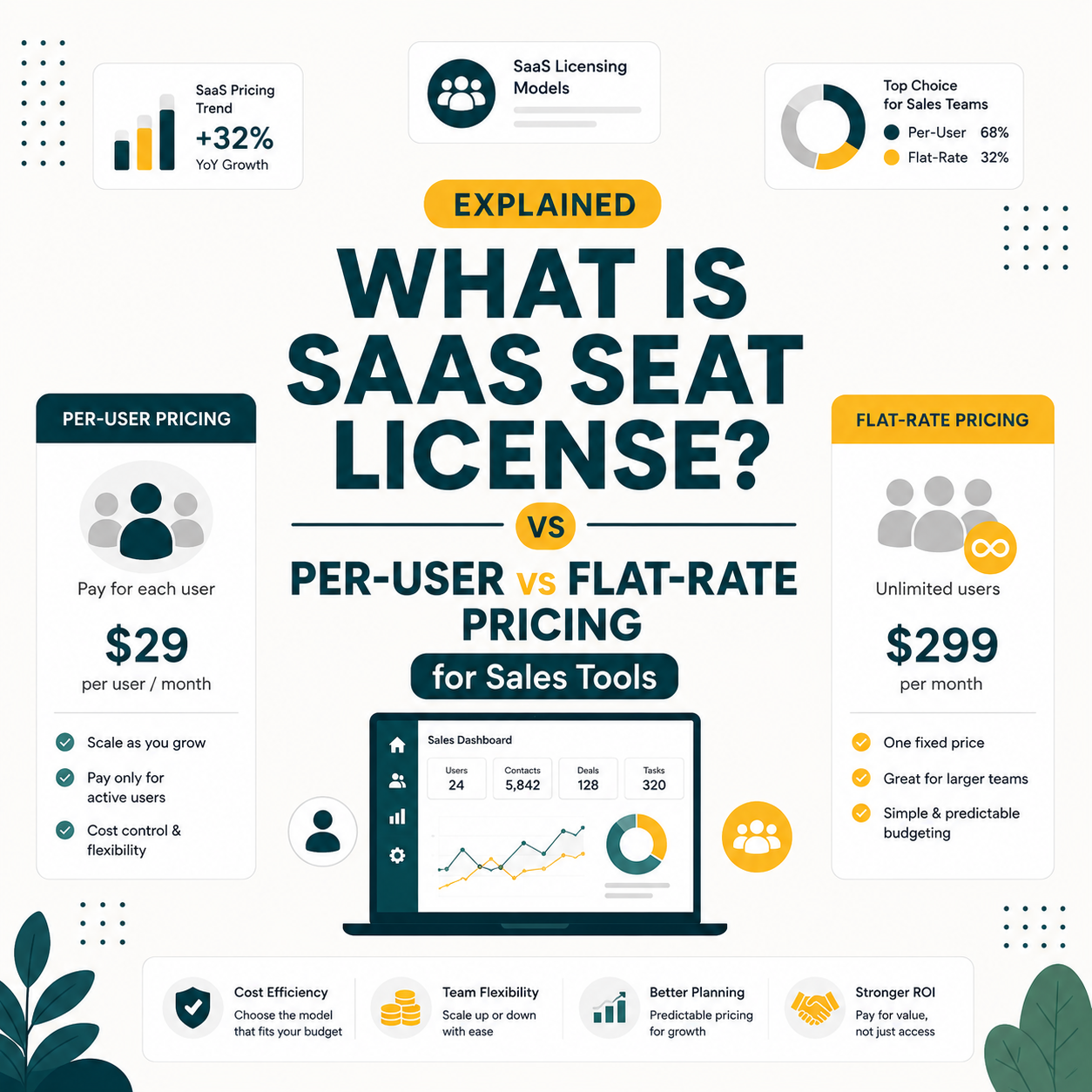
A SaaS seat license grants software access to a defined number of named users, billing per seat added. B2B sales tools charge $25 to $200 per user per month under this model. Credit-based tools like Hunter.io offer a flat-rate alternative: unlimited users share a monthly credit pool, cutting per-SDR cost up to 75 percent on teams of three or more. This guide explains both models with real cost data.
Table of Contents
What Is SaaS Seat License? Core Definition for B2B Sales and Marketing Teams
A SaaS seat license is a subscription pricing model that ties software access to a specific number of authorized users. Each seat represents one named user account; adding a team member adds a billable seat at the per-user rate. B2B sales tools like Salesforce, HubSpot, and Apollo.io use this model, charging $25 to $150 per user each month.
“A software license is a legal instrument governing the use or redistribution of software.”
: Wikipedia, Software License
Unlike perpetual software licenses that sold a product outright, SaaS seat licenses rent access month-to-month. This shifts capital expenditure to operating expenditure and lets vendors align revenue to active users. For SDR managers evaluating email intelligence tools, understanding which model a vendor uses is the first decision gate before any procurement conversation.
How Does SaaS Seat License Actually Work? The Technical Mechanism Explained
SaaS seat license billing rests on five technical layers that govern how users are provisioned, authenticated, and billed. Understanding each layer helps SDR managers spot where costs can leak and where credit-based alternatives remove friction entirely. The mechanism connects identity management to billing logic inside the vendor’s subscription infrastructure.
- License provisioning layer: Administrators assign seats to named email addresses in the vendor admin portal. Each provisioned seat activates one user account tied to a billing counter, logged on the subscription record.
- User authentication gate: Single sign-on or email/password authentication checks the user’s email against the seat roster on every login. A user not on the roster is denied access even on shared devices.
- Real-time seat counting: The billing engine counts active seats at the start of each billing cycle. Vendors differ on whether paused or deactivated users count toward seat totals; most count them unless explicitly removed.
- Overage detection logic: When an admin adds a user beyond the purchased seat count, the system either blocks the action (hard stop) or auto-bills the next tier (soft stop). Most enterprise tools default to soft stop, creating surprise invoices.
- Renewal and proration engine: Mid-cycle seat additions are prorated to the next billing date. Removals typically do not generate credits. This asymmetry is a documented cost trap for fast-growing SDR teams during headcount fluctuations.
The five-layer mechanism means that seat-licensed tools reward stable, predictable team sizes. SDR organizations with high churn, seasonal hiring, or contractor-heavy outreach programs pay a structural premium that credit-based tools like Hunter.io avoid by design.
What Are the Top 5 Use Cases for SaaS Seat License in B2B Sales?
Per-user seat licensing delivers clear value in specific B2B sales contexts where team size is stable, tool access is personal, and usage patterns are individual rather than shared. Five use cases below show where the model earns its cost, and where alternatives outperform it.
- CRM platform subscriptions: Salesforce, HubSpot, and Zoho charge per seat because each rep owns their pipeline data. Individual contact ownership, activity logging, and opportunity stages require named-user identity that seat licenses enforce cleanly.
- Sales sequencing and engagement tools: Outreach.io and Salesloft price per seat because sequences, call recordings, and email thread tracking tie directly to individual rep performance metrics managers pull for coaching.
- Video conferencing and meeting intelligence: Gong and Chorus record and transcribe calls tied to individual reps. Seat licensing maps one license to one recorder identity, keeping recordings attributable for QA and coaching workflows.
- Proposal and contract software: PandaDoc and DocuSign tie e-signatures and document audit trails to individual signer identities. Per-seat licensing satisfies legal accountability requirements that shared credentials would violate.
- Social selling and LinkedIn automation: Dux-Soup and LinkedHelper operate browser-session-bound. Each SDR needs an individual license tied to their own LinkedIn profile, making seat licensing the only viable model for compliance with LinkedIn’s Terms of Service.
“Every user in a Starter, Professional, or Enterprise subscription will have a seat.”
: HubSpot Knowledge Base, Manage Seats
The five use cases share a common trait: individual identity accountability. When tool value is inseparable from who uses it, seat licensing is the right architecture. When tool value is purely about output volume (emails found, leads verified, contacts enriched), credit-based pricing typically wins on total cost of ownership.
What Are the 5 Limitations of SaaS Seat License Every Buyer Should Know?
SaaS seat licensing introduces five structural limitations that create hidden costs and adoption friction for B2B sales teams. Buyers who negotiate seat contracts without understanding these dynamics routinely overspend relative to comparable usage-based tools covering the same workflow need.
- Linear cost scaling with headcount: Adding one SDR to a 3-person team at $59/seat raises the monthly bill by 33 percent instantly. Credit-based tools like Hunter.io absorb the same new hire into the existing credit pool at zero additional cost until the team exceeds the volume ceiling.
- Wasted seats from inactive users: Parental leave, role changes, and terminations leave paid seats idle unless admins proactively deactivate them. A seat that nobody has logged into for a full billing cycle still bills at the full per-user rate, and nothing in the vendor’s billing logic flags it.
- Annual commitment lock-in: Vendors discount annual plans, Apollo.io at $49 per user against $59 monthly and Hunter.io at a flat 30 percent, but the discount locks the seat count at contract signing. Mid-year team reductions do not generate refunds on most annual seat contracts.
- Feature parity gaps across tiers: Seat-licensed tools often gate key features (API access, advanced reporting, bulk exports) to higher-tier plans that cost significantly more per seat. Apollo gates phone data, the dialer, and A/B testing behind Professional at $79 per user annually. Teams buy a low-cost seat only to discover the feature they need requires an upgrade.
- Slow procurement approval cycles: Every new seat addition in enterprise organizations requires a new purchase order or contract amendment. High-growth SDR teams onboarding several reps in a quarter wait through a procurement cycle for each seat batch under per-user models.
“Hunter.io’s credit-based model lets an entire SDR team share one subscription, eliminating the per-seat cost spiral that grows unsustainably with headcount.”
: Growth Hack Suite, Hunter.io Email Finder Review
The five limitations point to the same underlying problem: seat licensing optimizes for vendor revenue predictability, not buyer cost flexibility. Teams that move email finding and verification off a seat-licensed tool and onto a shared credit pool cut that line item sharply, because the subscription stops tracking headcount and starts tracking volume.
How Has the Concept of SaaS Seat License Evolved Across the B2B Email Tool Category?
SaaS seat licensing emerged in the 2000s as cloud software replaced perpetual desktop installs. Early tools like Salesforce CRM (launched 1999) pioneered the per-user model, charging $50 per user per month for its Professional edition and $125 for Enterprise, at a time when competitors sold six-figure perpetual licences. By 2015, seat licensing had become the default SaaS pricing architecture for B2B tools.
The B2B email intelligence category followed this path from 2014 to 2019, with tools like Clearbit, ZoomInfo, and early Apollo charging per seat. The inflection point came when data-centric tools discovered that usage (searches, verifications, API calls) was a more natural billing unit than headcount. Hunter.io, founded in 2015, built its billing around search and verification volume rather than headcount, then consolidated finder and verifier spend into a single unified credit pool in July 2025.
OpenView’s State of Usage-Based Pricing survey found that 45 percent of SaaS companies had adopted some form of usage-based pricing by 2021, up from 34 percent the year before, and roughly three in five by 2022. The shift reflects a broader Product-Led Growth movement: let users start free, expand based on value delivered, and bill on outcomes rather than identities. Seat licensing persists primarily where individual accountability is legally or operationally required.
Today, the B2B email tool market is bifurcated: CRM and engagement tools remain seat-licensed for accountability reasons, while email discovery and verification tools have moved largely to credit-based or hybrid models. Understanding which side of this divide a tool falls on is now a first-order procurement question for any SDR manager building a stack.
What Are the Real Cost Implications of Implementing SaaS Seat License at SDR Team Scale?
Cost implications of seat licensing become material at three or more SDRs. At a single user, per-seat and credit-based pricing sit within about $10 of each other. Above three users, credit-based tools generate compounding savings that accelerate as the team grows. The math is straightforward but frequently ignored during vendor selection.
Source: Apollo.io and Hunter.io public pricing pages, verified July 2026. Both columns use monthly billing. Apollo Basic is $59 per user per month monthly, or $49 per user per month on annual billing. Hunter.io Starter is $49 per month for 2,000 credits and Growth is $149 per month for 10,000 credits, both with unlimited team members, and annual billing applies a flat 30 percent discount. One credit finds an email, verification costs half a credit.
For SDR teams of three or more, the credit-based model delivers roughly 50 to 75 percent lower monthly cost than a per-seat email intelligence tool, because the subscription stops scaling with headcount. The savings compound annually and fund additional outreach investment in sequencing tools, intent data, or coaching software. The tier-by-tier credit allowances behind these numbers are broken down in our hunter.io pricing guide, which covers what each plan includes and where the volume ceilings sit.
What Are the 5 Common Mistakes B2B Teams Make With SaaS Seat License?
Five recurring mistakes drive preventable overspend on seat-licensed SaaS tools. Each mistake follows a predictable pattern that B2B operations and RevOps teams identify during quarterly spend audits, but rarely catch before the annual renewal cycle locks in the damage.
- Over-buying seats at contract signing: Procurement teams buffer seat counts to avoid mid-year amendments. Every buffer seat on an annual contract bills for twelve months whether or not anyone logs in, and on a $59 seat that is $708 per unused seat per year with no pipeline attached to it.
- Failing to audit inactive users quarterly: Departed employees, contractors, and role-changers keep their seat allocation until an admin removes it manually. On an annual contract the seat stays billable through renewal even after deactivation, so the cost of a missed offboarding is the full remaining term.
- Choosing seat-based tools for shared-resource workflows: Email finding and list verification are team resources, not individual ones. A seat-licensed email finder at $59 per user costs a team of four $236 per month, while a $49 per month credit pool covers the same four users. That is $187 wasted from day one.
- Ignoring the credit reset policy during tool evaluation: Most credit-based tools, Hunter.io included, reset the pool on the billing date with no rollover. Size the plan against typical monthly volume rather than the busiest month, otherwise the unused balance disappears at reset and the effective cost per email quietly rises.
- Skipping negotiation on seat pricing at renewal: List price is rarely the last price on a mid-market seat contract. RevOps teams that benchmark competitor pricing (Apollo vs Hunter vs Snov) before the renewal conversation walk in with a credible alternative, which is the only leverage that moves a per-seat quote.
Avoiding these five mistakes requires one quarterly calendar event: a SaaS seat audit reviewing active users, usage ratios, and vendor alternatives. On a stack of a dozen seat-licensed tools, removing dormant seats and moving shared-resource workflows to credit pools is usually the largest single line-item saving available without cutting capability.
How Do SDRs, Email Marketers, and Founders Each Apply SaaS Seat License Differently?
Three buyer personas interact with SaaS seat licensing decisions from different vantage points: the SDR optimizing daily workflow cost, the email marketer managing list health at scale, and the founder owning total SaaS spend ROI. Each persona’s decision calculus produces a different preferred model and vendor selection criteria.
SDRs care primarily about the per-action cost of finding verified emails. A seat-licensed tool that grants access but still meters enrichment compounds costs in two directions simultaneously. For a Hunter.io email finder review persona building 50-lead lists daily, the credit model prices one contact found and verified at 1.5 credits, which is $0.037 on Starter monthly billing and $0.026 on annual billing.
Email marketers focus on list quality at volume. Seat licensing is less relevant to their workflow because most enterprise email marketing platforms (Mailchimp, Klaviyo, ActiveCampaign) price by contact count or send volume rather than users. However, email verification tools that sit upstream in their workflow do follow seat or credit models. Marketers running 50,000-contact campaigns prefer credit-based batch verification tools over per-seat options because verification is a bulk operation, not a named-user task.
Founders evaluate SaaS seat licensing at the portfolio level: total stack cost per revenue dollar generated. A three-person team paying $177 per month for a seat-licensed email finder against $49 per month for a shared credit pool frees $1,536 a year that could fund one additional SDR month or a quarter of paid experiments. Founders who run quarterly SaaS spend audits treat per-user tools as a default-guilty category requiring explicit justification.
Top 5 Tools Compared by SaaS Seat License Approach: Hunter, Apollo, Snov, ZeroBounce, Clearbit
The B2B email intelligence market splits across four distinct pricing architectures. The table below compares five leading tools on pricing model, team-size economics, and the specific workflow each pricing approach optimizes. Hunter.io’s credit model consistently outperforms seat-licensed alternatives for SDR teams of three or more.
Source: public pricing pages of each vendor, verified July 2026. Apollo.io Basic on monthly billing. Hunter.io Starter. Snov.io Starter on monthly billing. ZeroBounce pay-as-you-go minimum purchase. Clearbit is now sold as Breeze Intelligence and cannot be bought standalone; the entry cost combines a 100-credit pack with a paid HubSpot tier.
For teams specifically needing email finding and verification (not a full CRM or sequencer), Hunter.io’s credit model delivers the lowest per-seat equivalent cost at every team size above one user. The email finder pricing comparison shows Hunter holding the cost efficiency lead through the five-user tier before Growth plan pricing becomes more relevant.
What Are the Best Practices for Implementing SaaS Seat License in 2026?
Five best practices separate teams that extract maximum value from seat-licensed tools from those that overpay and underutilize. Implementing these practices lowers SaaS tool spend without reducing functionality or workflow capability.
- Audit seats quarterly, not annually: Quarterly reviews catch departed users within 90 days rather than 365 days, which cuts the billable life of a dormant seat by three quarters. Calendar the first day of each fiscal quarter as a mandatory seat cleanup day with RevOps owning execution.
- Separate shared-resource tools from individual-accountability tools: Email finding, list verification, and domain search are team resources. Assign them to credit-based tools. CRM, call intelligence, and e-signature tools require named users and belong in seat-licensed plans. Mixing the two categories creates guaranteed overspend.
- Negotiate seat caps rather than exact seat counts: Annual contracts negotiated with seat caps (for example, up to 10 seats at a flat monthly rate) carry a premium per seat but eliminate amendment friction during rapid hiring. Teams that expect to scale from 3 to 8 SDRs inside a contract year usually recover the premium well before renewal.
- Benchmark alternatives at every renewal: The email intelligence market reprices frequently. Hunter.io moved to a unified credit pool in July 2025, and Clearbit was absorbed into HubSpot as Breeze Intelligence. Teams that benchmark at renewal lock in current pricing and use competitor quotes as negotiation leverage.
- Start on the free plan for email discovery tools before committing: Hunter.io’s free plan includes 50 credits per month, enough for 50 email finds or 100 verifications, with no credit card required. Run it across the team for two weeks to measure actual credit consumption before choosing a tier, which prevents both over-buying and under-buying at upgrade time.
Teams implementing all five practices reduce SaaS tool cost in the 12 months following implementation while maintaining or growing outreach volume and pipeline contribution from their SDR function.
How Do You Apply SaaS Seat License Concepts in 5 Steps with Hunter.io (Free Workflow)?
Applying seat license evaluation principles to a real procurement decision takes five structured steps. The workflow below uses Hunter.io as the credit-based benchmark against which seat-licensed alternatives are measured, giving SDR managers a replicable framework for every future tool evaluation.
- Step 1, Map your team’s workflow identity: List every SaaS tool in your current stack. Mark each tool as “individual identity” (CRM, call recording, e-signature) or “shared resource” (email finder, verifier, enrichment). Individual identity tools belong in seat licenses; shared resource tools belong in credit-based models.
- Step 2, Calculate actual per-action cost on current seat tools: Divide your monthly seat cost by the number of verified emails, contacts enriched, or searches completed in the last 30 days. Compare that figure against Hunter.io Starter at $49 per month for 2,000 credits, which works out to $0.0245 per email found and $0.0123 per verification, or $0.037 for one contact both found and verified. The full tier ladder sits in our hunter.io pricing breakdown.
- Step 3, Pilot on the free plan for two weeks: Sign up for Hunter.io’s free plan (50 credits per month, no credit card required) and invite the whole team, since seats are unlimited on every tier. Have each SDR run their normal prospecting workflow and log credits consumed. The free pool is sized for validation rather than production, so use it to measure burn rate, not to clear a full list.
- Step 4, Model the annual cost difference: Using two weeks of usage data, extrapolate monthly credit consumption and map it to a tier: 2,000 credits on Starter, 10,000 on Growth, 25,000 on Scale. Calculate annual cost against your current per-seat tool, and apply the 30 percent annual billing discount if a 12-month commitment is realistic.
- Step 5, Present the savings case to procurement: Document per-seat cost, credit-based cost, and annual delta. Include the accuracy evidence, a 91 percent valid rate across a 1,000-email test on 50 corporate domains, and the free plan as risk mitigation. Procurement teams approve credit-based tools faster when the savings case is numeric and the trial data eliminates performance risk.
The five-step framework applies to any credit-based vs seat-licensed comparison, not just Hunter.io. Teams that complete the framework before annual renewals consistently negotiate better terms or identify superior alternatives that reduce outreach cost while maintaining lead quality.
Ready to replace per-seat pricing with credit-based email finding?
Try Hunter.io Free →Free plan: 50 credits per month. Unlimited team members. No credit card required.
What Industry Trends Are Reshaping SaaS Seat License Going Into Late 2026?
Four structural trends are accelerating the shift away from per-seat pricing in B2B sales tools, creating favorable conditions for credit-based and usage-based alternatives. SDR managers evaluating stack changes in late 2026 will encounter a market where pure seat licensing is increasingly a differentiating disadvantage for vendors competing against flexible-pricing entrants.
Product-Led Growth (PLG) expansion is the most disruptive trend. Vendors like Hunter.io, Apollo, and Snov.io all offer free tiers that require zero procurement approval, letting SDRs self-adopt and prove ROI before IT or RevOps gets involved. Free tiers erode the seat license model’s primary advantage (forced adoption from day one) by demonstrating value without financial risk.
AI-augmented prospecting tools are introducing consumption-based pricing that doesn’t map cleanly to seats. When an AI agent runs 200 domain searches on behalf of three SDRs simultaneously, billing by seat is technically incoherent. Tool vendors building AI prospecting workflows (Clay, Instantly, Hunter.io’s bulk task features) default to credit or API call pricing as the natural unit of account.
SaaS consolidation pressure from CFOs is pushing procurement teams to justify every seat across every tool. A mid-market revenue org now runs a sales stack of a dozen or more tools, and CFO-led rationalization audits routinely eliminate or renegotiate seat-licensed tools with low adoption rates, creating strong pressure toward flat-rate or usage-based alternatives that are harder to flag as waste.
The four trends collectively favor tools like Hunter.io that already operate on credit-based pricing. Teams choosing their email intelligence stack in late 2026 should treat per-user pricing as a yellow flag requiring justification rather than the default assumption.
SaaS Seat License: Frequently Asked Questions
The 12 questions below address the most common buyer objections and evaluation criteria SDR managers raise when comparing seat-licensed and credit-based pricing models for B2B email intelligence tools.
Which SaaS pricing model is best for a 3-person SDR team doing email outreach?
Credit-based pricing is better for a 3-person SDR team doing email finding and verification. Three SDRs on a seat-licensed email tool at $59 per user pay $177 per month. The same three SDRs on Hunter.io Starter share one pool of 2,000 credits for $49 per month total, with no per-user charge. The 72 percent cost reduction funds additional outreach investment without reducing capability.
How does SaaS seat license pricing compare to credit-based pricing for email intelligence tools?
Seat license pricing charges per named user regardless of how much each user consumes. Credit-based pricing charges for actions (searches, verifications, API calls) shared across unlimited users. For email intelligence tools used collectively by a team, credit-based pricing delivers 50 to 75 percent lower total cost at three to ten users and zero procurement friction from adding new team members.
What is the difference between a seat license and a named-user license in SaaS?
A seat license and a named-user license are essentially the same model: one license per individual user account. The terms differ by vendor preference. Some vendors use “seat” to emphasize concurrent access limits (only N users can log in simultaneously), while “named user” emphasizes identity (the license is tied to a specific person regardless of concurrency). In practice, both bill per person and restrict access to identified individuals.
How long does it take to migrate from a seat-licensed email tool to Hunter.io?
Migration from a seat-licensed email tool to Hunter.io takes 1 to 3 business days for most SDR teams. Day 1: sign up and invite all team members, since every tier includes unlimited team members. Day 2: export your contact lists from the previous tool and queue them for bulk verification, budgeting half a credit per address, which means a real list needs a paid tier rather than the 50-credit free plan. Day 3: reconnect CRM integrations through the integration hub. Access itself is available immediately, so outreach does not have to pause during the switch.
How much does per-user SaaS pricing actually cost for a growing sales team over 12 months?
A team growing from 3 to 8 SDRs over 12 months on a $59 per user seat-licensed tool pays months 1 to 6 at $177 per month, which is $1,062, plus months 7 to 12 at $472 per month for 8 seats, which is $2,832, totaling $3,894 for the year. The same team on Hunter.io pays $49 per month on Starter for the first half and $149 per month on Growth after the headcount jump, totaling $1,188. Annual difference: $2,706. The gap widens with each hire because seat cost tracks headcount while credit cost only moves when volume crosses a tier ceiling.
Will switching from a seat-licensed email finder to Hunter.io improve SDR results?
In our own testing, Hunter.io returned a 91 percent valid rate across 1,000 emails on 50 corporate domains, and Hunter reports a sub-1 percent bounce rate on addresses marked Valid. Accuracy drops on catch-all domains, where confidence scores are less reliable and separate verification is worth the extra half credit. The primary SDR performance driver is email accuracy; the pricing model affects cost efficiency but not the quality of verified contacts delivered.
Can an SDR team try credit-based pricing free before committing to an annual plan?
Hunter.io offers a permanent free plan with 50 credits per month and no credit card requirement. That covers 50 email finds or 100 verifications, which is enough for an SDR team to validate accuracy on their own target domains and measure credit burn rate before selecting a paid tier. The free plan is not time-limited, so teams can run extended pilots without procurement approval.
Does Hunter.io integrate with seat-licensed CRM tools like Salesforce or HubSpot?
Hunter.io integrates with Salesforce, HubSpot, Pipedrive, and Zoho CRM through its integration hub, syncing verified contacts, domain search results, and campaign data. This means an SDR team can keep their seat-licensed CRM while replacing their seat-licensed email finder with Hunter.io’s credit-based model, achieving stack cost reduction without disrupting the CRM workflow.
What is a SaaS seat license?
A SaaS seat license is a software subscription model where access rights are granted to a specific number of named users, with billing based on the count of authorized users rather than usage volume. Each user account (seat) is provisioned by an administrator and billed at the per-user rate. Adding users requires either upgrading the seat count or purchasing additional seats, triggering a corresponding increase in the monthly or annual subscription cost.
How does SaaS seat license billing work at renewal and mid-cycle?
SaaS seat license billing works on two cycles: the annual contract renewal and mid-cycle seat amendments. At annual renewal, the vendor locks in seat count and price for 12 months. Mid-cycle additions are prorated to the next billing date at the current per-seat rate. Removals almost never generate credits on annual contracts; the seat remains billable until the next renewal even if deactivated. Monthly seat license plans allow removals with one billing cycle notice.
Does Hunter.io use a seat license pricing model?
Hunter.io does not use a seat license pricing model. Hunter.io bills by credit volume: each tier includes a fixed monthly pool of credits, 50 on Free, 2,000 on Starter, 10,000 on Growth and 25,000 on Scale, shared across unlimited team members. One credit finds an email and half a credit verifies one. A single Starter plan at $49 per month covers an entire SDR team with no per-user charge, which distinguishes Hunter.io from seat-licensed competitors like Apollo.io at $59 per individual user per month.
What SaaS pricing features matter most for B2B SDR teams evaluating email intelligence tools?
Four pricing features determine total cost of ownership for B2B SDR teams evaluating email intelligence tools: (1) per-user vs credit-based model, because team size directly affects cost under seat pricing; (2) the credit reset policy, since most pools including Hunter.io’s reset monthly with no rollover and must be sized to typical rather than peak volume; (3) free tier availability, because a permanent free plan enables risk-free piloting; and (4) the annual commitment discount, which is a flat 30 percent on Hunter.io and roughly 17 percent on Apollo.
Stop paying per seat for email finding your whole team shares
Try Hunter.io Free →Unlimited users. 50 free credits a month. No credit card. Switch in 1 day.


