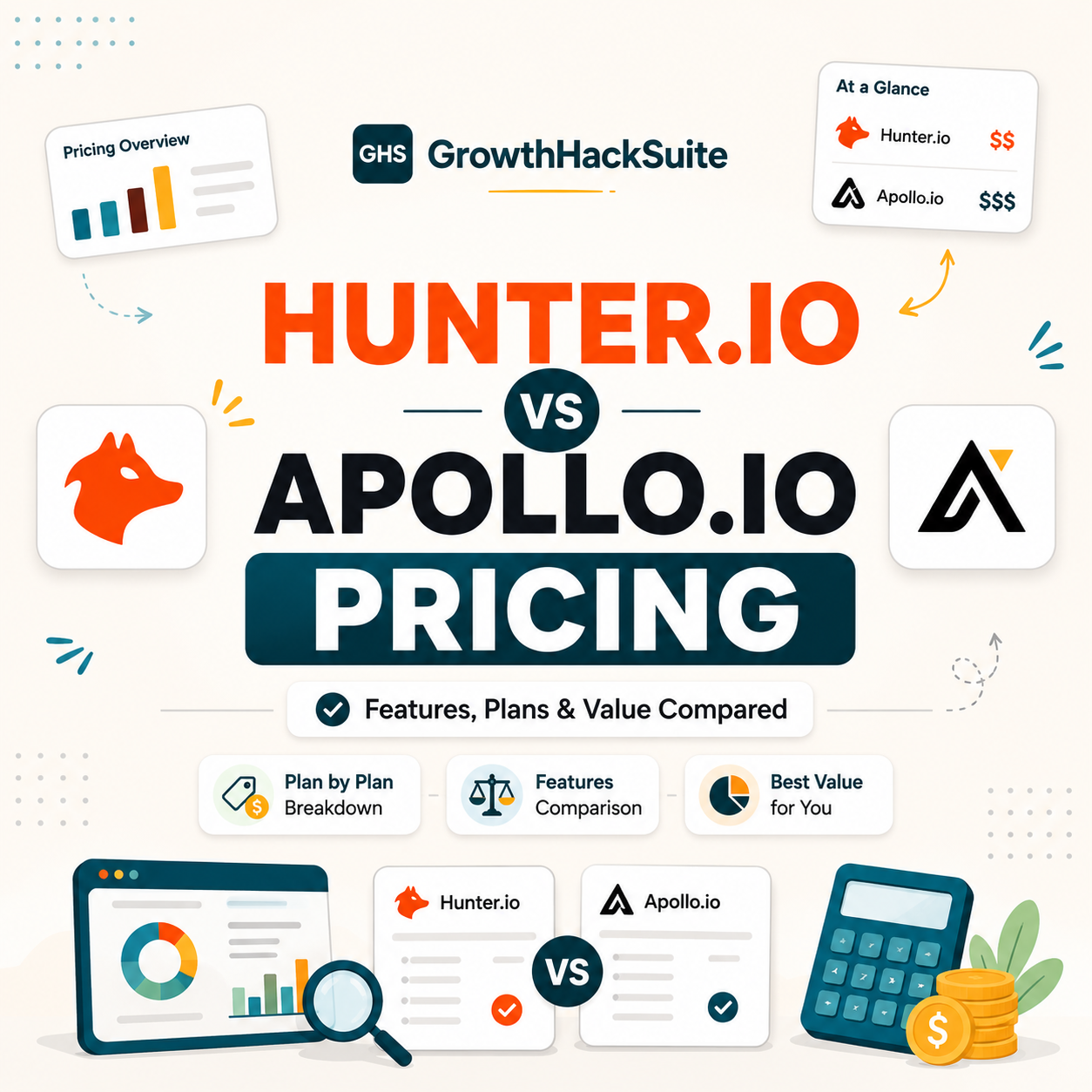
Hunter.io vs Apollo.io pricing works very differently on each side. Hunter.io charges per credit for email finding and verification with plans from a free 50-credit tier up to Scale at $209 monthly annual. Apollo uses a seat-based model that bundles a B2B database, sequencing, and CRM features, with paid plans starting around $49 per user per month. Hunter wins on pure verified-email cost; Apollo wins when database and sequences are bundled into the bill.
Table of Contents
Hunter.io vs Apollo.io Pricing at a Glance
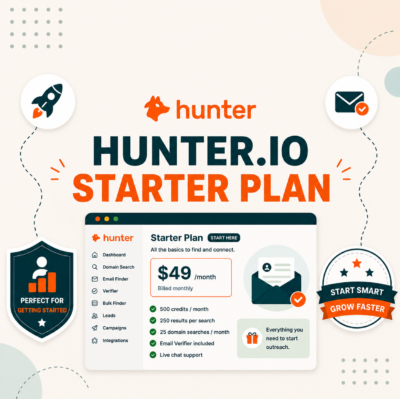
Hunter.io’s paid plans start at $34 per month on annual billing for Starter and climb to $209 for Scale, with credits as the usage unit. Apollo prices on seats with paid tiers typically starting around $49 per user per month annual, bundling a contact database and outbound sequencing alongside finder and verifier features.
Source: hunter.io/pricing verified June 2026; Apollo pricing from publicly listed tiers, may vary by promotion.
Direct comparison is misleading because the two platforms sell different things: Hunter sells credits, Apollo sells seats plus a database, which is why use case drives the real cost question.
How Do Hunter.io and Apollo.io Pricing Models Differ?
Hunter.io charges per credit for each action: one credit per find, half a credit per verification, and per email returned on Domain Search. Apollo charges per user seat at a monthly rate that includes a database of contacts, sequencing, and CRM functions, with additional usage limits inside the seat fee rather than separate credit costs.
- Credit versus seat basis: Hunter bills on credits consumed per action while Apollo bills on user seats with bundled monthly allowances, which makes per-lead math very different on each side.
- Database included or not: Apollo plans include access to its B2B contact database directly inside the seat; Hunter is a finder and verifier, not a contact database.
- Verification cost: Hunter charges half a credit per verification as an explicit line item; Apollo verifies within its platform but the cost is bundled into seat features rather than priced per call.
- Sequencing bundled: Apollo includes outbound sequencing and CRM in its standard seats, while Hunter charges separately for Campaigns recipients within its tier limits.
- Overage handling: Hunter sells one-time credit packs at higher per-credit rates; Apollo pushes users to higher seat tiers or add-on credits when usage exceeds plan allowance.
The model difference matters because the same monthly bill buys different bundles on each side, which is why direct dollar comparison alone never answers the cheaper question.
Which Has a Lower Cost Per Lead?
Cost per verified email is typically lower on Hunter.io because the platform is purpose-built for email finding and verification, with a clean per-credit denominator. Apollo’s per-lead cost is harder to isolate because the seat price covers database access and sequencing too, but on the email-only metric Hunter usually comes out ahead.
Source: hunter.io/pricing verified June 2026; Apollo bundle value depends on database and sequencing utilization.
Lower verified-email cost matters most for teams whose work centers on finding and validating addresses; Apollo’s bundle value matters more for teams that also use its database every day.
Which Is Cheaper for Low Volume?
For low-volume users Hunter.io is almost always cheaper. Its Starter plan at $34 annual or the permanent free tier with 50 credits per month beats Apollo’s minimum seat cost when monthly usage stays under a few thousand finds. Solo founders, freelancers, and early SDRs routinely pay less on Hunter at this scale.
Apollo only becomes competitive at low volume when the buyer also needs its database access; without that need, Hunter’s smaller bill is the obvious choice.
Which Is Cheaper at Scale?
At scale the answer depends on whether the team needs Apollo’s database. For pure verified-email volume Hunter.io Scale at $209 monthly annual delivers 25,000 credits at well below one cent per credit, which is hard to match on Apollo’s per-seat model. For teams that consume Apollo’s database, sequences, and CRM together the bundle value can rise above Hunter’s headline savings.
The deciding question at scale is bundle utilization rather than headline price, since paying for Apollo features that go unused is just as expensive as overbuying Hunter credits.
Apollo.io’s Database vs Hunter.io’s Accuracy: Value Trade-Off
Apollo sells breadth: a large B2B contact database, sequencing, and CRM in one seat. Hunter sells depth: accuracy on the find and verify actions, with deliverability as the primary value. The right tool depends on whether the team’s biggest cost driver is finding new contacts or making the contacts it has actually reach the inbox.
- Apollo database breadth: A pre-built B2B contact pool accessible inside the seat, useful when the team needs ongoing access to fresh accounts rather than verifying existing lists.
- Apollo CRM and sequences: Built-in outbound workflow including sequence builder and basic CRM features, which removes the need for separate sending and tracking tools.
- Hunter verification accuracy: Purpose-built verification that returns deliverability-confirmed addresses, with a published valid rate that supports cost-per-lead forecasting.
- Hunter deliverability focus: The platform optimizes for emails that reach the inbox, which directly lowers bounce rate and protects sender reputation across campaigns.
- True usable-lead cost: The decisive metric on both platforms, since unit price matters less than how many of the contacts produced actually convert into outreach pipeline.
The choice between sales tools should be guided by the specific data, automation, and integration needs of the buying organization rather than by headline price alone.
HubSpot, HubSpot sales engagement software guide
Breadth-versus-accuracy is the underlying trade, and it usually points to one platform clearly once the use case is named honestly.
Free Plan: Hunter.io vs Apollo.io
Both tools offer free plans, but they serve different purposes. Hunter.io’s free plan gives 50 finder and verification credits per month with no credit card required, ideal for testing accuracy. Apollo’s free tier provides limited database credits and basic sequencing access, ideal for sampling its breadth before committing to a seat.
Source: hunter.io/pricing verified June 2026; Apollo.io free tier details from publicly listed terms.
Running both free plans in parallel for a week is the cheapest way to confirm which platform fits the team’s real workflow.
Hidden Costs: Hunter.io vs Apollo.io
Both platforms have hidden cost patterns rather than hidden fees. On Hunter the traps are credit burn from Domain Search and no rollover on unused credits. On Apollo the traps are per-seat scaling as the team grows and data export caps that push upgrades. Knowing which pattern hurts most depends on the team’s workflow shape.
- Hunter credit burn: Wide Domain Searches and large bulk uploads consume credits faster than expected, with single calls sometimes spending many credits at once.
- Hunter no rollover: Unused credits expire each cycle, so paying for capacity that goes unspent is genuine waste rather than banked budget.
- Apollo per-seat scaling: Adding team members multiplies the seat fee linearly, which makes Apollo expensive fast for growing teams.
- Apollo export and data caps: Per-seat export limits and contact reveal caps push users toward higher tiers when database access becomes the daily workflow.
- Apollo upsell to higher tiers: Advanced sequencing, integrations, and analytics live behind premium tiers, so the entry seat usually does not cover the full feature set teams expect.
Neither side hides cost in the contract; both hide it inside usage habits the buyer controls, which means the comparison is really workflow versus workflow.
Which Tool Gives Better Value Per Dollar?
Hunter.io gives better value per dollar for verified email cost, while Apollo gives better value per dollar when its database, sequencing, and CRM are all actively used. There is no universally cheaper winner; the answer turns on which features the team will actually consume rather than which platform charges less at the headline level.
Verdict: For verified-email cost, Hunter usually wins per lead. For bundled database plus CRM, Apollo can be better value per dollar.
Match the platform to the workflow first, and the value question answers itself, which is why Hunter and Apollo coexist rather than compete head to head.
Growth Hack Suite, Hunter.io pricing guide
Better value is workflow-dependent, which is why most teams pick one tool decisively rather than treating it as a close call.
When Apollo.io Wins (and When Hunter.io Wins)
Apollo wins when the team needs a built-in B2B database, sequencing, and CRM in one bill. Hunter wins when the team prioritizes verified email accuracy, deliverability, and predictable per-credit cost. The choice is rarely about which is cheaper headline-to-headline; it is about which platform’s bundle matches the team’s actual prospecting motion.
- Need a built-in database: Apollo wins, since Hunter is a finder and verifier rather than a contact pool, which makes the database the deciding feature for teams without one.
- Need CRM and sequences in one tool: Apollo wins again, because bundled sequencing avoids buying a separate outreach platform alongside the email source.
- Pure email finding and verification: Hunter wins, with per-credit cost and verification accuracy that comes out ahead on the metrics that matter for clean outbound.
- Deliverability is the top priority: Hunter wins again, since its valid-rate and verification rigor are specifically built to lower bounce and protect sender reputation.
- Predictable monthly cost: Hunter wins for teams that prefer credit-based forecasting; Apollo’s seat-plus-overage model produces more variable monthly bills as usage grows.
Most teams know their answer the moment the database question is asked honestly; the rest of the comparison falls out naturally.
How Do You Choose Between Hunter.io and Apollo.io on Price?
The cleanest choice maps real needs first, then runs cost per lead on each platform against actual volume. Teams that need a database lean Apollo; teams that already have one or focus on accuracy lean Hunter. Trying both free plans before committing produces the most accurate cost picture for the specific workflow.
- Identify if you need a database or CRM: A built-in B2B database and bundled sequences only matter when the team will actually use them daily rather than once a month.
- Estimate monthly volume: Project the number of finds, verifications, and prospect lookups expected each month so the credit and seat math can be applied to real numbers.
- Calculate cost per lead on each: Apply each platform’s pricing to the expected monthly volume, including buffer for spikes, to land on a comparable per-lead figure rather than headline rates.
- Run both free plans in parallel: Test Hunter’s 50 free credits and Apollo’s free tier on the same sample prospect list to confirm accuracy and bundle utility before any commitment.
- Compare bundled-feature utilization: Audit which Apollo features the team will use daily versus monthly, since unused bundle value is the most common reason buyers overpay on seat pricing.
See Hunter’s full pricing before deciding.
Try Hunter.io Free →50 free credits per month, no credit card required
The wrong choice gets corrected by a bill at the end of the month; the right choice gets confirmed by usable leads through the cycle.
Try Hunter.io Free vs Apollo.io Free
Running both free plans in parallel for one week produces a clear picture of which platform fits the workflow. Test on the same sample prospect list, measure accuracy and usable-lead output on each, and compare against the team’s real needs. Whichever tool delivers more usable leads per credit or seat on the test set wins the cost question for that specific use case.
Start Hunter free and compare side by side.
Start Hunter.io Free →No card · Test accuracy and cost per lead on real data
For the full feature-by-feature comparison beyond pricing, see our deeper Apollo vs Hunter feature breakdown.
Related: Comparison and Pricing Guides
Hunter and Apollo are two of several B2B prospecting platforms worth comparing on price. The comparison framework that works for these two also applies to other matchups: map real workflow needs first, then run cost per lead on the platforms that fit those needs rather than benchmarking on headline rates.
Sales intelligence is information that salespeople use to make better-informed decisions, including prospect data, company data, and behavioral signals.
Wikipedia, Sales intelligence
Apollo and Hunter both fit the sales intelligence category, but they sit at opposite ends of it: Apollo as a broad platform, Hunter as a focused finder and verifier.
Hunter.io vs Apollo.io Pricing: Frequently Asked Questions
Is Hunter.io cheaper than Apollo?
For pure verified-email cost Hunter is often cheaper per usable lead. Apollo can be better value when the team also needs its database and CRM features.
How do Hunter and Apollo price differently?
Hunter charges per credit for each find and verification. Apollo uses seat-based plans that bundle a B2B database, sequencing, and basic CRM functions inside the per-user fee.
Which has a lower cost per lead, Hunter or Apollo?
Hunter typically wins on cost per verified email. Apollo’s per-lead value improves when its database and outreach tools are used together rather than for email finding alone.
Is Apollo’s free plan better than Hunter’s?
Apollo’s free tier includes database credits. Hunter’s free plan gives 50 verification and finder credits, which makes it the better choice for testing accuracy specifically.
Which is cheaper for a solo founder?
Usually Hunter. Starter at $34 monthly annual or the permanent free plan beats Apollo’s minimum seat cost for low-volume email finding without a database need.
Which is cheaper for a large team?
Apollo can be more cost-effective at scale when the team needs its database and CRM. Hunter stays cheaper on pure email volume thanks to shared credits across users.
Does Apollo include email verification like Hunter?
Apollo verifies within its platform, but Hunter is specialized for verification accuracy and deliverability with explicit per-credit pricing rather than bundled allowances.
What are the hidden costs of each tool?
Hunter has credit burn and no rollover. Apollo has per-seat scaling and data-export caps that push upgrades. Both are workflow-driven costs rather than contractual fees.
Should I pick Hunter or Apollo for cold email?
Pick Hunter for clean verified emails and predictable per-credit cost. Pick Apollo for an all-in-one database and sequencing. See the full Apollo vs Hunter feature comparison.
Can I use both Hunter and Apollo together?
Yes. Some teams source contacts in Apollo and verify with Hunter to cut bounce rate, though using both adds cost compared to picking one platform decisively.
Which tool has better data accuracy?
Hunter is known for verification accuracy and deliverability. Apollo offers breadth and bundled features rather than guaranteed accuracy. The full feature comparison covers the test data.
Is Hunter.io worth paying more than a cheaper rival?
Yes when deliverability matters. Accuracy lowers bounce and protects sender reputation, improving true ROI. The verdict in Is Hunter.io worth it covers when accuracy pays off.
Try Hunter.io Free, Compare Against Apollo.io’s Free Tier
The cleanest way to pick between Hunter and Apollo on price is to run both free plans against the same sample prospect list, measure real usable-lead output, and pick the platform whose bundle delivers more value for the team’s specific workflow. That parallel test produces a far more accurate cost answer than any headline price comparison.
Try Hunter free, compare Apollo’s free tier, then pick on real cost.
Hunter wins on verified-email cost; Apollo wins when database and sequencing both matter.
Start Hunter.io Free →No card · See the full Hunter.io pricing breakdown
Affiliate disclosure: links to Hunter.io on this page are affiliate links. The price is the same for you, and Growth Hack Suite may earn a commission if you sign up through them.