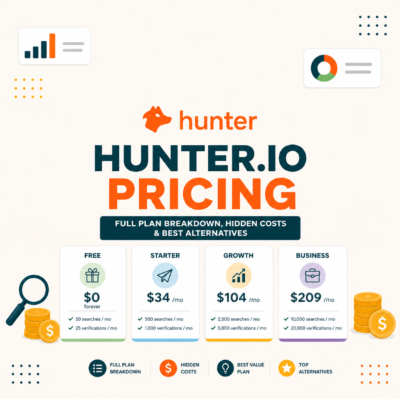
An annual SaaS discount lowers the price when a buyer pays for a full year upfront instead of monthly, typically 15 to 30 percent off the headline rate. Vendors offer it to secure revenue and reduce churn. Hunter.io’s annual discount is about 30 percent, cutting Starter from $49 to $34 monthly, Growth to $104, and Scale to $209, in exchange for a 12-month commitment.
What Is an Annual SaaS Discount?
An annual SaaS discount is a reduced subscription rate that vendors apply when the customer commits to and prepays for 12 months at once instead of paying month by month. The discount usually ranges from 15 to 30 percent, with higher figures appearing on tools that want to lock in long-term users.
- Prepay 12 months: The customer pays the full year upfront or commits to a year-long invoice schedule with monthly billing at the discounted rate.
- 15 to 30 percent off: Typical discount ranges, with most tools settling around 17 to 20 percent and aggressive vendors offering up to 30 percent.
- Locks the rate: Annual billing typically locks the per-month rate against mid-year price increases, providing budget certainty for the term.
- Reduces vendor churn: The discount trades a lower headline price for a longer customer relationship, which reduces churn risk on the vendor side.
- Trades flexibility for savings: The customer accepts reduced flexibility (no mid-year pause or downgrade without penalty) in exchange for the lower effective monthly cost.
Annual discounts are one of the most common SaaS pricing structures, applied across nearly every category of subscription tool.
Why Do Vendors Offer Annual Discounts?
Vendors offer annual discounts to secure predictable annual recurring revenue, reduce monthly churn risk, and improve cash flow by collecting 12 months of payment upfront. The discount cost to the vendor is more than recovered through the loyalty and predictability the longer commitment creates.
The economics work because retained annual customers are worth significantly more in lifetime value than the discount sacrifices in headline revenue.
What Is the Typical Annual Discount Range?
Most SaaS tools discount annual plans by 15 to 20 percent, the standard industry range. Aggressive plans push up to 30 percent, with tools like Hunter.io sitting at the higher end of typical discount territory to encourage long-term commitment from solo and team users.
Source: hunter.io/pricing and public SaaS pricing pages.
Hunter’s 30 percent sits at the aggressive end of typical SaaS discount practice, signaling strong interest in long-term retention.
How Does Hunter.io’s Annual Discount Work?
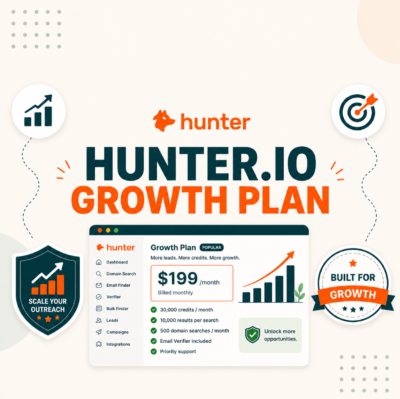
Hunter.io applies roughly a 30 percent annual discount across all paid tiers: Starter drops from $49 to $34 monthly, Growth from $149 to $104, and Scale from $299 to $209. Customers commit to 12 months and pay either upfront or via locked monthly billing at the discounted rate. See the Hunter.io annual versus monthly breakdown for full math.
Source: hunter.io/pricing.
The $1,080 annual saving on Scale is the largest absolute discount across Hunter’s tiers, making it the strongest annual-commitment case for agencies.
How Much Do You Actually Save?
Calculate true annual savings as (monthly rate times 12) minus (annual rate times 12). For Hunter Growth that produces $1,788 minus $1,248, equal to $540 per year saved by committing annually. The same formula applied to any SaaS tool reveals the dollar value of the commitment trade-off.
- Multiply monthly by 12: Calculate the total cost of staying on monthly billing for a full year as the headline monthly rate times twelve months.
- Multiply annual rate by 12: Calculate the total annual-billing cost as the discounted per-month rate times twelve months for the same 12-month period.
- Subtract the totals: Subtract annual total from monthly total to find the absolute dollar savings produced by committing to annual billing.
- Compare to break-even months: Divide annual total by monthly rate to find how many months of usage cover the annual prepayment.
- Factor in opportunity cost: Consider the cash that the annual prepayment ties up versus the absolute savings it produces over the year.
The five-step calculation turns the annual decision into deterministic math rather than gut-feel pricing comparison.
When Does the Annual Discount Pay Off?
An annual prepayment pays off immediately from month one if usage continues for the full 12 months, since the per-month rate is lower than monthly billing throughout. The break-even threshold for an early cancellation typically falls around month 8 or 9 on a 30 percent discount, after which monthly billing would have cost less in aggregate.
The break-even threshold is the practical cancellation cutoff: leaving before that point erases the annual savings.
What Are the Risks of Committing Annually?
Annual commitment trades cash savings for reduced flexibility, and the trade-offs matter for fast-changing teams. The risks include locked budget allocation, inability to pause during slow periods, limited refund terms, tool-fit changes within the year, and seasonal usage mismatches that leave the credit pool underused.
- Locked budget: The 12-month commitment ties up annual budget that could otherwise flex with team changes, reorganizations, or strategy shifts during the year.
- No mid-term pause: Most annual plans cannot pause for slow seasons or temporary team gaps, so the discount fee continues regardless of usage.
- Limited refund terms: Refund policies on annual prepayments are typically restrictive, often prorating remaining months rather than full reimbursement.
- Tool-fit risk: Tools that become wrong-fit mid-year still bill through the commitment term, since the discount was paid for the full period upfront.
- Seasonal mismatch: Workflows with strong seasonality (heavy in two quarters, light in others) can underuse the credit pool for the slow half of the year.
The risks favor monthly billing during evaluation and growth phases, even when the annual discount is mathematically attractive.
How Do Annual Discounts Affect Total Cost?
Annual discounts reduce the base subscription cost but only deliver savings to customers who actually use the tool for the full term. Underutilization erases the discount value, since unused credits or capacity still pay the same annual fee, raising effective cost per output above what monthly billing would have produced.
Subscription pricing models with annual prepayment options trade headline simplicity for vendor-side revenue predictability, and the discount level reflects how much the vendor values that predictability.
HubSpot, Sales operations resources
True cost includes both the headline discount and the utilization rate; high discounts on underused tools can still cost more per output than monthly billing.
How Do You Decide on Annual Billing?
Pick annual billing when usage will continue for at least 8 to 9 months at steady volume; pick monthly when in evaluation, growth, or organizational change. The decision rests on four measurable factors: commitment confidence, usage steadiness, dollar savings, and refund terms.
- Confirm 6+ months of commitment: Verify that the team and use case will continue using the tool for at least the break-even window before committing.
- Validate steady volume: Confirm that monthly usage is steady rather than seasonal, so the full annual capacity gets used across the year.
- Calculate dollar savings: Run the (monthly times 12) minus (annual times 12) calculation to quantify the actual savings produced by committing.
- Compare to break-even months: Identify the cancellation point past which annual costs less than monthly in aggregate, typically month 8 or 9.
- Check refund and downgrade terms: Read the vendor’s annual plan refund and mid-term downgrade policies before locking in the commitment.
The five-step framework prevents both over-committing (paying annually for tools that change fit) and under-committing (paying monthly for tools that will stay 12+ months).
How Does This Apply to Your Hunter.io Plan?
Hunter.io’s 30 percent annual discount delivers strong savings for teams that consistently use the credit pool month-over-month. Lock in annual billing after the first 60 to 90 days of confirmed Hunter usage; stay monthly while still validating fit during evaluation or organizational change.
Hunter.io’s 30 percent annual discount is at the aggressive end of SaaS pricing, which makes it the strongest ongoing cost-reduction lever for confirmed long-term users.
Growth Hack Suite, Hunter.io pricing guide
Lock the annual rate after confirming fit.
Try Hunter.io Free →Compare both billing modes on pricing
The discount is unconditional for users who stay 12 months; the trade-off is commitment confidence rather than dollar math.
Annual Discount Decision Checklist
Before choosing annual, confirm five points: commitment confidence, usage steadiness, calculated savings, refund terms read, and comparison to monthly run. Working the checklist takes about fifteen minutes and prevents both over- and under-commitment mistakes.
- Confirm 12-month commitment: Verify the team and use case will need the tool for the full year before paying upfront for the discount.
- Validate steady volume: Confirm monthly credit consumption is steady rather than seasonal, so the credit pool gets used evenly across months.
- Calculate dollar savings: Run the explicit (monthly times 12) minus (annual times 12) to quantify what the commitment actually saves.
- Check refund terms: Read the vendor’s annual refund policy and mid-term downgrade options to understand the trade-off completely.
- Compare to monthly run: Run a hypothetical 12 months on monthly billing as a baseline to confirm the annual discount produces genuine net savings.
The checklist takes fifteen minutes and prevents one expensive year of wrong-fit commitment.
Related Billing & Pricing Guides
Annual discount math interacts with credit pool sizing, refund terms, and tier choice. The full Hunter.io pricing guide covers all five tiers in monthly and annual modes for complete cost comparison.
The subscription business model is a recurring-revenue model in which customers pay a regular fee to access a product or service, often with discounts available for longer commitment periods such as annual billing.
Wikipedia, Subscription business model
Annual discounts are one of the most common monetization mechanics in the subscription economy, applied across nearly every SaaS category.
Annual SaaS Discount: Frequently Asked Questions
What is an annual SaaS discount?
A reduced subscription rate that vendors apply when the customer commits to and prepays for 12 months at once instead of paying month by month. Typical discounts range from 15 to 30 percent.
How much does Hunter.io’s annual plan save?
About 30 percent. Starter drops from $49 to $34 monthly, Growth from $149 to $104, and Scale from $299 to $209. See the Hunter.io annual versus monthly breakdown.
Why do SaaS tools offer annual discounts?
To secure predictable annual recurring revenue, reduce monthly churn risk, and improve cash flow by collecting 12 months upfront in exchange for a lower headline rate.
Is an annual discount always worth it?
Only if the tool gets used the full year. Cancelling early can erase the savings, since most refund policies prorate remaining months rather than refunding the full commitment.
When does the annual discount pay off?
From month one if the tool is used for the full 12 months. Leaving before roughly month 8 or 9 on a 30 percent discount erases the cumulative savings versus monthly billing.
What is the typical annual discount range?
Most SaaS tools offer 15 to 20 percent. Aggressive tools like Hunter.io go up to 30 percent. Below 10 percent is uncommon outside very large enterprise contracts.
What are the risks of paying annually?
Locked budget allocation, no mid-term pause, limited refunds, tool-fit changes within the year, and seasonal usage mismatch that underuses the credit pool.
How do I calculate my annual savings?
Multiply the monthly rate by 12 and subtract the annual rate times 12. The difference is the dollar savings annual billing produces over the year.
Does annual billing add more credits?
No. Annual billing only lowers the per-month price. Credit pool, account count, and recipient caps stay identical to the monthly version of the same tier.
Should I start annual or monthly?
Start monthly or on the free plan while validating fit and volume. Switch to annual once the team is confident the tool will stay for the full year. See the Hunter.io pricing guide for tier comparison.
Can I get a refund on an annual plan?
Refund terms vary by vendor and typically prorate remaining months rather than reimbursing the full commitment. See the Hunter.io refund policy for specifics.
Is Hunter.io’s 30 percent annual discount good?
Yes. It sits at the aggressive end of SaaS discount practice and is the strongest ongoing cost-reduction lever for users confirmed to stay 12 months.
Pick Annual After Confirming Fit
Hunter.io’s 30 percent annual discount delivers strong savings for confirmed long-term users. Start free or monthly first, then lock in annual billing after the team confirms steady usage.
Start free, then lock the annual rate.
Try Hunter.io Free → See Full Pricing →No card required for the free plan