Table of Contents
What is a spam trap? It is an email address used by mailbox providers and blocklists to catch senders with poor list hygiene. It looks like a normal address but belongs to no real person, so any mail to it signals a sender is reaching unverified data. Hitting one can blocklist a domain for weeks. This guide explains the types and how to avoid them.
Keep spam traps off your list — verify your addresses free.
Verify Your List Free →Free plan included · No credit card · Flags risky and invalid addresses
What Is a Spam Trap?
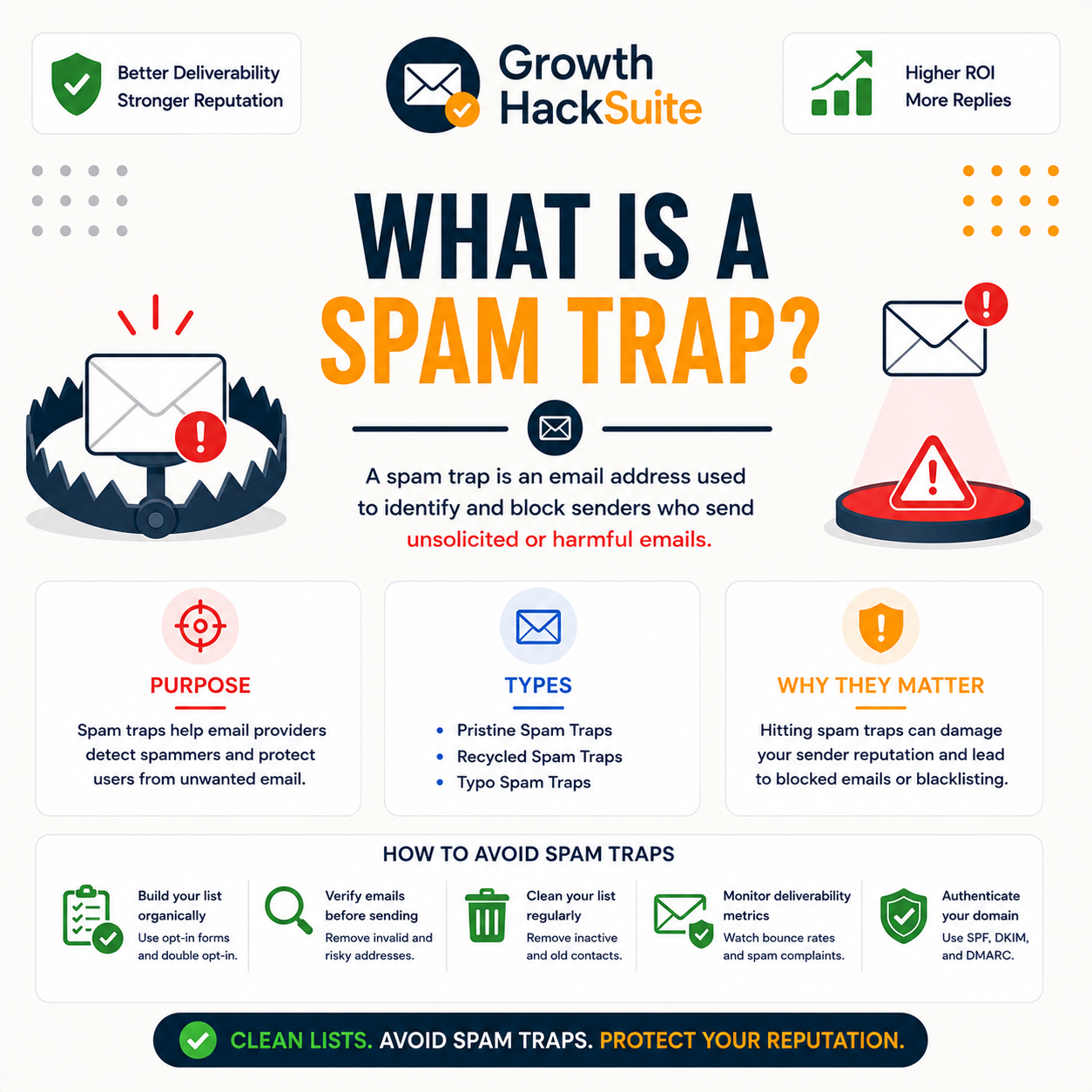
A spam trap is an email address created or repurposed by mailbox providers and anti-spam organizations to identify senders who do not maintain their lists. It looks like an ordinary address but belongs to no active person, so any message sent to it flags poor list hygiene. The trap exists only to expose senders mailing unverified or harvested data.
- Decoy address: A spam trap mimics a real inbox but accepts mail purely to record who sends to it. No human ever reads the messages, so the address measures sender behaviour rather than serving any genuine communication purpose.
- No real owner: Trap addresses belong to no active subscriber and were never knowingly handed to a sender. Mail reaching one therefore proves the address entered a list without consent or verification at some earlier stage.
- Hygiene signal: Each trap hit tells mailbox providers and blocklists that the sending domain mails addresses it cannot confirm. Repeated contact pushes that domain toward filtering, throttling, or outright blocklisting within their systems.
- Operator-controlled: Anti-spam organizations and large mailbox providers own and monitor trap addresses directly. They decide where traps live and how hits feed reputation scores, giving them a clean, deliberate signal of careless sending.
- Reputation weapon: A trap functions as a reputation penalty rather than a delivery failure. One contact can outweigh thousands of clean sends, because operators treat any hit as proof that a list contains unconfirmed data.
A spam trap is a decoy address — emailing one tells providers a sender is reaching unverified data rather than confirmed subscribers.
How Does a Spam Trap Work?
Anti-spam operators place trap addresses where only scrapers and careless list builders would find them, or convert abandoned mailboxes into traps. When a sender emails one, the operator records the hit against the sending domain and IP, using it as evidence of poor practice that feeds reputation scores and blocklist decisions.
- Placed or recycled: Operators seed pristine traps onto web pages where harvesters scrape, or reactivate long-dead mailboxes as recycled traps. Both routes guarantee the address only reaches lists built without permission or proper maintenance.
- Hit recorded: The moment mail arrives, the operator logs the sending domain, IP and timestamp. That record becomes a data point in blocklist databases that mailbox providers consult before accepting future mail.
- Evidence against sender: Accumulated hits form a pattern that anti-spam systems read as deliberate or negligent sending to unconfirmed addresses, triggering filtering, throttling or blocklisting that degrades inbox placement for every recipient.
- Shared across providers: Major blocklists publish trap-driven listings that many mailbox providers query in real time. A single hit recorded by one operator can therefore suppress mail across multiple receiving systems at once.
- Reputation compounding: Each recorded hit lowers domain and IP reputation, and lower reputation invites tighter filtering on subsequent sends. The damage compounds, so an unaddressed trap problem steadily worsens inbox placement over successive campaigns.
Traps are placed where only careless senders reach them, so one hit becomes recorded evidence against a sending domain.
What Are the Types of Spam Trap?
There are two main types of spam trap. Pristine traps are addresses never owned by a real person, created purely to catch spammers, and recycled traps are once-real addresses abandoned and reactivated as traps. Pristine traps reveal bought or scraped data, while recycled traps reveal poor list maintenance and aging subscribers.
Source: Spamhaus spam trap guidance and Validity sender resources, summarized 2026-06; trap categories are industry-standard definitions used by major blocklist operators.
Pristine traps expose bought data and recycled traps expose neglect, but both blocklist a domain on contact regardless of intent.
How Do Spam Traps End Up on Your List?
Spam traps arrive through purchased lists, scraped data, old un-maintained addresses, and signup forms without verification. Each path adds addresses no one confirmed, so a trap can sit unnoticed until a send triggers it. The common thread is unverified data entering the list, which is exactly what verification is designed to catch.
- Purchased or scraped: Bought and harvested lists carry pristine traps deliberately seeded where collectors operate. Acquiring addresses this way imports unknown contacts in bulk, dramatically raising the odds that a trap rides along undetected.
- Aged addresses: Subscribers who stop engaging may have their mailboxes abandoned and later reactivated as recycled traps. Lists that never suppress long-inactive contacts gradually accumulate these reactivated addresses over time.
- Unverified signups: Forms without validation or confirmed opt-in let typos, fake entries and malicious submissions through. A mistyped domain or planted trap address enters the list at the exact moment of collection.
- Appended data: Third-party append services that guess missing addresses from names and companies inject unconfirmed guesses into a list. Those appended records were never opted in, so traps slip through alongside the fabricated matches.
- Shared or co-registration: Addresses gathered through partner sign-ups, contests or co-registration deals often lack clear consent for a given sender. Importing them transfers another party’s hygiene problems, including any seeded traps, directly onto the new list.
Spam traps are addresses set up to identify senders mailing without permission.
— Hunter, email verification documentation
Every trap entry path shares one cause — unverified data — which verification closes before a send goes out.
How Much Damage Can a Spam Trap Cause?
A single pristine-trap hit can blocklist a domain for weeks, halting marketing and transactional mail alike, and recovery is slow. Because the cost is catastrophic rather than incremental, removing traps before sending is essential for any list built from external data. One mistake can undo months of sender-reputation work.
- Blocklisting: Hitting a major blocklist causes mailbox providers consulting it to filter or reject mail from the offending domain. The effect spreads beyond one campaign, suppressing every message including password resets and receipts.
- Slow recovery: Delisting requires fixing the underlying hygiene problem, requesting removal, and waiting for reputation to rebuild. The process can take weeks during which inbox placement stays degraded across the whole sending program.
One trap hit is a domain-level catastrophe rather than a minor dip, so prevention is the only sane option for any sender.
How Do Verifiers Help Avoid Spam Traps?
Verifiers cannot guarantee catching every pristine trap, but they remove the disposable, invalid and high-risk addresses that often accompany them, and flag suspicious patterns. By cleaning the unverified data traps hide in, verification sharply lowers trap risk before a send. Honest verifiers state this limit rather than promising total protection.
Verifying a list before the first send is the cheapest way to protect a sending domain.
— Growth Hack Suite, pre-send verification workflow
Verification removes most of the risky data traps hide in, making it the strongest single defense a sender can apply before a send.
How Common Are Spam Traps in Bought Data?
Purchased and scraped lists carry a meaningfully higher trap risk than opt-in lists, since traps are seeded exactly where scrapers collect. The older and less consensual the data, the higher the chance of a trap, which is why bought lists demand verification before any send, if they are used at all.
- Higher in bought data: Traps target the exact channels list sellers and scrapers use, so purchased data concentrates trap risk far above permission-based lists. Buying addresses effectively buys an unknown quantity of seeded traps alongside real contacts.
- Worse with age: Stale lists accumulate recycled traps as abandoned mailboxes get reactivated, and older harvested data sat longer in the wild. Time compounds both trap density and the general decay of address validity.
Bought and scraped data carry the highest trap risk, so verifying them before they ever go out is non-negotiable.
Spam Trap vs Invalid Address: What’s the Difference?
An invalid address simply bounces, while a spam trap accepts mail and reports you. That makes traps far more dangerous than invalids, because they actively damage reputation rather than just failing silently. An invalid wastes a send; a trap can blocklist an entire domain on a single contact.
Source: Spamhaus and Validity sender education resources, summarized 2026-06; behaviour reflects how blocklist operators and verifiers treat each address type.
Invalids just bounce while traps accept and report you, so that active harm makes the spam trap the bigger threat by far.
How Do You Avoid Spam Traps?
Avoid spam traps by building lists with permission, verifying before every send, never buying or scraping addresses, and applying a sunset policy to suppress long-inactive ones before they become recycled traps. Verification plus permission-based hygiene keeps trap risk near zero across every campaign.
- Permission-based building: Collecting addresses only through confirmed opt-in ensures every contact knowingly subscribed. This eliminates harvested and purchased data, the single largest source of pristine traps entering a list at scale.
- Verify before sending: Running every list through a verifier before a campaign removes disposable, invalid and high-risk addresses. The clean pass strips the unverified data that pristine and recycled traps typically hide within.
- Sunset inactives: Suppressing contacts who have not engaged for a defined period removes addresses heading toward abandonment. Retiring them early prevents once-valid subscribers from turning into recycled traps inside an active list.
- Use double opt-in: Requiring a confirmation click before activation filters out typos, bots and planted addresses at signup. The extra step blocks typo traps and fake entries from ever reaching the active subscriber list.
- Monitor engagement signals: Watching open, click and bounce trends surfaces segments decaying toward trap territory. Acting on falling engagement early lets a sender re-permission or suppress risky cohorts before any address flips into a recycled trap.
Scrub trap risk before you send — verify your list free.
Verify Your List Free →Free plan · No credit card · Removes risky and invalid addresses
Permission plus verification plus a sunset policy is the layered defense that keeps spam traps off a list for good.
What Tools Help Detect Spam Trap Risk?
Verifiers with disposable databases, risk scoring and role detection reduce trap-adjacent risk, though dedicated tools vary in depth. Hunter flags risky addresses with a free tier, while pure-play verifiers compete on bulk price. No tool detects every pristine trap, so the table compares trap-risk handling honestly.
Source: vendor product pages (hunter.io, zerobounce.net, neverbounce.com, validity.com), summarized 2026-06; confirm current free-tier terms on each provider before relying on them.
Depth of risk scoring is the differentiator across tools, because it directly lowers a sender’s exposure to traps before a campaign.
Verdict: How to Stay Clear of Spam Traps
A spam trap is a decoy that blocklists careless senders. No tool catches every pristine trap, but verification removes most of the risky data traps hide in, and permission-based building plus a sunset policy handle the rest. Verify before every send and never buy lists, and trap risk stays near zero.
Verdict: A spam trap is a decoy that blocklists careless senders. Two types matter — pristine traps expose bought data, recycled traps expose neglect — and one hit can blocklist a domain for weeks. No verifier catches every pristine trap, so layer verification, permission-based building and a sunset policy, and never buy lists.
A spamtrap is a honeypot used to collect spam.
— Wikipedia, Spamtrap
Verify your list free and avoid spam traps before your next send.
Verify Your List Free →Free plan · No credit card · Cleans risky data before it sends
Related Tools in the Hunter Stack
Spam traps tie directly to list hygiene and disposable addresses. The Hunter verifier resources cover risk scoring and how verification flags the data traps hide in, so cleaning a list before a send stays inside one connected workflow.
- Hunter Email Verifier: The validation layer that scores and flags risky addresses — start with what the Hunter Email Verifier is and its accuracy benchmark.
- Hunter Email Finder: The other half of the bundle for sourcing confirmed addresses — read the Hunter.io email finder review for permission-based list building.
Spam Traps: Frequently Asked Questions
The 12 most-asked questions about spam traps.
What is a spam trap?
A spam trap is an email address used by mailbox providers and blocklists to catch senders with poor list hygiene. It looks like a normal address but belongs to no real person, so any mail to it proves a sender is reaching unverified or harvested data rather than confirmed subscribers.
How does a spam trap work?
Anti-spam operators place trap addresses where only scrapers find them, or reactivate abandoned mailboxes as traps. When a sender emails one, the operator records the hit against the sending domain and IP, feeding blocklist databases that mailbox providers consult before accepting future mail.
What are the types of spam trap?
The two main types are pristine traps, addresses never owned by a real person and created to catch spammers, and recycled traps, once-real addresses abandoned then reactivated. Typo traps, registered on misspelled domains, form a third category. Pristine traps expose bought data; recycled traps expose neglect.
How do spam traps end up on my list?
Traps arrive through purchased lists, scraped data, old un-maintained addresses, and signup forms without verification. Each path adds addresses no one confirmed, so a trap can sit unnoticed until a send triggers it. The common thread is unverified data entering the list at some earlier stage.
How much damage can a spam trap cause?
A single pristine-trap hit can blocklist a domain for weeks, halting marketing and transactional mail alike, with slow recovery. Because the cost is catastrophic rather than incremental, removing traps before sending is essential for any list built from external or aged data.
How do verifiers help avoid spam traps?
Verifiers cannot guarantee catching every pristine trap, but they remove the disposable, invalid and high-risk addresses that often accompany them, and flag suspicious patterns. By cleaning the unverified data traps hide in, verification sharply lowers trap risk before any send goes out.
How common are spam traps in bought data?
Purchased and scraped lists carry meaningfully higher trap risk than opt-in lists, because traps are seeded exactly where scrapers collect. The older and less consensual the data, the higher the chance of a trap, which is why bought lists demand verification before any send.
Spam trap vs invalid address — what’s the difference?
An invalid address simply bounces, while a spam trap accepts mail and reports the sender. That makes traps far more dangerous, because they actively damage reputation rather than just failing. An invalid wastes a send; a trap can blocklist an entire domain on one contact.
How do I avoid spam traps?
Build lists with permission, verify before every send, never buy or scrape addresses, and apply a sunset policy to suppress long-inactive contacts before they become recycled traps. Verification plus permission-based hygiene keeps trap risk near zero across every campaign you run.
What tools detect spam trap risk?
Verifiers with disposable databases, risk scoring and role detection reduce trap-adjacent risk. Hunter flags risky addresses with a recurring free tier, while ZeroBounce, NeverBounce and Validity compete on scoring depth and bulk price. Depth of risk scoring is the practical differentiator between them.
Can verification catch every spam trap?
No. Verification cannot guarantee catching every pristine trap, which can look like a perfectly valid address. It does remove the disposable, invalid and high-risk data traps usually travel with, sharply lowering risk. Permission-based building and a sunset policy cover what verification alone cannot.
Are bought lists risky for spam traps?
Yes, bought lists are among the riskiest sources because traps are seeded where list sellers and scrapers collect. Purchasing addresses imports an unknown quantity of pristine traps alongside real contacts, which is why permission-based building is safer and verification is mandatory if bought data is used at all.