Table of Contents
Recycled vs pristine spam traps come down to origin. A pristine trap is an address never owned by a real person, created purely to catch spammers; a recycled trap is a once-real address abandoned and reactivated as a trap after long inactivity. Pristine traps expose bought or scraped data; recycled traps expose poor list maintenance. This guide explains the difference and how to avoid each one.
Avoid both trap types — verify your list with Hunter free.
Verify Your List Free →Free plan included · No credit card · Full status and scoring
Recycled vs Pristine Spam Traps: What Is the Core Difference?
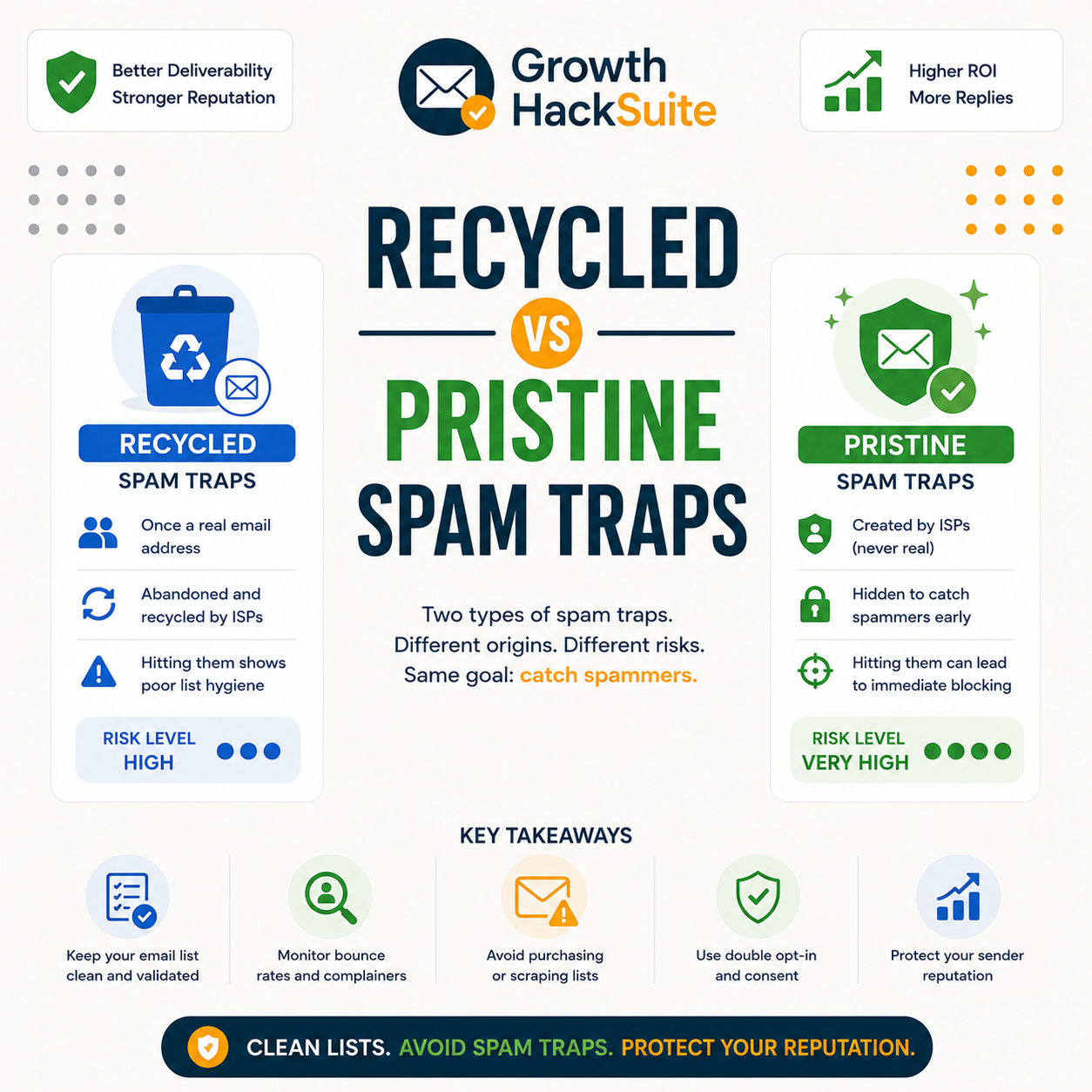
Recycled vs pristine spam traps differ by origin. A pristine trap was never used by a real person and exists only to catch spammers who scrape or buy data. A recycled trap was once a real mailbox, abandoned by its owner, left to bounce, then reactivated as a trap. Pristine catches harvested data; recycled catches neglected lists.
- Pristine: never real: A pristine spam trap address never belonged to a person and was never used to opt in anywhere. It is planted in hidden places online so only scrapers and list buyers ever collect it, making any mail to it proof of harvesting.
- Recycled: once real: A recycled spam trap address once belonged to a genuine subscriber who later abandoned it. After a long dormant period of hard bounces, the provider reactivates the address as a trap, so reaching it signals stale, un-reverified contact data.
- Origin defines the type: The single dividing line is whether a human ever owned the address. Pristine means no human history at all, while recycled means a real history that lapsed into abandonment before reactivation, and that origin drives every other contrast between them.
- Both signal data problems: A pristine hit signals harvested or purchased data, whereas a recycled hit signals neglected hygiene on legitimately sourced contacts. Each exposes a different failure, yet both warn a mailbox provider that the sender skipped basic list discipline somewhere.
- Same reputational outcome: Despite the different origins, both trap types feed the same blocklists and damage the same sending reputation. A domain hitting either kind risks listing, throttling and inbox placement loss across the major mailbox providers that consume trap data.
Pristine traps were never real, recycled traps once were, and that origin is the whole distinction between the two.
What Is a Pristine Spam Trap?
A pristine spam trap is an address created by an anti-spam operator that no real person has ever owned or opted in with. It is seeded in places only scrapers find, so any mail to it proves the sender harvested or bought addresses. It is widely treated as the most damaging trap type a sender can hit.
- Never opted in: A pristine trap address has no opt-in history because no human ever subscribed with it. Its presence on a list means the address arrived through scraping, buying or a third-party append, never through legitimate consent or a sign-up form.
- Seeded for scrapers: Operators hide pristine traps in page source, public directories and decoy listings designed to be collected only by automated harvesters. The seeding strategy ensures a hit reliably indicates non-consensual list building rather than an honest sender mistake.
A pristine trap proves harvesting, since no real person ever touched it, so any hit is damning evidence of bought or scraped data.
What Is a Recycled Spam Trap?
A recycled spam trap is an email address that once belonged to a real person but was abandoned, left to hard-bounce for a long period, then reactivated by the provider as a trap. Industry practice typically requires around twelve months of inactivity first. Emailing one shows a sender is reaching old, unmaintained data never re-verified.
- Once real: A recycled trap began as a working mailbox tied to a genuine person who opted in legitimately. The address only became a trap after that person stopped using it, so its history looks valid in older list records.
- Reactivated as trap: After a dormant window of hard bounces, the mailbox provider revives the address purely to detect senders mailing stale data. The reactivation turns a once-clean contact into a reputation hazard for anyone who never pruned it.
Verifying a list before the first send is the cheapest way to protect a sending domain.
— Growth Hack Suite, pre-send verification workflow
A recycled trap was a real address gone stale, so hitting one exposes unmaintained, un-reverified data sitting quietly on an old list.
How Does Each Trap Type Land on Your List?
Pristine traps enter a list through buying or scraping addresses, since they live only where harvesters look. Recycled traps enter when a sender keeps emailing an old address long after its owner abandoned it. The paths differ, but both trace back to the same root cause: skipping verification and clean sourcing.
- Pristine: bought or scraped: A pristine trap arrives whenever a list is purchased, rented, scraped from websites or appended from a shady third party. Because the address exists only in harvested sources, its appearance maps directly to non-consensual list acquisition.
- Recycled: stale data: A recycled trap appears when an old subscriber address is never pruned despite months of silence and bounces. Continued mailing to that dormant address eventually reaches it after the provider has converted it into a trap.
- Third-party appends: Buying enriched data or appending emails from an outside vendor frequently injects pristine traps, since those vendors often harvest the very public sources operators seed. Appended data carries trap risk that legitimate opt-in collection never introduces.
- Skipped sunset policy: Lists without a suppression rule for long-inactive subscribers keep mailing addresses that silently decay. Those neglected contacts are the exact population providers convert into recycled traps once a mailbox sits abandoned past the dormant threshold.
- Old imported lists: Re-importing an aged spreadsheet or migrating a years-old database without re-verification reintroduces addresses that may already have flipped to recycled traps. Stale imports are a common, overlooked source of trap hits on otherwise clean programs.
Pristine enters via bought data and recycled via stale data, yet both are verification failures with a shared underlying cause.
Which Trap Type Is More Damaging?
Both can blocklist a domain, but pristine traps are often treated as stronger evidence of bad practice, since hitting one means the address could only have come from harvesting. Recycled-trap hits suggest negligence rather than intent. A single pristine hit on a major blocklist can trigger listing fast, so either path is severe.
A single pristine trap hit can get a domain blacklisted immediately.
— Validity, spam trap guide
Pristine hits signal harvesting and recycled hits signal neglect, but both blocklist a domain and neither is survivable casually.
How Do You Avoid Pristine Traps?
Avoid pristine traps by never buying or scraping email addresses and by using only permission-based, opt-in data. Since pristine traps live exclusively in harvested sources, sourcing addresses ethically removes nearly all exposure to them. A confirmed sign-up process keeps these never-real decoys out of a list entirely.
- Never buy or scrape: Purchased lists, rented databases and scraped addresses are the only place pristine traps live. Refusing every bought or harvested source closes the single channel through which these never-real decoy addresses reach a sending list.
- Opt-in only: Permission-based collection through forms, double opt-in and genuine sign-ups guarantees every address came from a real person. Consent-first sourcing makes a pristine trap practically impossible, because no human would ever submit one voluntarily.
- Use double opt-in: A confirmation step that requires the new subscriber to click a verification link filters out invalid and planted addresses at sign-up. Double opt-in confirms a real inbox is behind every address before it ever enters a sending list.
- Avoid appended data: Email appends and enrichment vendors frequently pull from the same public sources operators seed with pristine traps. Skipping appended data entirely removes a common back door through which harvested addresses slip into an otherwise consent-based list.
- Honor form hygiene: Adding a honeypot field and basic validation to sign-up forms blocks bots that submit decoy addresses. Clean form capture keeps a sign-up flow from quietly ingesting the planted addresses that later read as pristine trap hits.
Pristine traps live only in harvested data, so opt-in sourcing removes almost all exposure to them in practice.
How Do You Avoid Recycled Traps?
Avoid recycled traps by re-verifying aging lists, applying a sunset policy that suppresses long-inactive addresses, and removing anything that has hard-bounced or gone silent. Because recycled traps form from abandoned addresses, retiring inactives before they convert into traps is the defense. Regular hygiene keeps a stale address from ever reaching trap status.
- Re-verify aging lists: Running older segments through a verifier before each major send catches addresses that have stopped responding. Periodic re-verification flags risky contacts early, well before a dormant mailbox can be reactivated as a recycled trap.
- Sunset inactives: A sunset policy automatically suppresses subscribers who have not opened or clicked across a defined window. Retiring those silent contacts removes the exact abandoned addresses that providers later convert into recycled traps.
Recycled traps form from abandoned addresses, so a sunset policy plus re-verification retires them before they convert.
Recycled vs Pristine Spam Traps: Side-by-Side
Pristine traps are never-real addresses from harvested data; recycled traps are once-real addresses from neglected lists. They enter differently and are avoided differently, though both blocklist a domain. The table below contrasts origin, entry path, relative danger and the defense that stops each one.
Source: Validity spam trap guide and Spamhaus deliverability resources, verified 2026-06-29. Recycled traps require a dormant period (industry standard ~12 months) before reactivation; pristine traps exist only in harvested sources.
Two Origins, One Reputation Risk
Pristine and recycled differ in origin and defense, but both demand verification and clean sourcing to keep off a list.
How Do You Avoid Both Trap Types?
Cover both by sourcing only opt-in data to stop pristine traps, verifying before every send, and re-verifying with a sunset policy to stop recycled traps. Verification removes the risky data both trap types hide in, while ethical sourcing and ongoing list maintenance close the entry paths that let either kind reach a list.
- Opt-in sourcing: Collecting every address through forms and confirmed sign-ups blocks pristine traps at the source, since these never-real decoys exist only in bought or scraped lists that consent-first collection never touches.
- Verify before sending: Running each list through a verifier flags syntax errors, dead mailboxes and risky addresses ahead of a campaign. Pre-send checks reduce exposure to both trap types and protect a domain reputation before any message goes out.
- Sunset and re-verify: Suppressing long-inactive subscribers and re-validating aging segments retires the abandoned addresses that become recycled traps. Routine hygiene keeps a once-clean contact from quietly converting into a reputation hazard over time.
- Monitor engagement signals: Tracking opens, clicks and bounces flags decaying contacts before they go fully dormant. Early engagement monitoring catches the slide toward abandonment that precedes a recycled trap, allowing suppression while the address still behaves like a real mailbox.
- Segment risky imports: Treating freshly imported or appended addresses as a quarantine segment until verified prevents pristine and stale-recycled risk from contaminating an established list. Isolating uncertain data limits the blast radius if any trap addresses slipped in.
Verify your list free to scrub both trap types before you send.
Verify Your List Free →Free plan · No credit card · Full status and scoring
Opt-in sourcing stops pristine and a sunset plus re-verify stops recycled, with verification underpinning the defense against both.
What Tools Help Against Spam Traps?
Verifiers with risk scoring and disposable detection reduce trap-adjacent risk, while ethical sourcing and list maintenance do the rest. Hunter flags risky addresses and offers a recurring free tier for ongoing checks. The table compares how leading verifiers handle trap-risk signals so the right hygiene tool is clear.
Source: Vendor verification documentation (Hunter, ZeroBounce, NeverBounce, Kickbox), verified 2026-06-29. Free-tier terms change; confirm current allowances on each provider’s site before relying on them.
Risk-scoring depth lowers trap exposure, but no tool replaces clean sourcing and steady list maintenance as the core defense.
Verdict: Recycled vs Pristine Spam Traps
Pristine traps were never real and expose bought or scraped data; recycled traps were once real and expose neglected lists. Both blocklist a domain. Avoid pristine by never buying or scraping, avoid recycled by re-verifying and sunsetting inactives, and verify before every send to cover both at once. Origin is the whole difference.
Verdict: Pristine traps are never-real addresses that expose bought or scraped data and can trigger a blocklist instantly. Recycled traps are once-real addresses, dormant for roughly 12 months, that expose neglected lists. Stop pristine with opt-in sourcing, stop recycled with a sunset policy, and verify before every send.
A spamtrap is an email address used to catch senders of unsolicited mail.
— Wikipedia, Spamtrap
Verify your list free and avoid both trap types before they cost you a domain.
Verify Your List Free →Free plan · No credit card · Results decide
Related Tools and Reading on Spam Traps
Understanding trap types is one piece of list hygiene; verifying and maintaining a list is the other. The verifier accuracy benchmark covers how risk scoring catches trap-adjacent addresses, and the verification basics explain the underlying check that keeps both trap types off a list.
- Verifier accuracy: How risk scoring catches trap-adjacent and risky addresses — see the Hunter Email Verifier accuracy benchmark for the test details.
- Verification basics: The core check that keeps both trap types off a list — read what email verification is for the fundamentals.
- Bounce reduction: The pre-send workflow that cuts bounces and trap hits together — follow the reduce email bounce rate guide to apply it.
Recycled vs Pristine Spam Traps: Frequently Asked Questions
The 12 most-asked questions about recycled vs pristine spam traps.
What’s the difference between recycled and pristine spam traps?
The difference is origin. A pristine spam trap is an address that was never owned by a real person and exists only to catch harvesters. A recycled spam trap was once a real mailbox, abandoned by its owner, then reactivated as a trap after a long dormant period.
What is a pristine spam trap?
A pristine spam trap is an address created by an anti-spam operator that no real person ever owned or opted in with. It is seeded in hidden places online so only scrapers find it, meaning any mail to it proves the sender harvested or bought addresses.
What is a recycled spam trap?
A recycled spam trap is an email address that once belonged to a real person but was abandoned, left to hard-bounce for a long period, then reactivated by the provider as a trap. Industry practice typically requires around twelve months of inactivity before reactivation.
How does each type land on my list?
Pristine traps enter through buying or scraping addresses, because they live only where harvesters look. Recycled traps enter when a sender keeps emailing an old address long after its owner abandoned it. The paths differ, but both trace back to skipping verification and clean sourcing.
Which trap type is more damaging?
Pristine traps are often treated as stronger evidence of bad practice, since hitting one means the address could only have come from harvesting. A single pristine hit on a major blocklist can trigger listing fast. Recycled-trap hits suggest negligence, but both are severe for a domain.
How do I avoid pristine traps?
Avoid pristine traps by never buying or scraping email addresses and by using only permission-based, opt-in data. Since pristine traps live exclusively in harvested sources, sourcing addresses ethically removes nearly all exposure. A confirmed sign-up process keeps these never-real decoys out of a list entirely.
How do I avoid recycled traps?
Avoid recycled traps by re-verifying aging lists, applying a sunset policy that suppresses long-inactive addresses, and removing anything that has hard-bounced or gone silent. Because recycled traps form from abandoned addresses, retiring inactives before they convert is the defense against them.
Recycled vs pristine side by side?
Pristine traps are never-real addresses from harvested data, signalling intentional harvesting and carrying the highest danger. Recycled traps are once-real addresses from neglected lists, signalling poor maintenance. Pristine is stopped by opt-in sourcing; recycled is stopped by a sunset policy plus re-verification of aging segments.
How do I avoid both types at once?
Cover both by sourcing only opt-in data to stop pristine, verifying before every send, and re-verifying with a sunset policy to stop recycled. Verification removes the risky data both trap types hide in, while ethical sourcing and list maintenance close the entry paths for either kind.
What tools help against spam traps?
Verifiers with risk scoring and disposable detection reduce trap-adjacent risk, while ethical sourcing and list maintenance do the rest. Hunter flags risky addresses and offers a recurring free tier; ZeroBounce, NeverBounce and Kickbox provide similar scoring. No tool replaces clean sourcing and steady hygiene.
Do both types blocklist a domain?
Yes. Both pristine and recycled trap hits can lead to a domain or IP being listed on a major blocklist. Pristine hits can trigger listing immediately because they prove harvesting, while recycled hits signal negligence. Either way, the reputation damage to deliverability can be severe and lasting.
Can verification catch spam traps?
Verification cannot detect a live spam trap directly, since a trap accepts mail like a normal mailbox. It does catch the risky signals around them, flagging dead, disposable and unmaintained addresses that often sit near traps, and re-verifying aging lists retires the inactives that become recycled traps.