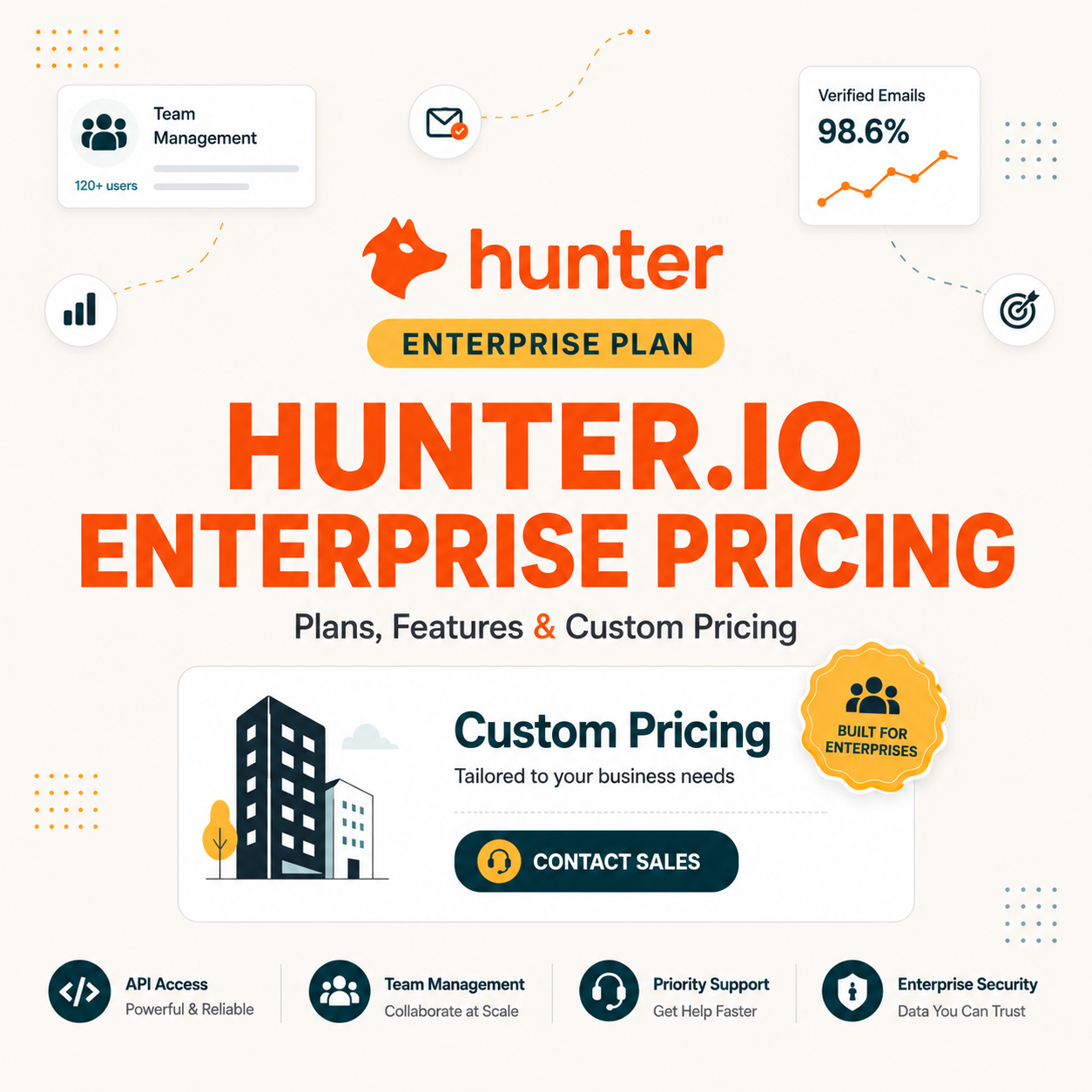
Hunter.io Enterprise pricing is custom rather than published, quoted based on monthly credit volume, number of seats, API throughput, and compliance scope. It typically starts above the Scale plan’s $299 per month rate and scales with volume, while adding SLA uptime guarantees, advanced compliance terms, SSO, dedicated onboarding, and an account manager that the published tiers do not include.
Table of Contents
What Is the Hunter.io Enterprise Plan?
The Hunter.io Enterprise plan is the highest tier on the platform, designed for organizations whose credit volume, seat count, or compliance requirements exceed what the published Scale plan covers. It bundles custom credit allowances, dedicated onboarding, SLA-backed uptime, and advanced security features into a contractually negotiated package rather than a self-serve subscription.
- Custom credit volume: Monthly credits are negotiated rather than fixed at 25,000, suited to teams that consistently consume more during peak prospecting cycles.
- Custom seat count: Connected sending accounts scale beyond the Scale plan’s 20-account cap, accommodating multi-department or multi-region sales operations.
- Dedicated onboarding: A hands-on implementation process with technical and sales support, reducing the time required to integrate Hunter into existing CRM and outbound workflows.
- SLA uptime guarantee: Contractual service-level agreements covering API availability and platform uptime, the level of reliability regulated buyers require.
- Advanced compliance and SSO: Data processing agreements, security review documentation, single sign-on, and granular access controls included as standard rather than upsells.
Enterprise is positioned as Hunter’s contractual tier where pricing, terms, and security become negotiable instead of off-the-shelf.
How Is Hunter.io Enterprise Pricing Determined?
Hunter.io Enterprise pricing is determined by five quote-driving factors: monthly credit volume, number of seats, API throughput requirements, compliance scope, and support level. Each factor independently raises the quote, which is why no two Enterprise contracts cost exactly the same even at similar volumes.
- Monthly credit volume: The base driver of cost, with quotes scaling beyond the Scale tier’s 25,000-credit ceiling toward whatever monthly volume the buyer needs.
- Number of seats: Connected sending accounts and user seats above the 20-account Scale cap, priced per unit beyond the platform default.
- API throughput requirements: Higher request ceilings on the public API for automated enrichment workflows, with rate limits negotiated for continuous integration loads.
- Compliance scope: Data processing agreements, regional residency, and security review depth add cost based on how heavily regulated the buying organization is.
- Support level: Dedicated account management, custom SLAs, and named technical contacts move pricing further above the Scale baseline.
Quote variance is normal because Enterprise pricing reflects real organizational requirements rather than a public list.
Who Needs the Hunter.io Enterprise Plan?
Enterprise fits large sales organizations, regulated industries, multi-department RevOps teams, and high-API integration buyers whose requirements exceed the Scale plan’s ceiling on credits, seats, or contractual terms. It is rarely the right choice for any team whose monthly volume still fits cleanly inside Scale’s 25,000-credit and 20-account boundaries.
- Large sales organization: Outbound teams of dozens of reps where total monthly credit consumption climbs past 25,000 and connected accounts pass 20 across regions.
- Regulated industry buyer: Finance, healthcare, or government-adjacent teams that require DPAs, residency, or audited security reviews before adopting any vendor.
- Multi-department RevOps: Companies where sales, marketing, and customer success each consume Hunter credits, with central procurement requiring one contract and SSO.
- High API integration user: Engineering teams piping Hunter into automated CRM and lead-scoring pipelines where API rate ceilings on Scale start to throttle production load.
- Procurement-driven buyer: Organizations whose purchase decisions go through formal procurement, where annual contracts, MSAs, and net-30 terms are non-negotiable.
Enterprise is the correct tier when compliance, contractual flexibility, and very high volume become procurement requirements rather than nice-to-haves.
Scale vs Enterprise: What You Gain
Enterprise adds custom credit volume, custom seat count, contractual SLAs, advanced compliance terms, dedicated onboarding, and a named account manager on top of Scale’s 25,000 credits and 20 connected accounts. Scale is a published tier at a fixed price; Enterprise is a contractual relationship priced on the specific organizational requirements.
Source: hunter.io/pricing verified June 2026.
The Scale-to-Enterprise jump is about contractual capabilities first and raw volume second, which is why most upgrades trigger on a compliance or SLA requirement rather than a credit ceiling.
What Enterprise Adds: SLA, Compliance, and API Throughput
Enterprise adds an uptime SLA guarantee, advanced compliance documentation, higher API rate limits, single sign-on, and a dedicated account manager on top of every feature already included in Scale. These additions are the contractual proof points that regulated and enterprise procurement teams need before any vendor contract is signed.
- SLA uptime guarantee: A contractual platform-availability commitment with defined credits or remedies if uptime falls below the agreed percentage.
- Advanced compliance and DPA: A formal data processing agreement plus the security review documentation procurement teams require for vendor due diligence.
- Higher API rate limits: Lifted public-API request ceilings that sustain always-on CRM enrichment loads without throttling during peak hours.
- Single sign-on and access control: SSO integration with the company identity provider and granular role-based permissions across the Hunter workspace.
- Dedicated account management: A named technical contact and account manager for renewals, escalations, and roadmap input, available only at the Enterprise tier.
Enterprise-only features are exactly the items procurement reviews flag as required, which is why this tier exists at all instead of a larger Scale variant.
How Much Does Hunter.io Enterprise Cost?
Hunter.io does not publish Enterprise pricing because every quote depends on the organization’s credit volume, seat count, API needs, and compliance scope. The practical starting point sits above the Scale plan’s $299 monthly rate, and quotes climb from there based on which factors push the most weight in the contract.
Source: hunter.io/pricing verified June 2026.
Treat the published Scale rate as the floor and price up from there based on which factors apply, since Hunter’s sales team builds every quote on that same starting point.
Hunter.io Enterprise Onboarding and Dedicated Support
Enterprise onboarding includes a guided technical implementation, custom integration support for CRM and outbound stacks, and an assigned account manager from day one. The objective is to compress time-to-value for large teams whose internal processes would otherwise slow Hunter adoption across multiple departments.
Self-serve setup is fine for Scale and below, but it becomes a real cost for organizations whose security and procurement steps run weeks long before any tool actually goes live.
Is the Hunter.io Enterprise Plan Worth It?
Enterprise is worth it for buyers whose compliance, SLA, or volume requirements make Scale infeasible. For everyone else Scale delivers most of the platform value at a fraction of the price, and the additional Enterprise features go unused. The decision turns on procurement and compliance, not on raw credit volume alone.
Verdict: Enterprise is worth it only when compliance, SLAs, or volume above 25,000 credits are non-negotiable; otherwise Scale delivers most of the value.
The right Hunter.io tier is the one whose contractual capabilities match procurement requirements, and Enterprise is that tier the moment SLAs and compliance turn into hard prerequisites.
Growth Hack Suite, Hunter.io pricing guide
Enterprise is a procurement tier first and a volume tier second; treating it any other way usually leads to overspending without using the contractual extras.
Security and Compliance on Hunter.io Enterprise
Hunter.io Enterprise wraps security and compliance into the contract itself: a data processing agreement, GDPR-aligned handling commitments, access controls, and security review documentation. These are the items that turn Hunter from a useful tool into an approvable vendor for regulated buyers and procurement-led purchases.
Hunter processes publicly available email addresses while maintaining strict adherence to privacy regulations including GDPR and CAN-SPAM, and provides a data processing agreement for customers that require one.
Hunter, Hunter security and compliance
Compliance language in the contract is often the deciding factor in whether Enterprise gets approved by procurement teams that would otherwise block any cold-outreach tool.
How to Negotiate Hunter.io Enterprise Pricing
The strongest negotiating position on Enterprise pricing comes from arriving with a real volume estimate, the Scale annual rate as a benchmark, and a multi-year intent. Buyers who anchor on Scale’s $209-per-month annual rate generally land closer to a fair quote than those who let sales set the starting point alone.
- Estimate real credit volume: Run a representative month on Scale to capture true monthly credit consumption, then use that figure as the basis for the Enterprise quote rather than a forecast.
- Anchor on Scale annual: Quote the $209 monthly Scale annual rate as the procurement benchmark, since any Enterprise pricing above that needs to be justified by named contractual additions.
- Ask for multi-year discounts: Commit to two or three years upfront in exchange for a lower per-credit rate, which sales teams will typically offer to stabilize annual recurring revenue.
- Bundle seats together: Combine sales, marketing, and customer success seats into one contract rather than negotiating each department separately, which lowers the per-seat rate at scale.
- Lock the SLA precisely: Define the specific uptime percentage, response times, and remedy structure required, since loose SLA language is where most buyer leverage gets lost.
Negotiation outcomes follow preparation: buyers who walk in with usage data and a clear benchmark consistently land better Enterprise terms than those who do not.
How to Request a Hunter.io Enterprise Quote
Requesting an Enterprise quote starts with contacting Hunter’s sales team directly, ideally with a one-page brief covering expected monthly credit volume, seat count, API throughput, and any specific compliance requirements. Running Scale in parallel while the quote is finalized prevents the team from sitting idle waiting for a contract to close.
Need custom volume? Start on Scale today and request an Enterprise quote.
Start Hunter.io Free →Validate volume on Scale before locking an Enterprise contract
Treat the quote process as a parallel workstream rather than a blocker, since Hunter’s published tiers cover the team during contract negotiation.
Should You Start on Scale Before Enterprise?
Starting on Scale before committing to Enterprise is the safer move for any team whose actual usage is still uncertain. Running a real Scale month produces the volume data the Enterprise quote requires, and the upgrade path from Scale to Enterprise is straightforward once the numbers prove the case.
Start free or on Scale, upgrade to Enterprise when contracts demand it.
Start Hunter.io Free →No card · Move to Scale or Enterprise when ready
Software as a service is a software licensing and delivery model in which software is licensed on a subscription basis and is centrally hosted.
Wikipedia, Software as a service
The freemium-to-enterprise ladder works in Hunter’s favor and the buyer’s: data accumulates on lower tiers, then a justified Enterprise contract follows.
Related Hunter.io Plans and Pricing
Enterprise sits at the top of the five-tier ladder: free, Starter, Growth, Scale, and Enterprise. Every published tier remains available alongside Enterprise, so a buyer running an Enterprise contract for sales can still let small teams test on free or Starter without complicating the main agreement.
The ladder is intentional: lower tiers prove the platform, Enterprise turns it into approved infrastructure.
Hunter.io Enterprise Pricing: Frequently Asked Questions
How much does Hunter.io Enterprise cost?
Enterprise pricing is custom and not published. It is quoted on credit volume, seats, API throughput, and compliance scope, with practical starting points above the Scale plan’s $299 monthly rate.
How is Hunter.io Enterprise pricing calculated?
By monthly credit volume, number of seats, API needs, and compliance requirements. Each factor raises the quote independently, so similar organizations can land at different prices based on their exact mix.
What does Enterprise add over the Scale plan?
Custom credit volume and seats, contractual SLA uptime, advanced compliance with DPA, higher API rate limits, SSO and access controls, and a dedicated account manager that Scale does not include.
Who should buy the Hunter.io Enterprise plan?
Large sales organizations exceeding 25,000 credits a month, regulated industry buyers, or teams whose procurement and security review require formal DPAs, SSO, and bespoke SLAs.
Is Hunter.io Enterprise worth it?
Only when contractual compliance, SLAs, or volumes above 25,000 credits are non-negotiable. Otherwise the Scale tier in the full pricing guide delivers most of the value for far less.
Does Enterprise include a dedicated account manager?
Yes. Enterprise contracts include dedicated onboarding and a named account manager for renewals, escalations, and roadmap input, which Scale and lower tiers do not provide.
Can I negotiate Hunter.io Enterprise pricing?
Yes. Arrive with real volume estimates, use the Scale annual rate as a benchmark, and ask about multi-year or seat-bundle discounts, which sales teams commonly offer for committed contracts.
Does Hunter.io Enterprise support SSO and DPA?
Yes. Enterprise typically adds single sign-on, granular access controls, and a contractual data processing agreement, which are the standard procurement requirements for regulated buyers.
How do I get a Hunter.io Enterprise quote?
Contact Hunter sales with monthly credit volume, seat count, and compliance needs. Running the Scale plan in parallel keeps the team operational while the quote and contract are finalized.
Is Enterprise overkill for a small agency?
Usually yes. Most small agencies are well served by Scale; Enterprise makes sense at large, regulated, or high-API integration volumes that exceed what Scale’s fixed tier supports.
Does Enterprise offer credit rollover?
Credit rollover is negotiated per contract on Enterprise. Standard Hunter plans do not roll credits over to the next billing cycle, but Enterprise agreements can include custom terms.
Should I start on Scale before Enterprise?
Yes when volume is uncertain. Start on Scale within the full pricing breakdown, track real usage, then move to a custom Enterprise quote once the numbers justify the contractual upgrade.
Start Free or on Scale, Upgrade to Enterprise When Volume Demands It
The smartest path into Enterprise is to validate Hunter on the free plan first, scale through Starter, Growth, and Scale as volume grows, and only request an Enterprise quote once contractual requirements or 25,000-credit ceilings genuinely block the team. That ramp produces the volume evidence Enterprise sales teams need to deliver a fair quote.
Validate volume on Scale, request Enterprise when contracts demand it.
Enterprise quotes start above the $299 monthly Scale rate and scale with your specific requirements.
Start Hunter.io Free →No card · Move to Scale anytime · See the full Hunter.io pricing breakdown
Affiliate disclosure: links to Hunter.io on this page are affiliate links. The price is the same for you, and Growth Hack Suite may earn a commission if you sign up through them.