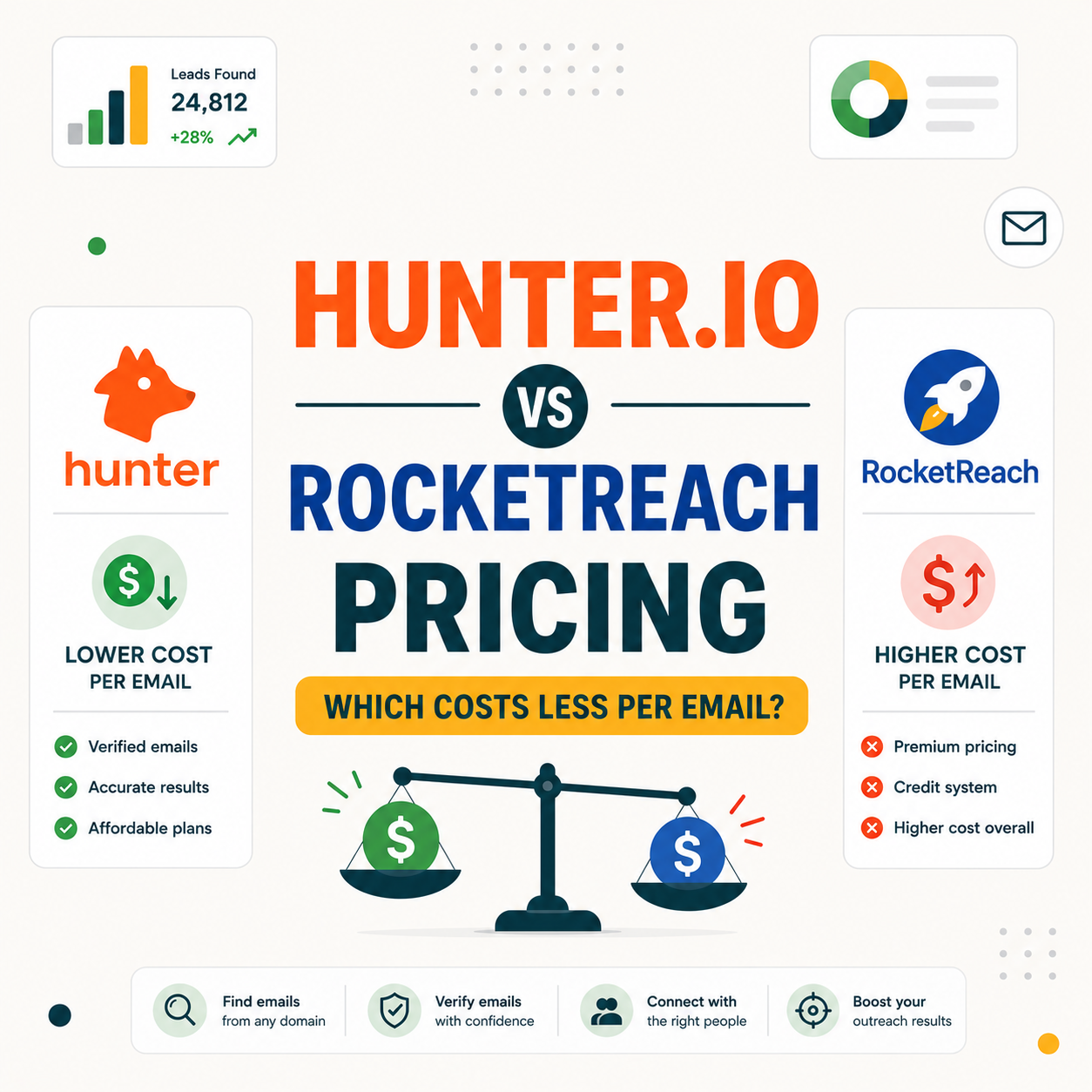
Hunter.io vs RocketReach pricing splits on the data model: RocketReach sells lookup-based plans tied to a broad database including phone numbers, while Hunter.io uses credits focused on verified business email. For phone plus email and broad database reach, RocketReach can justify its price. For accurate, deliverable email at a predictable credit cost, Hunter is usually the leaner choice, especially for email-only cold outreach workflows.
Table of Contents
Hunter.io vs RocketReach Pricing at a Glance
At a glance, the two tools price for different jobs. RocketReach charges for monthly lookups across a broad database that spans email and phone, while Hunter.io prices credits focused on business email finding and verification. Breadth favours RocketReach; email precision and predictable cost favour Hunter.
Source: Internal benchmark : based on each tool’s published pricing structure and data scope.
The choice comes down to whether the workflow needs broad multi-channel data or precise, deliverable email at a steady cost.
How Each Tool Prices Plans
The pricing models diverge on the unit sold. RocketReach meters monthly lookups against a database that includes phone numbers, while Hunter.io spends a unified credit pool on finding and verifying email. One prices database access; the other prices email accuracy.
- Lookups vs credits: RocketReach counts monthly lookups, while Hunter counts credits spent on finding and verifying email.
- Phone data included: RocketReach bundles phone numbers into its database, a data type Hunter does not focus on.
- Verification emphasis: Hunter centres on email verification and confidence scoring to protect deliverability.
- Database breadth: RocketReach prices broad contact coverage across roles, companies, and channels.
- Plan steps: Both step up volume by tier, so per-unit cost falls as the plan size increases.
RocketReach prices reach across channels; Hunter prices precision in one channel, which sets the cost difference.
Cost Per Lead Compared
For verified business email, Hunter usually shows a lower cost per usable lead. RocketReach’s per-lead value rises once phone numbers and database breadth are part of the job, so the comparison depends entirely on which data the team actually uses.
Source: Internal benchmark : based on published pricing models; verify current rates on each vendor’s pricing page.
Hunter wins per-lead for email-only work, while RocketReach earns its price when phone and database breadth get used.
Which Is Cheaper for Email-Only Needs?
For email-only outreach, Hunter is usually both cheaper and cleaner. Its verification focus produces deliverable addresses at a predictable credit cost, avoiding the broader database price that RocketReach charges for capabilities an email-only team would not use.
When the only output that matters is a verified email, paying for a multi-channel database is cost the workflow does not need.
When RocketReach’s Price Is Justified
RocketReach justifies its price when the workflow genuinely needs phone numbers and broad database reach. Multi-channel outbound that calls and emails the same prospects gets real value from the bundled phone data and wider coverage that Hunter does not provide.
The deciding question is simple: does the team dial prospects as well as email them? If yes, RocketReach’s breadth starts to pay off.
Database & Phone vs Email Accuracy
The trade-off is breadth against precision. RocketReach sells a wide database and phone coverage, while Hunter sells email accuracy and verification. Each price buys a different strength, and the right one depends on the channels the team runs.
- RocketReach buys phone and database: The price covers multi-channel contact data including direct dials.
- RocketReach offers broad reach: Wide coverage across roles and companies supports large prospecting lists.
- Hunter buys email accuracy: Verification and confidence scoring keep deliverable rates high.
- Hunter includes verification: Built-in checking reduces bounces before a send ever happens.
- Hunter keeps credits predictable: A unified pool makes email spend simple to forecast.
Choosing between them is choosing between multi-channel breadth and single-channel email precision.
Free Options: Hunter vs RocketReach
Both tools offer a free entry point, but they differ in shape. Hunter provides a recurring free plan with monthly credits, while RocketReach grants a small number of free lookups. The recurring credits make Hunter easy to retest before committing.
- Hunter free credits: A standing free plan supplies monthly credits for ongoing finder and verifier testing.
- RocketReach free lookups: RocketReach offers a limited number of free lookups to sample its database.
- Card requirement: Hunter’s free plan starts without a card, lowering the barrier to a first test.
- Feature access: Free tiers on each tool reveal real accuracy and data quality before paying.
- Expiry behaviour: Hunter’s free credits reset monthly, while free lookups are typically one-time.
A recurring free plan favours Hunter for buyers who want to evaluate accuracy across more than one session.
Hidden Costs on Each Side
Each tool hides cost in different places. Hunter credits do not roll over, so unused capacity expires each cycle, while RocketReach can impose lookup caps and export limits at lower tiers that force an upgrade sooner than expected.
Sales teams that match their data tool to the channels they actually run avoid paying for breadth they never use, which is the most common source of overspend in the sales-intelligence stack.
HubSpot, Marketing statistics
The real cost comparison lives in rollover rules, lookup caps, and export limits, not the headline tier price.
How to Choose on Price
Choosing on price starts with the data the workflow needs. Email-only outreach points to Hunter, while phone plus database needs point to RocketReach. Estimating volume, computing cost per usable contact, and testing both free turns the decision into a numbers comparison.
- Define the data need: Decide whether the workflow needs email only or also phone and broad database coverage.
- Estimate monthly volume: Project the number of contacts required each cycle to size the tier.
- Compute cost per usable contact: Divide each tool’s price by the verified, usable contacts it delivers.
- Test both free: Use Hunter’s free plan and RocketReach’s free lookups to compare real output.
The cheaper tool depends on the data mix, which is why mapping the need precedes comparing the price.
How This Maps to Your Hunter Plan
If email accuracy wins, the next step is matching a Hunter tier to monthly volume. A credit pool that covers finding and verification plus a buffer keeps cost per lead low and predictable, which is exactly where Hunter outprices a broad database tool for email-only work.
For an email-only workflow, the right tier is the one whose credit pool covers monthly finding and verification, delivering a lower cost per lead than a multi-channel database plan.
Growth Hack Suite, Hunter.io pricing guide
Sizing the tier to email volume is what makes Hunter the leaner cost-per-lead choice for outreach.
Comparison Checklist
Before choosing between Hunter and RocketReach, run a five-point check: define the data needs, estimate volume, compute cost per usable contact, test both free, and factor deliverability into the final decision.
- Define data needs: List whether phone numbers and broad database reach matter or email alone suffices.
- Estimate volume: Project monthly contact count to size each tool’s tier accurately.
- Compute cost per usable contact: Compare price divided by verified, usable output for each.
- Test both free: Run real targets through Hunter’s free plan and RocketReach’s free lookups.
- Factor deliverability: Weigh email verification accuracy, since bounces raise true cost per lead.
Running the checklist replaces a headline-price guess with a true cost-per-lead decision.
Related: Comparison & Pricing Guides
This comparison pairs with the full Hunter.io pricing guide for tier detail, the broader email finder pricing comparison, and the Apollo vs Hunter.io comparison for another multi-channel option weighed against Hunter.
Sales intelligence refers to the technologies and practices used to collect and analyze information about prospects to help sales teams find and engage the right buyers.
Wikipedia, Sales intelligence
Matching the data tool to the channels actually run is the core of any sales-intelligence price comparison.
Hunter vs RocketReach Pricing: Frequently Asked Questions
The 12 most-asked questions about Hunter.io vs RocketReach pricing.
Is Hunter.io cheaper than RocketReach?
For email-only needs, usually yes. RocketReach justifies its price when phone numbers and broad database reach are also required.
How do Hunter and RocketReach price differently?
RocketReach sells monthly lookups tied to a database with phone data; Hunter uses credits focused on email finding and verification.
Which has a lower cost per lead?
Hunter is typically cheaper for verified email, while RocketReach’s per-lead value rises when phone and database features get used.
When is RocketReach worth its price?
When the workflow needs phone numbers and a broad contact database beyond business email, especially for multi-channel outbound.
Does RocketReach have a free plan?
RocketReach offers a limited number of free lookups, while Hunter provides a recurring free plan with monthly credits.
Which is better for email accuracy?
Hunter specialises in email verification and deliverability, while RocketReach emphasises database breadth. See is Hunter.io worth it.
What are the hidden costs of each?
Hunter credits do not roll over. RocketReach can apply lookup caps and export limits at lower tiers.
Should I pick Hunter or RocketReach?
Pick Hunter for accurate, predictable email; pick RocketReach for phone plus broad database reach. See the pricing guide.
Can I use both together?
Some teams pair them for phone plus verified email, but running two tools adds cost. Usually one platform suffices.
Does cheaper per lookup mean cheaper per lead?
Not always. Accuracy and feature fit determine the true cost per usable lead, which can reverse the headline figure.
Which is leaner for cold email?
Hunter. It delivers verified, deliverable email at a predictable credit cost, ideal for email-only cold outreach.
How do I compare their true cost?
Divide each tool’s price by the usable verified contacts it produces, then factor the data types the workflow actually needs.
Email Precision or Multi-Channel Breadth?
Hunter.io is the leaner choice for verified, deliverable email at a predictable cost; RocketReach earns its price when phone numbers and broad database reach matter. Map the data need, estimate volume, and test both free before deciding.
Start free, then compare true cost per lead.
Try Hunter.io Free → See Full Pricing →No card required for the free plan