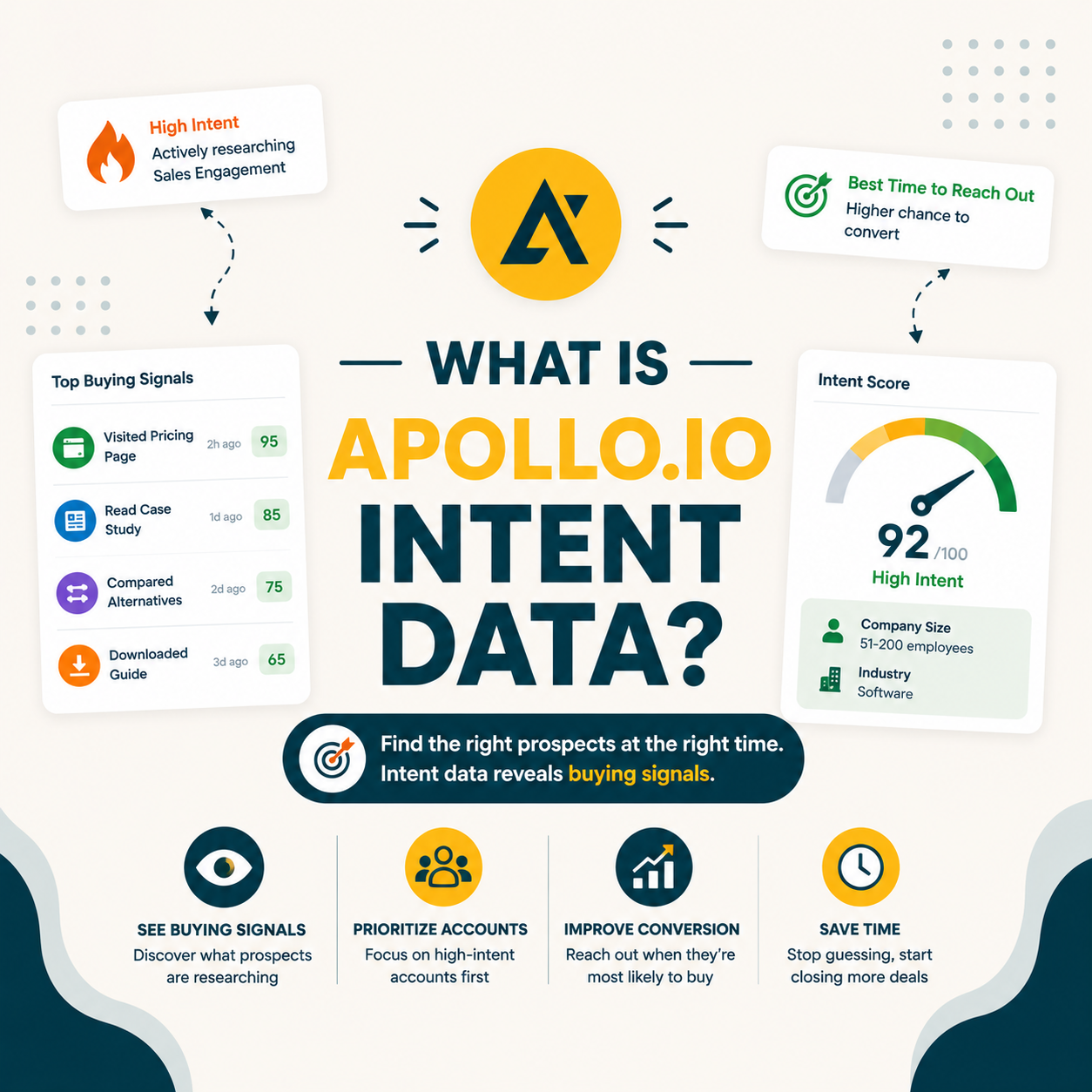
Apollo.io Intent Data is a feature inside Apollo.io that flags companies showing buying signals on B2B topics relevant to your offer. The data is sourced primarily from Bombora topic surge tracking across 5000+ B2B publisher sites. Sales Ops teams use it to prioritize outreach to in-market accounts. Most teams pair Apollo intent signals with Hunter for the verified email find plus verify step.
Table of Contents
What Is Apollo.io Intent Data and Where Do the Buying Signals Come From?
Apollo.io Intent Data is a feature inside Apollo.io that flags companies showing buying signals on B2B topics relevant to your offer. The data comes primarily from Bombora topic surge tracking, which monitors content consumption patterns across a B2B publisher network of 5000+ websites. Apollo layers Bombora signals onto its 275M contact database, returning companies actively researching topics like CRM, email marketing, and sales engagement. The feature lives on Apollo Professional plan at 79 dollars per user per month and higher.
For a full comparison of how Apollo and Hunter work together in sales stacks, see our full Apollo vs Hunter direct comparison.
“Sales intelligence is the technology, application, and practice of gathering, analyzing, and presenting information that is useful in sales.”
: Wikipedia: Sales intelligence
Apollo.io Intent Data is essentially Bombora topic surge data plus Apollo contact database in one dashboard. The signal layer is licensed from Bombora, the targeting layer comes from Apollo. Same intent data many ABM tools surface, different distribution.
How Does Apollo.io Intent Data Actually Work? The Bombora Topic Surge Mechanism Explained
Four steps produce intent signals you see in Apollo. Bombora tracks content consumption across 5000+ B2B publishers via cookie-based tracking. Topic taxonomy assigns each page to a topic from Bombora’s 10000+ B2B topic catalog. Surge calculation compares a company’s content consumption on a topic to its 12-week baseline, flagging deviations above 80 percent. Apollo layers Bombora topic surge signals onto its contact database, surfacing companies plus contacts plus surge intensity per topic in dashboard.
- Content consumption tracking: Bombora cookies on partner B2B publishers (5000+ sites covering trade press, industry blogs, vendor research portals) record which companies read which pages, anonymized at the company level not personal level.
- Topic taxonomy assignment: each tracked page maps to topics from Bombora’s 10000+ B2B topic catalog (CRM software, email marketing, sales engagement, marketing automation, customer data platform).
- Surge calculation against baseline: Bombora calculates each company’s 12-week baseline consumption per topic, flags when a topic shows surge above 80 percent of baseline as a buying intent signal.
- Apollo integration and distribution: Apollo licenses Bombora data, layers topic surge signals onto its 275M contact database, surfaces companies plus contacts plus surge intensity scores in dashboard with topic filters.
Intent data is statistical inference from content consumption patterns. Bombora measures deviation from baseline, Apollo distributes the signal. Accuracy depends on whether the company actually consumes content at one of the 5000 tracked publishers.
What Are the Top 5 Use Cases Where Apollo.io Intent Data Drives Real Pipeline?
Five workflows justify Apollo.io Intent Data investment for Sales Ops teams. Account prioritization within Apollo ICP filters surfaces 100 high-intent accounts from 5000 ICP-fit accounts weekly. Outbound timing alerts notify reps when target accounts surge on buying topics. Marketing-Sales alignment shares intent topics between SDR and Marketing automation. Competitive replacement targeting flags accounts researching competitor categories. Renewal risk monitoring catches existing customers researching alternative vendors before they churn.
See our Hunter cold email workflow guide for how to leverage intent signals in the outreach sequencing step.
Five use cases below show where Apollo.io Intent Data delivers measurable pipeline impact for Sales Ops teams running ABM motion.
- Account prioritization within Apollo ICP: filter your 5000 ICP-fit Apollo accounts down to 100 weekly high-intent accounts surging on buying topics relevant to your offer category for focused SDR work.
- Outbound timing alerts: Apollo notifies reps when assigned target accounts begin surging on intent topics, letting outreach hit during the research window instead of cold-pitching unaware accounts.
- Marketing-Sales alignment on warm accounts: share intent topic data between SDR pipeline and Marketing automation, triggering nurture sequences on accounts showing research signals before SDR outreach.
- Competitive replacement targeting: flag accounts researching competitor categories or vendor names in Bombora topics, prioritize replacement pitch outreach within 7 to 14 day surge window.
- Renewal risk monitoring: catch existing customers researching alternative vendors before they actively churn, intent surge on competitor names triggers Customer Success retention outreach.
“Buying signals are behavioral clues that indicate a prospect is ready to make a purchase decision.”
: Salesforce: Buying Signals Guide
Intent data is a prioritization layer, not a discovery layer. It tells you which accounts in your existing target list are warm right now. Same target universe, different sequence of outreach. To check whether the extra spend pays back, run your numbers through the Hunter.io ROI calculator.
What Are the 5 Limitations of Apollo.io Intent Data Sales Ops Should Plan For?
Five limitations cap what Apollo.io Intent Data can deliver. Bombora network coverage gaps mean some target accounts never appear in surge data because they consume content outside the tracked publisher network. Topic taxonomy lags emerging categories by 3 to 6 months. Surge scoring requires 12 weeks of baseline data, missing newer companies. Apollo distribution layer is limited to Apollo contact database coverage. Plan gating restricts Intent Data to Professional tier at 79 dollars per user per month, expensive for small teams.
For tools that address specific intent and coverage gaps, see our review of Hunter alternatives when Apollo coverage gaps appear in your target market.
Five limitations below shape whether Apollo.io Intent Data fits your target market and team size for ABM motion.
- Bombora network coverage gaps: companies that consume buying content outside the 5000 tracked B2B publisher sites never appear in surge data, leaving entire industry segments invisible in intent signals.
- Topic taxonomy lag for emerging categories: Bombora’s 10000+ topic catalog updates quarterly, new emerging B2B categories (AI agents, vector databases) lag 3 to 6 months before signals become reliable for outreach prioritization.
- Baseline requirement excludes new companies: surge calculation needs 12 weeks of baseline consumption data per topic, newer companies and small firms with low content consumption volume produce noisy signals or none at all.
- Apollo contact database coverage limit: intent signals require matching to Apollo’s 275M contact database, gaps in Apollo coverage of regional markets or specialized industries reduce signal usability for those segments.
- Plan gating at Professional tier: Apollo.io Intent Data is only available on Professional plan at 79 dollars per user per month and higher, prohibitively expensive for teams under 5 SDRs and most early-stage SaaS companies.
“As detailed in our Hunter.io Email Finder review, Hunter provides the email find plus verify layer needed regardless of which intent provider flags the accounts, with 91 percent verified email accuracy applying after Apollo or another tool surfaces the priority list.”
: Growth Hack Suite: Hunter.io Email Finder review
Apollo.io Intent Data is powerful but has structural blind spots tied to Bombora network coverage plus Apollo’s contact database limits. Smaller B2B segments and newer companies often miss the signal entirely.
Top 5 B2B Intent Data Providers Compared: Apollo, Bombora, 6sense, ZoomInfo, G2
Five tools dominate B2B intent data in 2026. Apollo.io Intent Data wins on integration with Apollo’s 275M contact database at 79 dollars per user per month. Bombora direct licensing fits enterprise teams needing raw data feed. 6sense leads on AI-powered account scoring at 50000+ dollars annually. ZoomInfo Intent integrates with their firmographic data deeply. G2 Buyer Intent provides software category-specific signals from review site traffic. Hunter is not an intent provider but the email layer needed regardless of which intent tool flags your accounts.
See the Apollo vs Hunter integration patterns and pricing comparison for how each tool fits different stack configurations.
Five B2B intent data tools below cover the main ABM and outbound prioritization use cases, with pricing and signal source tested in early 2026.
Apollo wins for teams already on Apollo. 6sense wins on AI scoring at enterprise spend. ZoomInfo wins for legacy ZoomInfo customers. G2 wins for software vendors specifically. Hunter wins as the email find layer regardless of intent tool choice.
How Do You Run Apollo.io Intent + Hunter Email Workflow in 5 Steps?
Five steps combine Apollo.io intent flagging with Hunter verified email find for outbound efficiency. Configure intent topics in Apollo dashboard matching your offer category. Set surge intensity threshold (60 to 80 percent recommended) and target geo filters. Export weekly list of 50 to 200 high-intent accounts to CSV. Run Hunter Domain Search or Bulk Task on the exported account domains to find verified decision-maker emails. Enroll the verified-email list in your cold email sequence within the 7 to 14 day surge window for highest reply rate.
See the Hunter.io quick start guide for step-by-step setup of the email layer in this workflow.
Five steps below combine Apollo intent flagging with Hunter verified email lookup for higher-converting outbound motion.
- Step 1, configure intent topics in Apollo: in Apollo dashboard navigate to Intent Topics tab, select topics matching your offer category (CRM software, email marketing, sales engagement), narrow to your ICP segment.
- Step 2, set surge intensity threshold: configure surge intensity threshold at 60 to 80 percent (lower captures more accounts, higher reduces noise), apply geo filters and company size filters to refine signal quality.
- Step 3, export weekly high-intent account list: Apollo dashboard surfaces 50 to 200 high-intent accounts per week, export to CSV with company name plus domain plus surge intensity per topic for processing.
- Step 4, run Hunter Domain Search on exported list: upload CSV to Hunter Bulk Task or run Domain Search per account, return verified decision-maker emails plus 0 to 100 confidence scores for outreach prep.
- Step 5, enroll verified emails in sequence within surge window: import verified-email list to Hunter Campaigns or external sequencer, launch outreach within 7 to 14 day surge window to maximize reply rate impact.
Get the email layer for your Apollo intent workflow free.
Hunter free tier covers 25 finds plus 50 credits per month with no credit card needed, enough to test the verified-email-on-intent-account workflow on your top 25 high-intent accounts.
Get verified emails with Hunter free →50 credits free per month · No credit card · SMTP-verified B2B accuracy
Apollo flags the accounts, Hunter finds the emails. Five steps, one weekly cycle, intent-prioritized outbound running on verified emails. Free Hunter tier covers 25 finds per month, enough to test the workflow on top 25 intent accounts before plan upgrade.
Apollo.io Intent Data: Frequently Asked Questions
Twelve questions below cover what Sales Ops and Marketing Ops search when evaluating Apollo.io Intent Data: how it compares to Bombora direct or 6sense, plan availability, accuracy of buying signals, and how to combine with Hunter for the email layer.
Which B2B intent data provider is best for SaaS teams?
Depends on team size and budget. Apollo Intent Data wins for teams already on Apollo at 79 dollars per user per month. 6sense wins on AI-powered scoring at 50000+ dollars annually for enterprise ABM. ZoomInfo Intent fits legacy ZoomInfo customers. G2 Buyer Intent fits software vendors targeting category buyers. For most SaaS teams under 5 SDRs, Apollo Intent represents the most accessible entry point at sub-enterprise pricing.
How accurate is Apollo Intent Data for buying signal detection?
Accuracy varies by topic and company size. Apollo licenses Bombora data with industry-reported 60 to 75 percent accuracy on surge detection for mid-market accounts in well-tracked categories (CRM, email marketing). Accuracy drops to 40 to 55 percent for emerging categories or small companies with low content consumption. Always validate signals with manual outreach research before committing rep time.
What is the difference between Apollo Intent Data and Bombora direct licensing?
Apollo Intent Data is Bombora topic surge data layered onto Apollo’s 275M contact database in a unified dashboard. Bombora direct licensing gives raw topic surge feed for enterprise teams to build custom integrations. Apollo wins for teams wanting integrated workflow at 79 dollars per user per month. Bombora direct wins for enterprise teams with engineering resources to build custom intent stack at higher cost.
Can Apollo Intent Data replace 6sense or ZoomInfo Intent?
For teams under 50 SDRs, yes mostly. Apollo Intent covers the core Bombora topic surge data layer at lower cost than 6sense or ZoomInfo Intent. For enterprise teams needing AI-powered account scoring, predictive buyer stage modeling, or deep CRM integration with multi-source intent fusion, 6sense or ZoomInfo offer features Apollo cannot match. Choose Apollo for SMB to mid-market, 6sense for enterprise ABM.
How much does Apollo Intent Data cost per seat?
Apollo Intent Data is included on Professional plan at 79 dollars per user per month and Organization plan at 119 dollars. Free tier and Basic plan (49 dollars per user) do not include intent data. For a 5-SDR team, Professional plan costs 395 dollars per month total, significantly cheaper than 6sense or ZoomInfo Intent which start at 30000+ dollars annual contracts.
Will Apollo Intent Data improve outbound reply rate?
Yes by 20 to 40 percent typically when paired with proper timing. Intent surge signals identify accounts in active research phase, outreach within the 7 to 14 day surge window hits higher reply rates than cold outreach to unaware accounts. The lift requires proper sequencing (intent flag plus verified email plus personalized message), not just dropping intent accounts into existing cold sequences blindly.
Can Apollo Intent Data work with Hunter for the email layer?
Yes effectively. Apollo flags high-intent accounts, Hunter finds verified emails at those accounts via Domain Search or Bulk Task at 91 percent accuracy. The combined workflow gives intent-prioritized outreach running on clean verified emails, the highest-converting outbound motion for SMB to mid-market B2B SaaS in 2026. Hunter free tier covers 25 finds per month to test the workflow.
Does Apollo Intent Data integrate with Salesforce or HubSpot?
Yes natively. Apollo Intent flags push to Salesforce and HubSpot contact records via Apollo’s native CRM sync. Intent surge alerts trigger workflow automation in both CRMs to assign accounts to reps or enroll in nurture sequences. The Organization plan adds bidirectional sync with broader CRM data field mapping for enterprise sales workflows running on intent prioritization.
What is Apollo Intent Data?
Apollo Intent Data is a feature inside Apollo.io that flags companies showing buying signals on B2B topics relevant to your offer. The data is sourced primarily from Bombora topic surge tracking across 5000+ B2B publishers. Apollo layers Bombora signals onto its 275M contact database, surfacing in-market accounts plus contact-level data plus surge intensity scores.
How does Apollo Intent Data buying signal detection work?
Four steps run. Bombora cookies track content consumption on 5000+ B2B publisher sites. Topic taxonomy assigns each tracked page to 10000+ B2B topics. Surge calculation compares company consumption to 12-week baseline, flags deviations above 80 percent. Apollo licenses the signal and layers it onto its contact database, surfacing companies plus contacts plus surge intensity in dashboard with topic filters.
Is Apollo Intent Data available on the free plan?
No. Apollo Intent Data is gated to Professional plan at 79 dollars per user per month and Organization plan at 119 dollars. Free tier and Basic plan (49 dollars per user) do not include intent data. For teams wanting to test intent-driven outbound on a budget, Professional plan with 5 seats at 395 dollars per month total is the entry point.
Can Apollo Intent Data work with non-Apollo email tools?
Yes. Apollo Intent flags export to CSV with company plus contact plus surge intensity data, the exported list works with any email tool downstream including Hunter for find plus verify, Lemlist or Instantly for sequencing, Salesforce or HubSpot for CRM enrollment. Apollo Intent is the prioritization layer, the email layer and sequence layer can come from any vendor.
Apollo Intent Data is the prioritization layer on top of Apollo’s contact database. Pair with Hunter for verified email find plus verify: the workflow that turns intent signals into pipeline-ready outreach.
Try Hunter.io free: get verified emails for the Apollo intent accounts you prioritize
Apollo flags the in-market accounts. Hunter finds the verified emails to reach decision-makers at those accounts. Hunter free tier covers 25 finds plus 50 credits per month, enough to validate the workflow on your top intent-flagged targets.
Get verified emails with Hunter free →7M+ professionals use Hunter. No card. Cancel anytime.