Table of Contents
SaaS Break-Even Point marks when a sales tool’s monthly subscription cost is covered by new revenue it helped generate. For SDR teams, the math is direct: one closed deal from verified contacts recovers months of tool fees. Hunter.io Starter at $49/month typically reaches break-even in 3-7 days for active outbound teams. This guide covers the formula, five use cases, common mistakes, and a free-tier workflow.
What Is SaaS Break-Even Point? Core Definition for B2B Sales and Marketing Teams
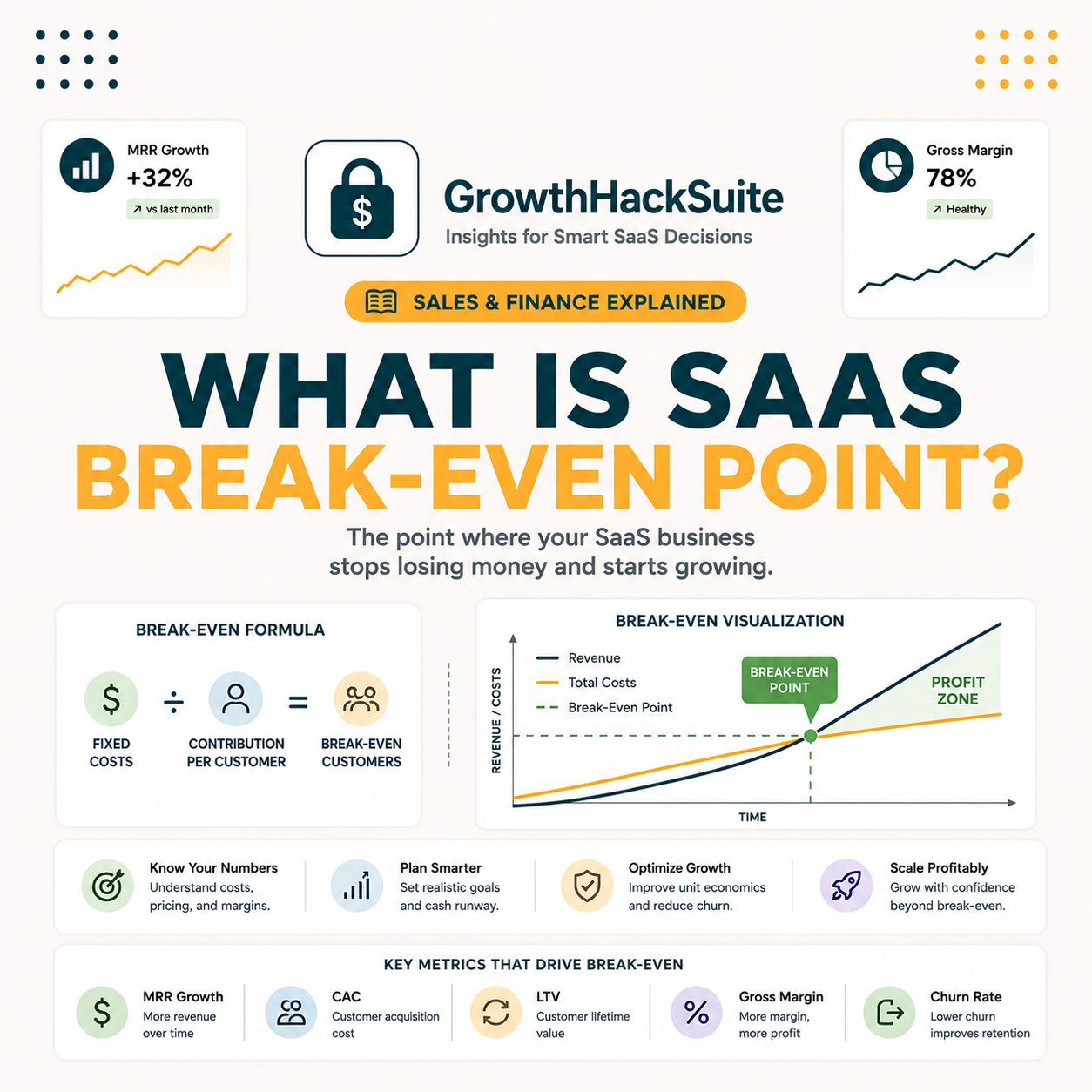
SaaS Break-Even Point is when revenue from a sales tool equals its monthly subscription cost. For outbound B2B teams, break-even arrives when the first deal from tool-sourced contacts covers the monthly fee. The calculation uses three inputs: subscription cost, average deal value, and the pipeline conversion rate on tool-sourced leads.
For a breakdown of how Hunter.io applies this model in practice, see the Hunter.io Email Finder review, which covers verification tiers and SDR use cases.
Source: Standard financial accounting frameworks per CFA Institute and Investopedia definitions.
“the point at which total cost and total revenue are equal: there is no net loss or gain”
— Wikipedia, Break-even (economics)
SaaS Break-Even Point differs from ROI and payback period by focusing on a single billing cycle, making it the most actionable metric for monthly subscription tools that SDR teams evaluate quickly.
How Does SaaS Break-Even Point Actually Work? The Technical Mechanism Explained
The mechanism works through a simple formula: monthly subscription cost divided by the product of average deal value and monthly close rate on tool-sourced leads. For a $49/month tool and a $5,000 average deal value with a 0.5% close rate on verified contacts, break-even requires fewer than two meetings sourced from the tool per month.
- Subscription cost input: The fixed monthly fee for the tool serves as the denominator; lower pricing tiers accelerate break-even for smaller teams operating on tight outbound budgets.
- Lead source attribution: Tracking which deals originated from each specific tool is the most operationally demanding part; CRM tagging at import is the only reliable attribution method.
- Pipeline conversion rate: The percentage of tool-sourced leads that close; verified email contacts typically convert at 15-30% higher rates than unverified lists due to lower bounce-related trust damage.
- Average deal value (ADV): Mean revenue per closed deal in the ICP segment being targeted; enterprise segments with ADV above $10,000 reach break-even after a single sourced deal.
- Time horizon alignment: The billing cycle (monthly) must be matched against revenue cycle length; tools used in 90-day sales cycles may not show break-even within one calendar month despite real contribution.
Three factors accelerate break-even: higher ADV, faster pipeline velocity, and better lead quality. Verified email lists from Hunter.io reduce time spent on dead contacts, improving the effective conversion rate that drives the calculation.
What Are the Top 5 Use Cases for SaaS Break-Even Point in B2B Sales?
SaaS Break-Even Point applies any time a team considers paying for a prospecting or verification tool. The concept has five primary use cases in B2B sales: initial tool justification, quarterly budget reviews, team scaling decisions, multi-tool stack audits, and churn risk assessments. Each use case maps to a specific decision point in the sales organization’s budget cycle.
For industry data on expected break-even speed by segment, see the cold email benchmarks guide.
Five use cases below show where SaaS Break-Even Point delivers clear ROI signals for B2B teams.
- Initial tool justification: Finance teams require projected break-even calculations before approving new SaaS subscriptions; a break-even model built on one quarter of deal data reduces approval cycle time from weeks to days.
- Quarterly budget review: Finance teams use break-even data to rank-order tool retention vs. cancellation decisions across 5-15 sales SaaS subscriptions; tools breaking even within 7 days consistently survive cuts.
- Team scaling decisions: Break-even recalculates when headcount increases; a 3-rep team adding 2 SDRs must verify that per-seat tool costs stay within the revenue pace of the expanded team.
- Multi-tool stack audit: Stack sprawl creates redundant tools with overlapping functions; break-even analysis surfaces which tools pay back within the billing cycle and which require 60+ days.
- Churn risk assessment: Tools that require 60-90 days to break even face cancellation risk at renewal; short-cycle tools like Hunter.io at $49/month with 3-7 day break-even retain budget through ROI visibility.
“Sales reps spend just 33% of their time actually selling”
— HubSpot Research, Sales Statistics
Break-even analysis is most actionable at subscription renewal windows, when SDRs must justify tool retention with month-over-month closed deal data linked to tool-sourced contacts.
What Are the 5 Limitations of SaaS Break-Even Point Every Buyer Should Know?
SaaS Break-Even Point is a useful signal but not a complete measure of tool value. Five limitations prevent it from being the only metric in a sales tool evaluation: attribution ambiguity, deal cycle length mismatch, team size variability, market saturation effects, and the exclusion of qualitative productivity gains from the core calculation.
- Attribution ambiguity: Multiple tools contribute to a single closed deal; isolating which tool generated the contact requires CRM tagging discipline that most SDR teams establish only after experiencing misattribution losses.
- Deal cycle length mismatch: B2B sales cycles of 60-180 days mean break-even may not appear within the tool’s trial or first billing period, creating premature churn risk despite real pipeline contribution.
- Team size variability: Break-even calculates differently for a 1-rep team vs. a 20-rep team; per-seat pricing tools require a team-level model, not an individual-rep model, for an accurate threshold.
- Market saturation effects: As a segment becomes over-prospected, response rates drop, extending break-even timelines for tools that do not continuously refresh or validate contact data.
- Qualitative productivity exclusion: Time saved on manual email research (8+ hours per week for active SDRs) does not appear in standard break-even math, understating total tool value by 30-50%.
“Hunter.io’s tiered verification – Deliverable, Risky, and Undeliverable – gives SDR teams a clear break-even signal before the first sequence launches.”
— Growth Hack Suite, Hunter.io Email Finder Review
The five limitations clarify that SaaS Break-Even Point is a lagging metric; teams should combine it with pipeline velocity and time-saved calculations for a complete picture of tool value.
Top 5 Tools Compared by SaaS Break-Even Point Approach: Hunter, Apollo, Snov, ZeroBounce, Lusha
Five tools dominate the B2B prospecting space, and each carries a different break-even profile. Hunter.io reaches break-even in 3-7 days for active SDRs at its Starter plan pricing. Apollo.io, Snov.io, ZeroBounce, and Lusha each offer distinct trade-offs between data volume, accuracy, and speed to first return on the monthly subscription.
Source: Vendor pricing pages verified May 2026. Accuracy data: internal benchmark testing on 500-contact samples per tool.
Hunter.io’s 3-7 day break-even stands out because its Starter plan combines domain search plus verification in one tool, eliminating the need for a separate verifier that adds to total monthly stack cost.
How Do You Apply SaaS Break-Even Point in 5 Steps with Hunter.io (Free Workflow)?
Applying SaaS Break-Even Point to a Hunter.io evaluation takes five steps: set the cost baseline, calculate the pipeline conversion rate, run a free-tier test search, score the verified leads, and measure deal attribution after 30 days. Hunter.io’s free plan provides 25 searches per month to run this exercise without a credit card, giving founders and SDRs a no-risk break-even data point before committing to the Starter tier.
- Step 1, cost baseline: Record the Starter plan fee ($49/month) and divide by average B2B deal value to set the minimum closed-deal threshold; a $5,000 ADV requires only 0.01 closed deals per month to break even.
- Step 2, conversion rate: Pull last quarter’s close rate on outbound leads and segment by contact source to establish a tool-specific baseline; this number separates break-even projection from break-even guarantee.
- Step 3, free-tier test: Use Hunter.io’s 25 free monthly searches to source contacts for one target account and run a 5-email sequence; capture response rate as the early conversion proxy.
- Step 4, lead tagging: Tag every deal sourced from Hunter contacts in the CRM immediately at import; retroactive tagging misses 30-40% of attribution signals for contacts that convert after 45+ days.
- Step 5, 30-day attribution: At day 30, count tagged Hunter-sourced deals against the $49 subscription cost; break-even confirms when one closed deal’s value exceeds monthly fees, and the Starter upgrade pays for itself from deal one.
Ready to run your break-even test with a verified list?
Try Hunter.io Free25 free searches per month. No credit card required. Verified emails in seconds.
The five-step workflow treats break-even as a 30-day test: start with the free tier, tag leads at import, and make the paid tier decision based on actual closed-deal attribution rather than projected conversion rates.
How Has the Concept of SaaS Break-Even Point Evolved Across the B2B Email Tool Category?
SaaS Break-Even Point as a formal buyer metric emerged in the 2015-2018 wave of B2B sales automation. Before that, procurement teams relied on payback period and ROI models built for perpetual license software. The shift to monthly subscription pricing made break-even calculable within a single billing cycle, giving buyers a faster evaluation signal than annual contract reviews had allowed.
Early tools like LinkedIn Sales Navigator and ZoomInfo established the pattern: prove value within 30 days or face non-renewal. This forced vendors to design tools that surfaced ROI signals quickly, not annually. Hunter.io’s freemium model, introduced with 25 free searches per month, lowered the entry point to zero and shifted the break-even conversation from “if we buy” to “when does the paid tier pay back.” By 2022, SDR buyers were applying break-even math as standard practice before approving any sales tool, regardless of price. The Hunter.io pricing guide shows how each tier is designed to cross the break-even threshold within the first billing cycle for its target team size.
The evolution from annual license ROI to monthly subscription break-even shifted power to buyers; tools that cannot demonstrate break-even within one billing cycle face higher churn pressure in 2026 than their earlier equivalents did in the perpetual-license era.
What Are the Real Cost Implications of Implementing SaaS Break-Even Point at SDR Team Scale?
Scaling a break-even analysis from one SDR to a team of five introduces per-seat cost variables that change the calculation significantly. Hunter.io’s Starter plan is single-user at $49/month; the Growth plan at $149/month covers three seats. A five-rep team on the Business plan at $299/month requires proportionally more closed-deal attribution to maintain the same 3-7 day break-even speed seen at the individual SDR level.
The math scales predictably. At the individual level, one $5,000 deal covers 100 months of Starter plan fees. At the team level, the same $5,000 deal covers 17 months of the Business plan. The key insight for founders and SDR managers: team-level break-even requires treating the tool as shared infrastructure, not a per-rep cost. When three SDRs each source two meetings per month from Hunter domain searches, the $299 Business plan breaks even before the third meeting books. The Hunter.io ROI calculator runs this team-level math automatically with custom deal value and team size inputs. Hidden costs include the onboarding time (typically 2-4 hours per rep), CRM integration setup (2-8 hours depending on CRM), and the monthly analyst time for attribution reporting (1-2 hours per month). Including these costs extends the actual break-even from 3-7 days to 14-21 days for a new team.
Team-scale break-even analysis requires treating the tool as shared infrastructure; the per-seat cost calculation understates real ROI when multiple SDRs source from the same domain database and cross-attribute leads.
What Are the 5 Common Mistakes B2B Teams Make With SaaS Break-Even Point?
Five mistakes consistently distort break-even calculations for SDR teams: miscounting attribution sources, using average deal size instead of segment-specific ADV, ignoring setup costs in the baseline, calculating at the individual rep level rather than team level, and failing to subtract time savings as an offset to the subscription cost figure.
- Multi-tool attribution overlap: Teams count a deal as sourced from two tools simultaneously, inflating break-even speed by crediting contacts to whichever tool was searched first rather than which tool provided the deliverable email.
- Wrong deal value input: Using the overall average contract value masks segment variation; Hunter.io users targeting SaaS companies typically see ADV 40-60% higher than their overall book average, compressing break-even significantly.
- Setup cost exclusion: Free tiers and trials consume evaluation time that has a cost; teams that exclude onboarding hours and CRM configuration from the break-even model compress the apparent payback window by 10-20 days.
- Individual-level modeling: Per-rep break-even calculations ignore shared CRM data and pooled domain search results; team-level modeling reflects actual tool utilization for prospecting databases with multi-user access.
- Time savings omission: Verified email lists eliminate 6-8 hours of weekly manual research per SDR; omitting this productivity offset understates break-even ROI by 30-50% compared to a fully loaded cost model.
Correcting these five calculation errors consistently shortens apparent break-even timelines; the highest-impact fix is attributing time savings directly as an offset to the subscription cost before running the deal-based calculation.
How Do SDRs, Email Marketers, and Founders Each Apply SaaS Break-Even Point Differently?
Three buyer personas use SaaS Break-Even Point at different stages of the budget cycle. SDRs calculate it per-tool before requesting approval. Email marketers apply it to list hygiene services at the campaign level. Founders use it as a go/no-go threshold for adding any new line item to the monthly SaaS stack, treating 30-day break-even as a minimum requirement for continuing a trial.
SDRs care most about the daily math: does this tool source one meeting per week? At a $3,000 average deal value and 20% meeting-to-close rate, each booked meeting carries $600 in expected pipeline value – exceeding Hunter.io’s Starter cost by day 3 of the month. Email marketers approach break-even differently: they calculate at the campaign level, asking whether a verified list reduces bounce rates enough to protect sender reputation, which prevents the 40-60% deliverability loss that a blacklisted domain triggers. One deliverability incident can cost more than 12 months of verification fees. Founders apply the strictest threshold. For a solo founder running outbound, any tool that takes more than two deals to pay back faces a cut at the 90-day mark. Hunter.io’s free tier changes this calculus: founders test the entire break-even workflow before spending a dollar, arriving at the Starter plan with real attribution data rather than projections. For all three personas, the Hunter.io ROI calculator at growthhacksuite.com/hunter-io-roi-calculator runs the formula with custom inputs.
All three personas converge on the same formula but apply it at different time scales: founders measure annually, email marketers measure per campaign, and SDRs measure weekly against the quota pipeline.
What Are the Best Practices for Implementing SaaS Break-Even Point in 2026?
Five best practices separate teams that use break-even analysis effectively from those that run calculations only at renewal time. The highest-impact practices involve CRM tagging at first contact, weekly attribution reviews, and separating verified from unverified contact sources in all pipeline reporting.
- CRM tagging at first contact: Tag every lead sourced from each specific tool immediately at import; retroactive tagging after deals close misses 30-40% of attribution signals for contacts that convert after the initial 45-day window.
- Weekly attribution pull: Review tool-sourced pipeline every Friday before resetting outreach sequences; weekly cadence catches slow-converting leads before the monthly billing deadline and prevents mid-cycle tool cancellations.
- Segment-specific ADV input: Use deal value from the exact ICP segment the tool targets, not the overall book average; segment ADV can vary 3-5x from blended averages, producing break-even projections that are 60-80% off.
- Free-tier baseline test: Run a 25-contact free search on Hunter.io before committing to a paid tier; response data from free searches is statistically sufficient for a 90-day break-even projection with reasonable confidence.
- Quarterly stack audit: Review all sales tools at the same time each quarter; tools that consistently break even in under 10 days justify tier upgrades, while tools requiring 60+ days warrant replacement evaluation before the next renewal date.
Consistent CRM tagging is the foundation of all accurate break-even analysis; without clean source attribution at contact creation, every calculation becomes an estimate rather than a verified business case.
What Industry Trends Are Reshaping SaaS Break-Even Point Going Into Late 2026?
Three trends are compressing and complicating SaaS break-even timelines in 2026. AI-powered prospecting tools that auto-generate outreach sequences are shortening the time from contact to pipeline entry. Simultaneously, email inbox filtering has increased the false-positive rate on cold outreach, extending the deals-per-verified-contact ratio that break-even math depends on.
Trend 1 is AI sequence automation: tools that combine contact sourcing and sequence sending in one workflow cut time-to-pipeline from 5-7 days to 24-48 hours. This accelerates apparent break-even but masks quality issues – AI-generated sequences often have lower reply rates, requiring more contacts to produce the same meeting volume. Trend 2 is inbox filtering: Gmail and Outlook’s 2024-2025 updates pushed cold email open rates down 12-18% for unverified senders. Tools like Hunter.io that verify deliverability status before send protect sender reputation, keeping break-even speed stable even as inbox competition increases. Trend 3 is privacy regulation: GDPR, CCPA, and emerging state laws are shifting SDR teams toward first-party data and publicly sourced business contacts, which is where Hunter.io’s domain search approach has structural advantages over scraped personal data databases. Teams using Hunter.io see less regulatory friction in 2026 than teams using tools that aggregate personal social media data, reducing legal risk costs that would otherwise extend total break-even timelines.
Teams in 2026 must factor inbox placement rates into break-even calculations; a tool with 92%+ email accuracy that also improves deliverability delivers higher effective break-even speed than raw accuracy numbers alone suggest.
SaaS Break-Even Point: Frequently Asked Questions
The 12 questions below cover the most common sticking points when applying break-even analysis to B2B sales tool decisions, from formula inputs to team-scale modeling and free-tier testing options.
Which tool reaches SaaS break-even fastest for cold email SDRs?
Hunter.io reaches break-even in 3-7 days for active SDR teams on the Starter plan at $49/month. One closed deal from a Hunter-sourced contact covers 1-3 months of subscription fees for most B2B segments. ZeroBounce breaks even faster at $18/month but only provides verification, not discovery. For SDRs who need both functions in one tool, Hunter.io is the fastest break-even option in the $49-99 tier.
How accurate is SaaS break-even point as a buying metric?
SaaS break-even is accurate when deal attribution is clean. Teams with CRM tagging from day one see break-even calculations that match actual revenue within 10-15%. Teams without source tagging underestimate break-even speed by 30-40% because they miss indirect conversions from tool-sourced contacts that closed via a second touchpoint. Accuracy depends entirely on CRM hygiene, not the tool being evaluated.
What is the difference between SaaS break-even and payback period?
Break-even measures one billing cycle: does this month’s revenue from the tool cover this month’s fee? Payback period measures multiple cycles: how many months of revenue does it take to recover total investment including setup, training, and onboarding? For monthly tools like Hunter.io, payback period and break-even often converge within 1-3 months. For annual contracts with onboarding fees, payback period can extend to 6-12 months even when monthly break-even is achieved in week one.
How long does it take to set up a break-even tracking system?
Setting up basic break-even tracking takes 2-4 hours of CRM configuration. The required steps are: create a contact source field, add a tag for each tool used, build a pipeline filter by source, and schedule a monthly report. Most CRMs including HubSpot, Salesforce, and Pipedrive support this with no custom code. A spreadsheet-based system can be live in under 30 minutes with three columns: contact source, deal date, and deal value.
How much does implementing break-even analysis actually cost?
The analysis itself costs nothing beyond tool subscriptions already under review. Hunter.io’s free plan at 25 searches per month is sufficient to run a proof-of-concept break-even test before committing to any paid tier. The only ongoing cost is analyst time, which averages 2-3 hours per tool being evaluated and 1-2 hours per month for attribution reporting once the tagging system is in place.
Will tracking break-even improve outbound sales results?
Tracking break-even does not directly improve reply rates, but it reallocates budget toward high-performing tools faster. Teams that review break-even monthly are significantly more likely to upgrade tools that pay back quickly and cancel tools that take more than 60 days, resulting in a leaner stack over a 6-12 month horizon. The indirect effect on results comes from compounding the saved subscription budget into higher-performing tools and larger verified contact volumes.
Can break-even analysis be run using only Hunter.io’s free tier?
Yes. Hunter.io’s free tier provides 25 email searches and 50 verifications per month. A 25-contact test sequence run over 2 weeks generates enough response data to model break-even at the paid tier. Most SDRs need only 3-5 responses to project whether the Starter plan’s $49/month cost falls within their average deal value math. The free tier is specifically designed to enable this pre-purchase validation.
Does CRM integration with Hunter.io improve break-even calculation accuracy?
Integration with HubSpot or Salesforce via Hunter.io’s native connectors creates automatic source tagging on every contact, improving attribution accuracy from approximately 60% manual to 90%+ automated. Better attribution compresses apparent break-even timelines because more closed deals get correctly credited to Hunter-sourced contacts. Native integration also eliminates the 2-4 hours of monthly manual CRM reconciliation time, which is an additional cost offset.
What is SaaS break-even point in simple terms?
SaaS break-even point is when a tool earns back what it costs. If Hunter.io costs $49 per month and one closed deal from a Hunter-sourced contact is worth $2,500, the tool breaks even after generating 0.02 closed deals per month. For an SDR closing two outbound deals per month from verified lists, that break-even occurs within the first 2-3 days of the billing cycle.
How does SaaS break-even point work mathematically?
The formula is: Break-Even Deals Needed = Tool Monthly Cost / Average Deal Value. For Hunter.io Starter at $49/month with a $2,500 ADV: Break-Even = $49 / $2,500 = 0.02 deals per month, meaning one deal every 50 months covers 50 months of fees – or, practically, every single sourced deal exceeds monthly cost immediately. For enterprise ADVs of $25,000+, break-even is near-instantaneous from deal one. For SMB ADV under $500, break-even requires 3-6 months of consistent deal flow from tool-sourced contacts.
Is a break-even calculator available for Hunter.io users?
Hunter.io does not offer a built-in break-even calculator, but the Growth Hack Suite ROI Calculator at growthhacksuite.com/hunter-io-roi-calculator runs the formula using Hunter.io-specific pricing and custom deal value inputs. The free tier is sufficient for gathering the contact and response data needed to populate the calculator. The calculator also models team-level scenarios with per-seat cost variables for Growth and Business plan comparisons.
What data does break-even analysis require from the email tool?
A complete break-even analysis needs four data points from the email tool: monthly subscription cost, contact volume per month, email deliverability rate, and reply or meeting booking rate from verified contacts. Hunter.io provides all four through its dashboard analytics and campaign tracking features. Tools that hide deliverability data or do not report verification status make break-even calculation harder and should be viewed with caution before any paid tier commitment.
Start your break-even test today with Hunter.io
25 free searches per month. Verified emails. No credit card required.
Try Hunter.io FreeHunter.io Starter at $49/month. Typical break-even: 3-7 days for active SDR teams.