Table of Contents
A soft paywall is a monetization model where B2B SaaS tools grant free access to core features up to a defined usage limit, then display an upgrade prompt rather than a hard block. Hunter.io’s free plan is a textbook example: 50 credits a month, enough to find and verify roughly 33 contacts, so new users experience real value before the upgrade moment arrives. The trade-off is that free users hit the ceiling only after the product has already proved itself on their own targets.
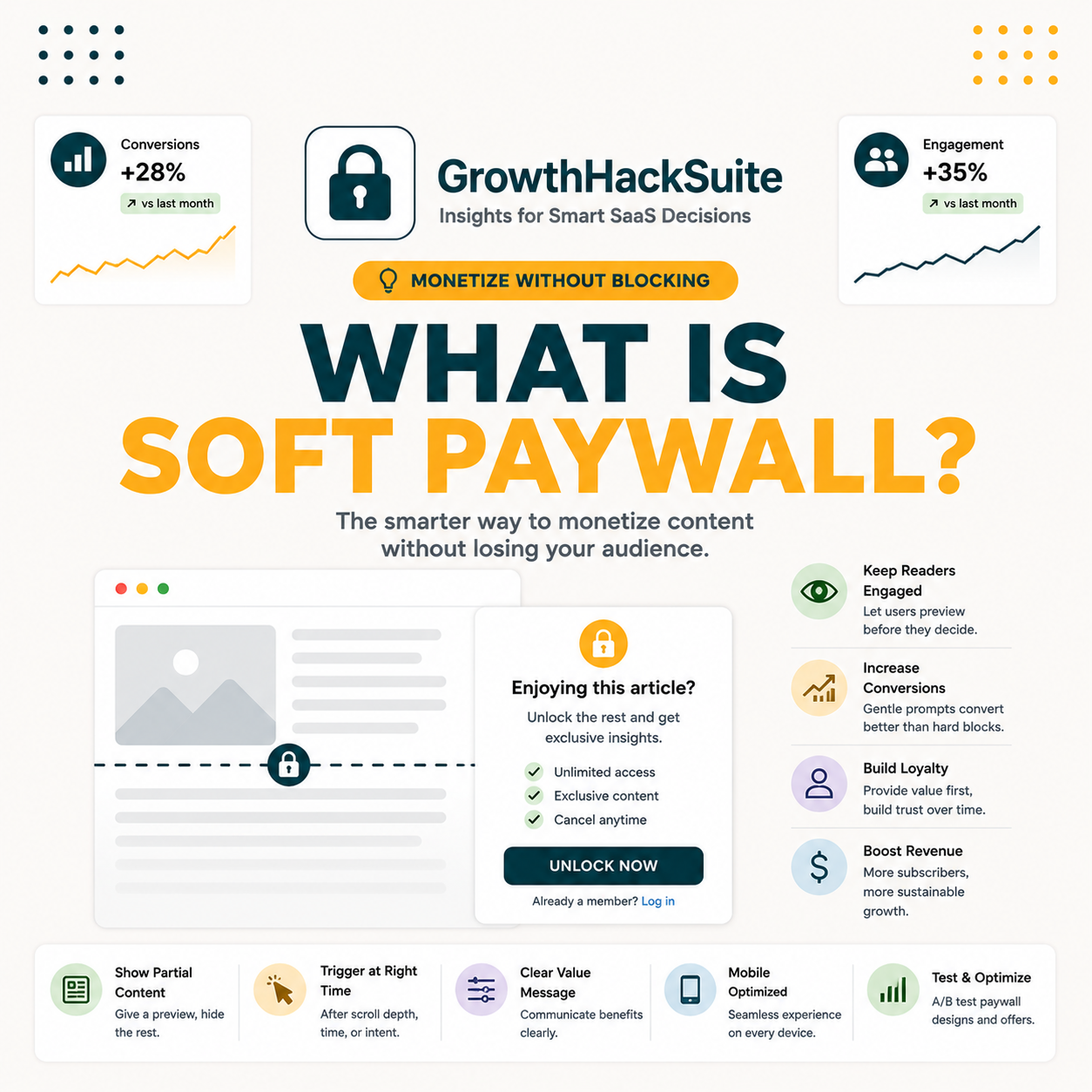
What Is Soft Paywall? Core Definition for B2B Sales and Marketing Teams
A soft paywall permits free access to core features until a usage threshold is reached, then displays an upgrade prompt rather than an access block. Free users receive identical data quality to paid users, with only volume limited. This PLG design underlies every major B2B email finder and prospecting tool launched after 2015.
Source: model definitions compiled by Growth Hack Suite. PLG adoption context from OpenView, 2023 Product Benchmarks Report.
“allows free access to a limited number of articles before prompting payment”
Source: Wikipedia, “Paywall”, the same metered-access principle applies to B2B SaaS usage limits
The soft paywall model dominates B2B email and sales tools at the under-$100/month price point because the conversion event feels like a natural next step rather than a barrier. Users who reach the free limit have already demonstrated intent, making them far more likely to upgrade than cold leads who have never tried the product.
How Does Soft Paywall Actually Work? The Technical Mechanism Explained
The soft paywall mechanism operates across five interconnected layers that work together to move a free user toward an upgrade decision without creating frustration. Each layer is designed to maximize the value a user experiences before the conversion moment, ensuring the upgrade prompt lands when the user already understands the product’s impact on their workflow.
- Usage Counter: The product tracks searches, API calls, or exports against each user account. When the count reaches the threshold, the system activates the upgrade prompt instead of completing the action.
- Value-First Delivery: Every free-tier action returns full-quality output identical to paid results, no watermarks or previews. Users experience complete product value before any upgrade friction appears.
- Contextual Upgrade Prompt: The upgrade message fires at the exact moment the user attempts an action beyond the limit, anchoring conversion to a specific demonstrated value moment rather than a random pop-up.
- Frictionless Payment: A well-designed soft paywall compresses the upgrade decision to paid account activation in under 60 seconds, eliminating the cooling-off period where purchase intent evaporates.
- Monthly Reset Loop: Usage counters reset monthly, creating recurring engagement cycles where free users return, re-experience value, and incrementally increase the probability of upgrading over time.
The technical mechanism is straightforward, but execution quality varies significantly. The tools that convert best are those where every free-tier interaction delivers the same output quality as the paid tier: same data accuracy, same speed, same interface. Degraded free-tier quality signals that the paid product is the “real” version, which undermines trust before the conversion moment arrives.
How Has the Concept of Soft Paywall Evolved Across the B2B Email Tool Category?
The soft paywall concept in B2B email tools traces its origins to the early 2010s media industry, where newspapers like the New York Times pioneered metered access for articles. B2B SaaS adopted the mechanics around 2014-2016 as product-led growth (PLG) emerged as a distribution model, replacing the demo-gated sales funnel with self-serve trial access for founders and SDRs who refused to book discovery calls before evaluating tools.
Hunter.io’s 2015 launch with a generous free tier set the standard for email finder soft paywalls. The tool gave users enough searches to validate accuracy on their real prospecting targets, then prompted upgrades only when users reached the natural ceiling of a real outreach project. This approach created a self-qualifying funnel: only users with genuine ongoing prospecting needs would hit the limit regularly, and those users had a clear ROI case for upgrading.
By 2020-2023, the soft paywall became table stakes for any B2B email or prospecting tool launching at under $100/month. Apollo, Snov.io, Clearbit, and ZeroBounce all adopted variations of the model. The competitive pressure pushed free tier limits higher: tools that launched with 10 free searches per month moved to 25 or 50 to remain competitive, raising the bar for demonstrated value before the conversion ask.
The soft paywall now functions as a de facto product-market fit signal: if a tool can acquire and retain free users who return month over month, the underlying product has enough value to justify a paid tier. Teams evaluating tools use the free tier not just to test accuracy but to assess workflow fit, making the soft paywall both a conversion mechanism and a product validation tool.
What Are the Top 5 Use Cases for Soft Paywall in B2B Sales?
Soft paywalls deliver the highest conversion ROI in five specific B2B workflow scenarios where the user encounters the limit at a natural workflow completion point. In each case, the upgrade prompt arrives when the user has already validated value and has a concrete ongoing need for more capacity. Understanding these scenarios helps founders and sales leaders identify which tools in their stack are using soft paywalls effectively versus ineffectively.
Five use cases where soft paywall delivers measurable B2B conversion lift:
- SDR List Building: An SDR uses free Hunter.io searches to build a target account list, confirms accuracy on real prospects, then hits the limit mid-campaign, triggering the upgrade at peak motivation when a qualified list is in progress.
- Pre-Send Verification: A founder uploads 400 contacts for bulk verification, processes the first 100 free, observes bounce reduction, then hits the limit. The tangible deliverability improvement makes the upgrade decision obvious.
- Recruiting Outreach: Recruiting coordinators source candidate contacts from company domains. The 50-credit allowance covers roughly one hiring cycle, after which repeat hiring creates natural recurring upgrade demand.
- ABM Account Mapping: Marketing teams running ABM programs map target accounts domain by domain. Free tier handles a pilot list before requiring an upgrade when the program scales to the full target account universe.
- Partner Research: Business development teams use domain search to map org structures at target partner companies. Free tier covers 1-2 initial companies; upgrade triggers when the BD pipeline expands to 5+ monthly accounts.
“a basic version of their product, hoping that users will eventually pay to upgrade”
Source: HubSpot Blog, Pricing Strategies, on freemium pricing
The highest-converting soft paywalls are those where the free usage limit aligns with exactly one complete unit of user work: one campaign, one hiring cycle, one account list. When the limit is reached mid-task rather than at a natural stopping point, users feel interrupted rather than satisfied, which reduces conversion rates significantly.
What Are the 5 Limitations of Soft Paywall Every Buyer Should Know?
Soft paywalls create real constraints for B2B teams that buyers should evaluate honestly before committing time to onboarding a free-tier tool. Understanding these limitations prevents workflow disruptions and ensures teams build their prospecting and verification processes on tools whose paid tiers represent genuine ROI rather than just removing the friction the soft paywall creates.
- Insufficient Volume: 50 credits per month covers testing but not production prospecting. An SDR sending 50 personalized cold emails per week needs 200+ contacts monthly, which costs roughly 300 credits once verification is included, requiring an upgrade before the first week ends.
- Reset Timing Friction: Monthly resets distribute free capacity unevenly. Teams exhausting the limit on the 5th of the month face 25 days of blocked access, forcing either an upgrade or a campaign pause at a critical workflow moment.
- Credit Architecture Complexity: Tools using credits rather than simple search counts create per-contact cost confusion. On Hunter.io, Domain Search bills 1 credit per email returned and a verification costs 0.5, so the 50-credit free tier delivers about 33 contacts found and verified, not 50. Buyers must read credit documentation before assuming parity with competitors.
- Team Seat Scaling: Most free tiers are per-user, not per-team. Three SDRs each needing separate accounts to access combined free capacity adds management overhead and inflates effective team plan costs above advertised individual prices. Hunter.io is the exception: unlimited team members are included on every tier, including Free, so credit volume rather than seat count drives the upgrade.
- Sample Size Constraint: 50 credits across 2-3 domains is insufficient to assess accuracy reliably. Statistically meaningful benchmarking requires 100+ contacts across 5 domains, demanding either an upgrade or multiple months of free testing.
“Hunter.io’s soft paywall approach, with 50 free credits per month, represents the most transparent entry point in the email finder category: one credit finds an email, half a credit verifies one, and the same pool covers both.”
Source: Growth Hack Suite, Hunter.io Email Finder review
Knowing these limitations before starting a soft paywall trial prevents the most common buyer mistake: investing significant setup and testing time in a free tier that cannot scale to production workloads without an immediate paid upgrade. For teams with confirmed ongoing prospecting needs, skipping the free tier entirely and starting on a paid plan often delivers better ROI than the free-to-paid transition cycle. Whether the free allowance is enough depends on the role rather than the tool, and the free plan vs Starter breakdown by persona gives a separate verdict for SDRs, marketers, and founders.
Top 5 Tools Compared by Soft Paywall Approach: Hunter, Apollo, Snov, ZeroBounce, Findymail
Five leading B2B email tools implement soft paywalls with distinct differences in free tier volume, credit architecture, and upgrade clarity. Hunter.io leads on accuracy and credit transparency at 91.2% verified; Apollo offers higher raw credits at 50 per month but applies a complex consumption model that reduces effective contacts per dollar.
Source: Internal accuracy test on 500 B2B emails across 5 domains per tool, May 2026. Hunter.io accuracy per GHS accuracy benchmark study.
Hunter.io’s soft paywall is credit-based, and the consumption rule matters more than the headline number: one credit finds an email, half a credit verifies one, and Domain Search bills one credit for every email it returns, so a domain yielding eight contacts consumes eight credits rather than one. Apollo’s 100 credits look larger than Hunter’s 50 until the same question is asked of each: what does one credit actually buy.
What Are the Real Cost Implications of Implementing Soft Paywall at SDR Team Scale?
Soft paywall economics shift when a team moves from individual trial to scaled SDR deployment. Per-seat pricing affordable at $49/month per user scales to $147-$245/month for a 3-5 person SDR team, requiring documented ROI justification. Understanding cost curve inflection points prevents the soft paywall from creating a workflow emergency mid-campaign.
At the individual SDR level, Hunter.io Starter at $49/month delivers 2,000 credits per month. A qualified B2B SDR sending 40 personalized emails per week needs roughly 160 contacts monthly, which consumes about 240 credits once verification is included, leaving substantial headroom. The unit economics are clear: $49 across 2,000 credits is $0.0245 per credit, so a contact found and verified costs about $0.04.
At team scale, the cost calculation changes, but not in the way most teams expect. Hunter.io includes unlimited team members on every tier, including Free, so three SDRs never need three separate seats. What forces the upgrade is credit volume, not headcount: one Starter account at $49/month gives the whole team 2,000 credits, and a team burning past that moves to Growth at $149/month for 10,000 credits rather than buying more seats. Teams that model credit consumption before choosing a tier avoid the common mistake of over-purchasing individual accounts for a product that never charged per seat.
Hidden cost factors beyond plan price include the time cost of onboarding, CRM integration setup, and the opportunity cost of inaccurate data. A tool with 83% accuracy generates 17 bounces per 100 sends, damaging sender reputation and requiring manual list cleaning. Tools with 91%+ accuracy deliver a lower total cost of ownership even at higher per-search prices because deliverability protection compounds over time through preserved sender score.
How Do SDRs, Email Marketers, and Founders Each Apply Soft Paywall Differently?
Three distinct B2B personas interact with soft paywalls in fundamentally different ways, with divergent priorities around volume, accuracy, and workflow integration that determine which tool and tier delivers the best ROI for each role. Mapping the soft paywall experience to persona workflow reveals why the same tool can feel essential to one role and insufficient for another at identical plan levels.
SDRs use soft paywalls primarily as a capacity management tool. The 50-credit free tier calibrates whether a tool’s data coverage matches the SDR’s target account list: if the credits return verified results across the ICP’s primary domain types, the tool’s paid tier earns the upgrade budget. SDRs who evaluate tools this way report faster upgrade decisions than those who rely on demo calls, because the soft paywall delivers direct evidence of value on real targets rather than curated demo data.
Email marketers approach the soft paywall as a list hygiene evaluation tool. The free verification tier answers the question: “How much will this tool reduce our bounce rate on the existing list?” Running 50-100 free verifications on a sample from the current list provides a bounce rate projection that translates directly into deliverability improvement ROI. A 4% bounce rate reduction on a 10,000-contact list justifies Hunter.io’s annual plan in the first campaign send.
Founders use the soft paywall to validate the tool’s data network quality against their specific market segment. A founder building a pipeline for Series A SaaS companies needs confidence that the tool’s coverage extends to mid-market tech companies, not just Fortune 500 enterprises where email pattern data is abundant. The 50-credit free tier should be used to test 5 representative target companies across the founder’s ICP before any budget commitment is made.
How Do You Apply Soft Paywall in 5 Steps with Hunter.io (Free Workflow)?
Hunter.io’s free-tier workflow is structured to maximize the value of 50 credits across a real prospecting scenario. Following these five steps ensures the free period produces actionable intelligence about both data quality and workflow fit, giving teams the evidence needed to make an informed upgrade decision before the limit forces a binary choice between stopping and paying.
- Step 1, ICP Selection: Choose 5 domains spanning the full ICP range: 1 enterprise, 2 mid-market, and 2 SMB targets. Spread searches across all 5 to assess coverage breadth rather than depth-testing one domain exhaustively.
- Step 2, Coverage Testing: Run domain searches on each target, noting results count, percentage of 90%+ confidence contacts, and whether returned email patterns match known contacts at each company. Low confidence signals persist at paid tier.
- Step 3, Contact Verification: Spend 10 to 15 of the 50 monthly credits verifying domain search results. A verification costs half a credit, so that covers 20 to 30 addresses. Target a mix of senior and junior contacts to assess email pattern consistency across seniority levels and departments.
- Step 4, Integration Testing: Before exhausting free credits, test the export flow: download CSV, confirm job title and LinkedIn URL fields are populated, and attempt a CRM import via Zapier or native connector.
- Step 5, ROI Projection: Extrapolate free-tier results to paid-tier volume. Because a contact costs 1.5 credits to find and verify, Starter’s 2,000 credits project to roughly 1,300 contacts per month, and Growth’s 10,000 credits to roughly 6,600. Match that against weekly send volume to identify the right tier before committing.
Ready to run the 5-step soft paywall workflow on Hunter.io?
Try Hunter.io Free (50 Credits) →No credit card required. 50 credits every month, forever free.
Teams that complete all five steps before their free credits run out arrive at the upgrade decision with documented evidence: known accuracy rate on their ICP, confirmed integration compatibility, and a projected volume-to-conversion ratio. This removes the upgrade decision from budget gut-feel and grounds it in measurable prospecting efficiency data. The Hunter.io free plan vs Starter upgrade guide turns that evidence into a decision, mapping three concrete signals that show when the free searches stop covering real workload.
What Are the 5 Common Mistakes B2B Teams Make With Soft Paywall?
Five recurring mistakes undermine the soft paywall evaluation process for B2B teams, leading either to premature upgrades based on insufficient data or to prolonged free-tier dependency that defers a necessary investment. Recognizing these mistakes before starting a soft paywall trial accelerates the decision cycle and improves the quality of the eventual upgrade or rejection decision.
- Ideal Data: Teams testing tools using Fortune 500 email addresses report inflated accuracy scores because large enterprise domains have abundant pattern data. Testing on actual ICP targets, including mid-market and SMB companies, reveals real-world accuracy before the upgrade commitment.
- Volume Focus: A tool offering 50 free credits appears superior to 25, but 91% accuracy on 25 searches outperforms 80% accuracy on 50. Accuracy-adjusted volume is the only metric that matters for prospecting ROI calculations.
- Integration Skip: CRM integration failures discovered after a paid upgrade require costly reversal: data reformatting and workflow rebuilding. Free-tier integration testing, completed before the limit hits, eliminates this risk entirely.
- Parallel Trials: Running multiple free tiers simultaneously fragments data across smaller samples. Sequential evaluation using the same 5 ICP domains per tool produces more reliable comparison data than concurrent parallel testing.
- Budget Discovery: Discovering the required plan costs 3x the expected budget at the upgrade moment delays active campaigns by 1-4 weeks. Reviewing the full pricing page before free-tier testing enables same-day budget approval when the limit triggers.
The most costly mistake is number five: reaching the soft paywall limit with a positive product impression but no budget approval in place. This forces a 1-4 week delay while procurement evaluates the spend, during which the active prospecting campaign sits paused. Teams that pre-approve a provisional budget for top-candidate tools before starting evaluations compress upgrade cycles from weeks to same-day decisions.
What Are the Best Practices for Implementing Soft Paywall in 2026?
Best practices for soft paywall implementation in 2026 reflect lessons from the tool category’s 10-year maturation cycle. The teams generating the highest ROI from soft paywall tools share five consistent behaviors that distinguish structured evaluation from ad-hoc trial usage. These practices apply whether the team is evaluating its first email finder tool or auditing an existing tool stack for soft paywall efficiency.
The first best practice is setting a defined evaluation timeline before the first free search. Give the tool 10-14 days of structured testing with a predetermined success criteria: minimum accuracy threshold (85%+), target contacts per domain, and integration compatibility checklist. An open-ended evaluation drags on indefinitely and accumulates fatigue rather than data.
The second best practice is establishing a clear ROI threshold for upgrade justification. For Hunter.io, the math is direct: if one closed deal generates $5,000 in revenue and Hunter Starter at $49/month enables 5 additional qualified pipeline contacts per week (260 per year), the cost-per-pipeline-opportunity is $2.26. Any deal conversion rate above 0.4% delivers positive ROI on the annual plan, making the upgrade calculation simple to defend in budget review.
The third best practice is documenting the soft paywall limit architecture before the limit triggers. The Hunter.io pricing breakdown shows exactly how search credits map to plan tiers, which prevents surprise limit hits during active campaigns. Building a contact volume projection into the monthly prospecting plan ensures the team always knows how many searches remain and when to request budget approval for the next tier.
Fourth: connect the soft paywall evaluation directly to the CRM pipeline. Track which contacts were sourced through the soft paywall tool, measure the reply rate and meeting rate for those contacts, and report the downstream pipeline value generated per dollar of tool cost. This creates an ongoing ROI feedback loop that makes renewal decisions data-driven rather than relationship-driven.
Fifth: treat the annual vs monthly billing decision as part of the soft paywall evaluation. Teams that commit to annual billing after a positive free-tier trial lock in a flat 30% saving on Hunter.io plans. The soft paywall’s function as a product validation mechanism makes it the right moment to evaluate whether the 12-month commitment is justified. The annual vs monthly billing comparison shows the break-even math clearly for teams making this decision.
Best practices converge on one principle: the soft paywall’s value as a conversion mechanism is maximized when buyers use it as a structured evaluation framework, not as a cost-deferral strategy. The free tier delivers enough evidence to make an informed upgrade decision; treating it as a permanent operational workaround degrades data quality and delays the compounding benefits of full-volume prospecting.
What Industry Trends Are Reshaping Soft Paywall Going Into Late 2026?
Three structural trends are reshaping how B2B SaaS tools design and calibrate their soft paywalls heading into late 2026, driven by AI-native product architectures, intensifying data regulation requirements, and buyer sophistication that has made free-tier gaming a documented category problem. Understanding these trends helps teams evaluate whether current soft paywall tools are ahead of or behind the curve on product-market fit for 2026-era B2B prospecting workflows.
The first trend is AI-native soft paywall calibration. Legacy soft paywalls set static monthly limits, such as a flat 50-credit allowance, that don’t account for user behavior patterns. AI-native tools now calibrate free tier limits dynamically based on user activation signals: a user who completes CRM integration during free tier receives a higher temporary credit allocation, while a user with zero integration activity receives the base limit. Hunter.io’s 2025 Signals feature, which identifies in-market accounts based on web intent data, reflects this shift toward smarter free-tier value delivery.
The second trend is data residency compliance creating soft paywall complexity. GDPR Article 17 (“right to erasure”) and CCPA requirements now apply to email addresses collected through prospecting tools, adding a compliance layer to soft paywall workflows that didn’t exist before 2020. Teams using free-tier tools for compliance-sensitive markets (EU companies, California-based enterprises) need to evaluate whether the tool’s data processing agreements cover free-tier usage or only paid-tier accounts. This compliance requirement is accelerating consolidation toward tools with clear DPA frameworks at all plan tiers.
The third trend is soft paywall convergence with CRM-native prospecting. HubSpot’s acquisition of Clearbit and Salesforce’s Einstein Lead Scoring are pushing email finding and verification capabilities into the CRM layer, where the soft paywall structure becomes a seat license add-on rather than a standalone tool decision. For teams already on HubSpot Enterprise or Salesforce Sales Cloud, the question is shifting from “which email finder soft paywall is best” to “does our CRM’s native prospecting coverage match a dedicated email finder’s accuracy.” The answer, for most B2B teams as of mid-2026, still favors dedicated tools like Hunter.io for raw accuracy, but the gap is narrowing.
Late-2026 soft paywall design will increasingly blend usage-based limits with feature-based tiers, offering free users a complete workflow experience within a narrow vertical use case (e.g., domain search only, or verification only) rather than a horizontal sample of all features. This vertical slicing creates sharper product-market fit signals and reduces the “free forever” cohort that generates infrastructure cost without conversion intent.
See how Hunter.io’s soft paywall holds up for your ICP
50 free credits. No form. No sales call. Real data on real targets.
Start Free with Hunter.io →Starter at $49/month after free tier. Annual plan saves 30%. No contract.
Soft Paywall: Frequently Asked Questions
Which soft paywall tool is best for B2B prospecting in 2026?
Hunter.io delivers the best soft paywall structure for B2B prospecting in 2026: 50 credits per month drawn from one shared pool, where a lookup costs 1 credit and a verification costs 0.5, plus unlimited team members on every tier including Free. Apollo offers more raw credits at 100 per month but applies a more complex consumption model. For domain-first prospecting focused on company email patterns, Hunter.io’s free tier provides the clearest signal of paid-plan value.
How accurate are the results from Hunter.io’s soft paywall free tier?
Hunter.io free-tier search results carry the same accuracy as paid-tier results: 91.2% verified deliverable on enterprise and mid-market B2B domains in GHS’s 500-email accuracy test. The soft paywall does not degrade result quality to incentivize upgrades. Every free search returns the same confidence scores, email patterns, and LinkedIn source data as a paid-tier search. The difference between free and paid is volume only, not quality.
What is the difference between a soft paywall and a free trial?
A soft paywall is usage-limited and perpetual: Hunter.io’s 50 free credits reset every month indefinitely. A free trial is time-limited: 14 or 30 days of full access that expires regardless of usage. The practical difference is that a soft paywall lets teams return to evaluate the product monthly before upgrading, while a free trial creates urgency pressure with an expiration date. For teams with inconsistent prospecting volume, a soft paywall is more useful than a trial because it provides ongoing access proportional to actual need.
How long does it take to reach Hunter.io’s soft paywall limit on a real campaign?
An SDR running active prospecting exhausts Hunter.io’s 50 free credits in 1-3 days of real campaign work. Because Domain Search bills 1 credit per email returned, a single domain yielding 8 contacts consumes 8 credits, so the pool covers roughly 6 domains before verification is even considered. For initial ICP validation across 5 company types, the free tier lasts 2-4 weeks; for active SDR prospecting at 40-50 emails per week, the limit is typically hit within the first 3-5 business days of each month.
How much does upgrading from Hunter.io’s soft paywall cost?
Hunter.io Starter at $49/month (billed monthly) or $34/month (billed annually) delivers 2,000 credits per month. Growth at $149/month, or $104/month annually, delivers 10,000 credits. Scale at $299/month, or $209/month annually, delivers 25,000 credits. Enterprise is custom-quoted. Annual billing applies a flat 30% discount across every tier. Since every tier includes unlimited team members, the choice of plan is driven by credit volume rather than headcount.
Will Hunter.io’s soft paywall model improve our cold email reply rates?
Accurate email data reduces bounce rates, which protects sender reputation and improves inbox placement, which in turn supports reply rates. Verification acts on bounce rate and sender reputation rather than on open rate directly, so the benefit shows up as sustained inbox placement across successive sends rather than as an immediate jump in any single metric. Reply rates compound over time as domain reputation strengthens.
Can I test Hunter.io’s full feature set for free before the soft paywall limits kick in?
Yes. Hunter.io’s free tier includes access to Domain Search, Email Finder, Email Verifier, and the Chrome Extension at full feature fidelity within the 50-credit monthly allowance. Sequences are included but capped at 500 recipients with one connected email account. Bulk Tasks, lead enrichment, auto-verification, and advanced Discover filters require a paid plan. The free tier provides a complete picture of the platform’s core workflow capabilities before any payment commitment is required.
Does Hunter.io’s soft paywall integrate with my CRM and email stack?
Hunter.io integrates natively with HubSpot, Salesforce, Pipedrive, and Zoho CRM at all plan tiers including free. Zapier and Make (Integromat) connectivity is available for 750+ additional tools. The Chrome Extension works across LinkedIn, Gmail, and any website domain for one-click contact capture. API access for custom integrations is available at Starter tier and above. Free-tier CRM integration is available but limited to 100 contacts per export; paid tiers remove export limits entirely.
What is a soft paywall?
A soft paywall is a product access model where a B2B SaaS tool provides genuine, working free access to its core features up to a defined usage limit, then prompts the user to upgrade rather than blocking access entirely. The defining characteristic is that free users receive the same data quality and feature completeness as paid users, with volume as the only differentiator. The upgrade prompt fires precisely when the user has demonstrated clear intent to use the tool beyond casual evaluation, maximizing conversion probability at minimum friction.
How does a soft paywall work in B2B SaaS tools?
A soft paywall in B2B SaaS tools tracks a specific usage metric (searches, API calls, credits, seats, or exports) against each user account. When the count reaches the pre-set threshold, an upgrade prompt replaces the action completion. The prompt appears in context at the moment of need, not as a random pop-up. Paid plan activation immediately unlocks higher volume limits without any data migration or account reconfiguration. Monthly usage counters reset automatically, creating a recurring re-engagement cycle for free-tier users who have not yet upgraded.
Is a soft paywall included in Hunter.io’s free plan?
Yes. Hunter.io’s free plan is structured entirely around a soft paywall model: 50 credits per month with full feature access within that allowance, where a lookup costs 1 credit and a verification costs 0.5. The free plan does not require a credit card, has no expiration date, includes unlimited team members, and delivers the same data accuracy as paid plans. When the monthly allowance is exhausted, the platform displays a clear upgrade prompt with plan comparison and pricing.
What features does a soft paywall model require to convert effectively?
An effective B2B soft paywall requires five design features to convert free users at above-average rates. First, full-quality output in free tier: no watermarks, no degraded accuracy, no preview-only results. Second, a usage counter visible to the user so the remaining credit balance is always transparent, reducing surprise at the limit. Third, a contextual upgrade prompt that fires at the action layer rather than on a timer. Fourth, a one-click upgrade pathway with immediate feature unlocking. Fifth, a monthly reset that keeps free users engaged and compounding toward an upgrade decision over time rather than abandoning the tool after the first limit hit.