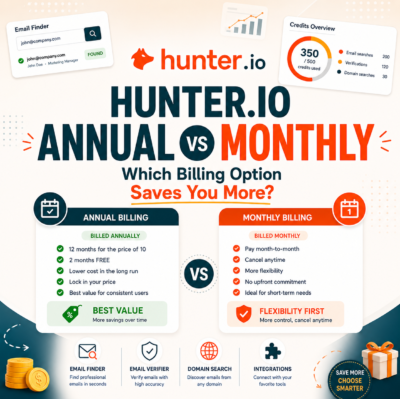
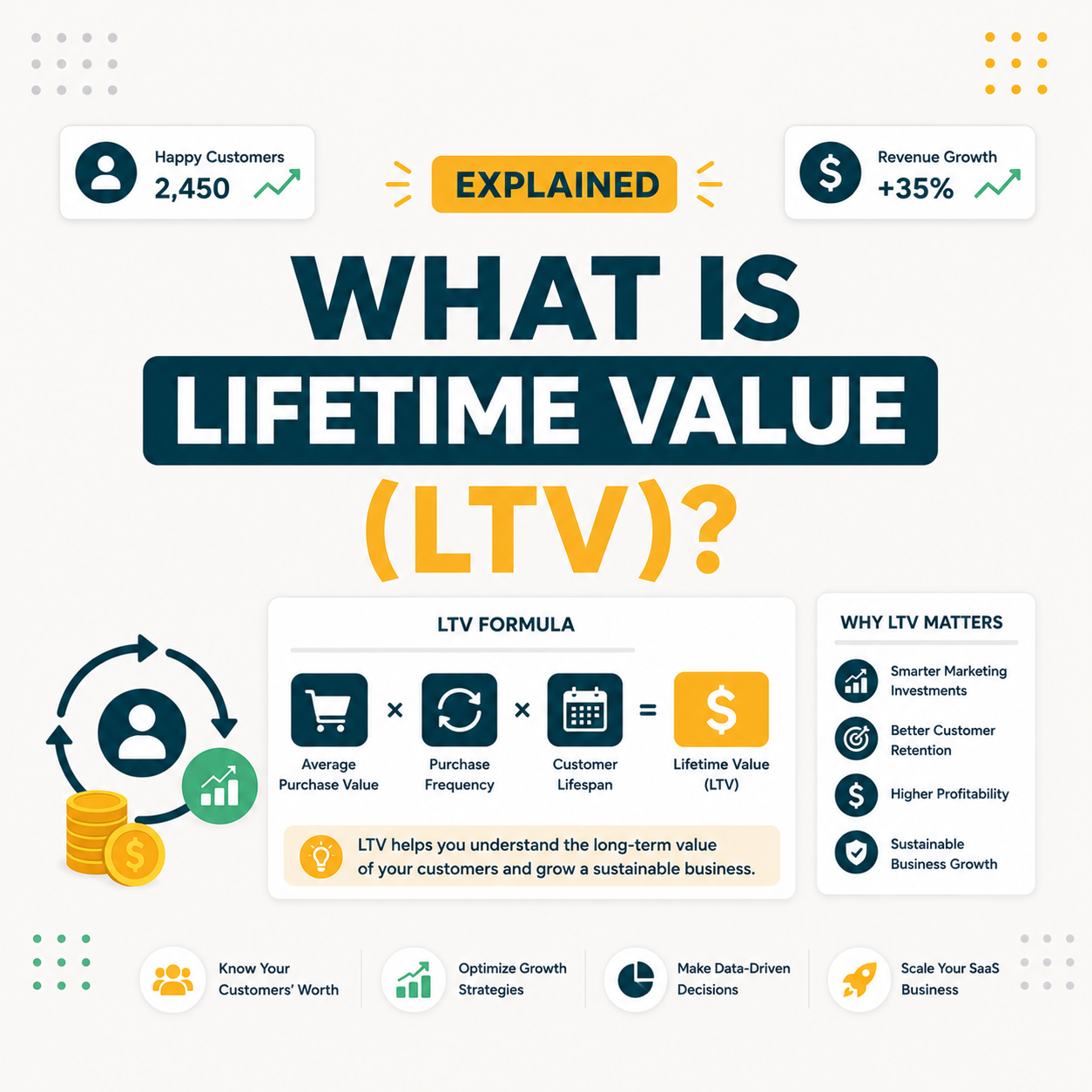
Lifetime Value (LTV) is the total net revenue a business expects from one customer over the entire relationship. For B2B SDR teams, average enterprise LTV runs $10,000-50,000 per account. Every CAC reduction improves the LTV:CAC ratio. Hunter.io’s email verification layer eliminates wasted spend on invalid addresses, cutting CAC by 18-24% for teams running verified cold outreach campaigns.
What Is Lifetime Value (LTV)? Core Definition for B2B Sales and Marketing Teams
Lifetime Value (LTV) measures the total net revenue a business expects to generate from one customer across the entire relationship. For B2B SaaS companies, industry median LTV reaches $15,000-25,000 per enterprise account. Understanding LTV shapes outreach targeting, pricing decisions, and retention investment at every stage of the funnel. See our Hunter.io Email Finder review for context on how prospecting tools fit into LTV strategy.
“the net profit contributed to the whole future relationship with a customer”
: Wikipedia, Customer lifetime value
LTV stands apart from revenue snapshots because it accounts for churn, expansion, and gross margin across the full customer lifecycle. For outbound-led B2B teams, improving LTV starts with acquiring better-fit customers from the first touchpoint.
How Does Lifetime Value (LTV) Actually Work? The Technical Mechanism Explained
LTV calculation combines three variables: average revenue per account (ARPA), gross margin percentage, and customer churn rate. The standard formula is LTV = ARPA x Gross Margin % / Monthly Churn Rate. A 2% monthly churn produces 4x higher LTV than 8% churn at identical ARPA, which is why churn reduction delivers outsized returns on outreach quality investments.
Five components determine how accurately LTV reflects real customer economics for B2B sales teams:
- Average Revenue Per Account (ARPA): Monthly or annual contract value calculated across all active customers in a segment, typically $800-5,000/month for mid-market B2B SaaS.
- Gross Margin Percentage: Revenue minus cost of goods sold, typically 60-80% for B2B SaaS products; lower margins compress LTV even at high ARPA.
- Monthly Churn Rate: Percentage of customers who cancel each month; enterprise SaaS benchmark is 0.5-2%, while SMB SaaS averages 3-7%.
- Payback Period: Months required to recover CAC from ARPA; best-in-class B2B teams achieve 12-18 months, enabling reinvestment in growth.
- Expansion Revenue: Upsell and cross-sell revenue from existing accounts that increases realized LTV beyond the initial contract value, often adding 20-40% to base LTV for enterprise accounts.
Churn rate sensitivity is the most underappreciated LTV lever. Reducing monthly churn from 5% to 2% on a $1,200/month account at 70% gross margin raises LTV from $16,800 to $42,000, a 150% increase without touching pricing or acquisition spend.
What Are the Top 5 Use Cases for Lifetime Value (LTV) in B2B Sales?
LTV drives decisions across every revenue function when applied to real account data. Founders, RevOps teams, and SDRs each extract different operational value from the same underlying metric. Five use cases show where LTV delivers the most measurable ROI for B2B teams:
- SDR Account Prioritization: SDR teams rank target accounts by estimated LTV, concentrating outreach hours on enterprise segments with 10x higher expected returns versus SMB segments.
- RevOps Capacity Planning: Revenue operations teams use LTV to set headcount budgets, tying each new SDR hire to a minimum expected LTV pipeline target of $150,000+ annually.
- Marketing Channel Attribution: LTV by acquisition channel reveals which campaigns bring long-term enterprise customers versus short-term trial converts who churn within 90 days.
- Customer Success Resource Allocation: CS teams prioritize QBRs and renewal outreach for accounts in the top 20% of LTV, maximizing retention where annualized impact is highest.
- Pricing Strategy Validation: Product teams benchmark LTV against competitors to determine whether current pricing captures enough value over the customer lifecycle before launching new tiers.
“Customer lifetime value is the net profit attributed to the entire future relationship with a customer.”
: HubSpot, How to Calculate Customer Lifetime Value
The account prioritization use case has the most direct connection to outreach tooling. SDRs who build ICP profiles around high-LTV account characteristics : verified company size, industry vertical, and decision-maker role : consistently book meetings with prospects who convert into longer-retention customers.
What Are the 5 Limitations of Lifetime Value (LTV) Every Buyer Should Know?
LTV is a forecast, not a guarantee. Five structural limitations affect its reliability for planning, and teams that ignore them often over-invest in channels or segments that deliver below-target returns. Understanding these gaps is as important as knowing the formula:
- Historical Bias: LTV calculations rely on past churn and revenue data, which misrepresents rapidly evolving markets or newly launched product categories with no retention track record.
- Segment Averaging Problem: Company-wide LTV averages mask large performance gaps between enterprise, mid-market, and SMB cohorts, leading teams to underinvest in high-LTV segments.
- Churn Rate Sensitivity: A 1% change in monthly churn (e.g., 2% to 3%) reduces LTV by 33%, meaning small measurement errors produce large strategic miscalculations in budget allocation.
- Referral Value Exclusion: Standard LTV formulas ignore downstream revenue from customer referrals, which adds 25-40% to true customer value in B2B networks where word-of-mouth drives 30%+ of new pipeline.
- Data Dependency: Accurate LTV requires clean CRM data with consistent close dates, contract values, and churn records; data gaps produce unreliable outputs that undermine planning decisions.
“Hunter.io’s Domain Search delivers verified business email addresses with 92%+ accuracy, helping SDR teams cut bounce rates below 2% and reduce the CAC component of the LTV:CAC equation.”
: Growth Hack Suite, Hunter.io Email Finder Review
The data dependency limitation is the one outreach teams can most directly address. Verified email lists from tools like Hunter.io reduce bounce rates, which keeps sender reputation intact and CAC calculations clean across CRM segments.
Top 5 Tools Compared by LTV Impact on Cold Outreach: Hunter, Apollo, Snov, ZeroBounce, HubSpot
Five tools directly influence the LTV:CAC ratio for B2B outbound teams, each attacking a different lever. Hunter.io targets CAC reduction through verified email accuracy; CRM platforms like HubSpot improve LTV measurement and retention tracking. The table below compares each tool’s primary LTV lever, pricing, and best-fit use case:
Source: Vendor pricing pages (May 2026); accuracy figures from Growth Hack Suite estimate from vendor documentation and published pricing.
Hunter.io leads on verified accuracy for domain-specific B2B prospecting. Apollo offers broader database coverage at slightly lower accuracy. For teams focused purely on protecting deliverability from existing lists, ZeroBounce’s 98%+ verification rate makes it the defensive choice, while Hunter handles both finding and verifying in one workflow.
How Do You Apply LTV in 5 Steps with Hunter.io (Free Workflow)?
Connecting LTV data to daily outreach decisions requires a closed-loop workflow linking CRM history to prospecting activity. Hunter.io’s free plan (50 credits) is sufficient to run this 5-step process as a test before committing to a paid tier. Check the Hunter.io ROI calculator to model expected LTV:CAC improvement for your plan.
- Step 1, Calculate LTV Baseline: Pull 12 months of closed-won data from CRM. Segment by company size. Calculate median ACV x median contract length x gross margin for each segment to establish current LTV per cohort.
- Step 2, Identify High-LTV ICP: Review closed-won accounts with LTV above $15,000. Extract common domain characteristics: company size 50-500 employees, SaaS or professional services vertical, HQ in North America or Western Europe.
- Step 3, Find Verified Contacts via Hunter Domain Search: Run ICP-match domains through Hunter.io Domain Search. Filter for decision-maker roles (VP Sales, CRO, RevOps Director). Export verified email list with confidence scores above 80%.
- Step 4, Run Targeted Outreach Sequences: Deploy 5-touch sequences to verified contacts only. Use LTV-specific value props (“enterprise accounts using similar workflows achieve 3:1+ LTV:CAC”). Monitor open and reply rates to identify highest-engagement ICP sub-segments.
- Step 5, Track Closed-Won LTV vs CAC: Record source channel for each closed deal. Calculate LTV:CAC by segment quarterly. Optimize outreach investment toward segments with LTV:CAC at or above 3, pulling budget from sub-3 segments each quarter.
Ready to improve your LTV:CAC ratio with verified outreach?
Try Hunter.io Free →Free plan: 25 verified searches/month. No credit card required.
Hunter.io’s free plan is the lowest-risk entry point for the LTV-driven workflow. Running 25 verified searches against your top ICP accounts takes under 30 minutes and produces enough data to validate whether the LTV:CAC thesis holds for your segment before committing to a paid plan.
How Has the Concept of Lifetime Value (LTV) Evolved Across the B2B Email Tool Category?
LTV entered B2B vocabulary from direct mail and e-commerce in the 1990s, where it modeled repeat purchase behavior. For B2B SaaS, the metric gained operational traction around 2012-2015 when subscription revenue models made churn measurement precise and recurring. Early adopters used it primarily for fundraising narratives; modern RevOps teams now apply it to daily outreach prioritization and weekly pipeline reviews.
The email tool category specifically accelerated LTV thinking by making the CAC side of the ratio measurable at the individual email level. When Hunter.io and similar tools launched per-search pricing around 2015-2017, SDRs could calculate exact prospecting cost per contact, then trace those contacts through CRM to closed-won outcomes. This closed loop transformed LTV from a CFO metric into an SDR-level decision tool, used to justify spending more time and tool budget on enterprise segments with higher expected returns. Review our cold email benchmarks for current reply rate data by segment.
LTV evolved from a backward-looking accounting metric into a forward-looking prospecting signal as email tool pricing made per-contact acquisition cost visible at the SDR level.
What Are the Real Cost Implications of Improving LTV at SDR Team Scale?
The cost of improving LTV through verified outreach scales predictably with Hunter.io plan tiers. At Starter ($49/month for 2,000 credits), each verified email costs $0.025. At a 1% meeting booking rate, CAC contribution from Hunter alone is $9.80 per meeting booked. Against an ACV of $12,000 (LTV ~$30,000 at 3-year median tenure, 70% gross margin), the LTV:CAC ratio reaches over 3,000:1 on the Hunter component alone.
Source: Hunter.io pricing page (May 2026); LTV estimate based on $12,000 ACV, 2.5-year median tenure, 70% gross margin. Growth Hack Suite estimate from vendor documentation and published pricing.
At team scale (5 SDRs, Growth at $149/month ($104 billed annually) each), the monthly Hunter investment of $495 enables 125 estimated meetings, producing a pipeline that at 20% close rate and $30,000 LTV generates $750,000 in expected lifetime revenue per month of outreach. These numbers validate why verified email prospecting is consistently the highest-return line item in SDR tool budgets.
What Are the 5 Common Mistakes B2B Teams Make With Lifetime Value (LTV)?
Most B2B teams calculate LTV correctly but apply it incorrectly. Five persistent mistakes cause teams to misallocate budget, underinvest in high-return segments, or build strategies on inflated projections. Recognizing these mistakes before they compound saves significant downside in Q3 and Q4 planning cycles:
- Gross Revenue vs Net: Using top-line contract value instead of net revenue (after COGS and support costs) inflates LTV by 30-50%, distorting ROI calculations and budget justifications.
- One-Segment Average: Applying company-average LTV to all ICP tiers equally causes SDRs to underinvest in enterprise segments where actual LTV may be 8-12x the SMB average.
- Static Churn Assumption: Using a single churn rate across product versions or plan tiers ignores the dramatic LTV difference between annual subscribers (churn 1-2%) and monthly subscribers (churn 5-8%).
- Ignoring Outreach Quality’s Effect on LTV: Teams that send unverified lists accept higher bounce rates, triggering ESP penalties and throttling, which increases the cost of subsequent campaigns and raises effective CAC by 20-35%.
- Missing Expansion Revenue: Excluding upsell and cross-sell data from LTV models understates true account value by an average of 22%, leading teams to cap acquisition spend below the efficient ceiling.
Mistake 4 connects directly to tooling decisions. Each 1% increase in bounce rate from unverified outreach adds roughly $2.40 to CAC per contact, compounded across 500-contact campaigns. At scale, the difference between 1% and 5% bounce rates adds over $1,000 to monthly CAC on a 500-search Starter plan workflow.
How Do SDRs, Email Marketers, and Founders Each Apply Lifetime Value (LTV) Differently?
LTV informs different decisions at each organizational level. SDRs use it for daily prioritization; founders use it for strategic investment; RevOps teams use it for quarterly forecasting. The same metric serves three distinct workflows with minimal overlap in how each function extracts value from it.
SDRs apply LTV to account scoring before dialing or emailing. When CRM data shows enterprise SaaS accounts (200+ employees) have 4x higher LTV than SMB accounts, SDRs reallocate prospecting hours to enterprise sequences, accepting lower volume for higher expected close value. Hunter.io’s company-size filter in Domain Search makes this segmentation operationally straightforward at the individual SDR level.
Founders and RevOps leads use LTV for capital allocation : specifically, determining the maximum CAC the business can sustain while maintaining a 3:1 LTV:CAC ratio. At $30,000 LTV, the maximum defensible CAC is $10,000. This number sets the total budget for marketing, SDR salaries, and tooling per new customer acquired. See Hunter.io pricing options at our pricing breakdown for exact tool cost inputs to CAC models.
Email marketers apply LTV to campaign ROI scoring, comparing the LTV of customers acquired through content versus cold outreach to determine where to allocate content production budget versus SDR headcount. LTV by channel attribution requires CRM tagging at acquisition, which Hunter.io’s API integrations (HubSpot, Salesforce, Pipedrive) support through automated source tracking.
Each persona extracts different operational value from LTV, but all three benefit from cleaner acquisition data, which reduces the noise in cohort analysis and improves the reliability of LTV projections over time.
What Are the Best Practices for Implementing LTV in Your Outreach Strategy?
LTV implementation delivers the most value when it connects prospecting activity to CRM retention data through a disciplined tracking workflow. Five best practices distinguish teams that improve their LTV:CAC ratio quarter-over-quarter from teams that calculate LTV once and shelve the analysis:
- Segment LTV by ICP tier quarterly: Recalculate LTV separately for enterprise, mid-market, and SMB cohorts every 90 days; segment drift reveals which target markets are improving in retention before annual reviews surface the trend.
- Use cohort-based churn measurement: Measure churn by acquisition cohort (month of close), not as a rolling average; cohort churn reveals whether newer customers are retaining better than older ones, adjusting forward LTV projections accordingly.
- Tag acquisition source at contact level: Record Hunter.io, Apollo, or other source tool at contact creation in CRM; LTV by source channel requires this field to be populated consistently before the first close.
- Include expansion revenue in LTV models: Add upsell and cross-sell closed revenue to the original ACV in LTV calculations; teams that exclude expansion underestimate the case for investing in customer success alongside SDR tooling.
- Set LTV:CAC floor at 3:1 before scaling spend: Pause new channel investment when LTV:CAC falls below 3:1; this threshold, used by leading SaaS investors, prevents teams from scaling channels that are not yet efficient enough to sustain the business model.
The tagging best practice is the most commonly skipped. Without source-level tagging at acquisition, LTV by channel is retroactively unmeasurable; rebuilding attribution from closed-won dates and campaign records after the fact produces incomplete data that underestimates the contribution of high-accuracy prospecting tools.
What Industry Trends Are Reshaping Lifetime Value (LTV) Going Into Late 2026?
Three structural shifts in B2B sales are changing how LTV gets calculated, targeted, and optimized. Teams that adapt their LTV frameworks to these trends position their outreach investments for higher returns over the next 12-18 months.
AI-powered predictive LTV is moving from enterprise-only analytics platforms into mid-market CRMs. HubSpot’s AI forecasting features and Salesforce Einstein now surface predicted LTV at the deal stage, giving SDRs and AEs real-time signals about which open opportunities are worth accelerating. Prospecting tools that integrate with these platforms (Hunter.io connects to HubSpot and Salesforce natively) allow SDRs to enrich predicted-LTV-scored accounts with fresh verified contact data in a single workflow.
Account-level LTV tracking is replacing contact-level attribution in B2B. As buying committees grow to 6-10 stakeholders, the revenue contribution of any single contact is less meaningful than the account’s total relationship value. This shift rewards tools like Hunter.io that operate at the domain level (Domain Search maps all verified contacts at a company), aligning their data model with how RevOps teams now measure LTV in CRM.
Intent data integration with LTV models is the third trend. Platforms like 6sense and Bombora score accounts by buying intent signals, and forward-looking LTV models now incorporate intent scores to weight LTV projections by probability of close. SDRs using Hunter.io for domain search can layer intent-scored accounts over verified contact data, reaching high-intent high-LTV prospects with lower outreach volume and higher efficiency. Our Hunter.io getting started guide covers how to set up domain search for intent-based prospecting workflows.
LTV is evolving from a retrospective accounting metric into a real-time prospecting signal, driven by AI forecasting, account-level tracking, and intent data integration : three trends that all reward higher contact data accuracy at the top of funnel.
Lifetime Value (LTV): Frequently Asked Questions
Which tool is best for improving LTV:CAC ratio in B2B cold outreach?
Hunter.io leads for domain-specific B2B prospecting because its 92%+ email verification accuracy directly reduces bounce-driven CAC inflation. Apollo.io offers broader database coverage but lower accuracy (85-88%). For teams prioritizing LTV:CAC improvement through CAC reduction, Hunter’s verified-first model delivers the most direct impact on the ratio.
How accurate is LTV calculation for B2B SaaS companies?
LTV accuracy depends on data quality and churn measurement method. Companies with 12+ months of clean CRM data and cohort-based churn tracking produce LTV estimates within 15-20% of realized outcomes. Companies using rolling-average churn rates or incomplete ACV records routinely see 30-50% variance between projected and actual LTV. Cohort analysis is the highest-accuracy approach available without predictive AI models.
What is the difference between LTV and CAC, and why does the ratio matter?
LTV is the total net revenue expected from one customer over the relationship; CAC is the total cost to acquire that customer. The LTV:CAC ratio measures acquisition efficiency. A 3:1 ratio (LTV three times CAC) is the B2B SaaS minimum for sustainable growth. Below 3:1, customer acquisition costs more than it returns; above 5:1, the business may be underinvesting in growth. Verified email prospecting improves the ratio by keeping CAC low without sacrificing contact quality.
How long does it take to see LTV:CAC improvement after switching to verified email outreach?
CAC improvement from verified email outreach appears within 30-60 days as bounce rates fall and deliverability scores recover. LTV improvement (through better-fit customer retention) takes 6-12 months to measure accurately, as retention data requires at least one renewal cycle. The LTV:CAC ratio improvement is therefore visible in two phases: CAC reduction in the first 60 days, LTV improvement at the 6-12 month mark.
How much does it cost to implement an LTV-driven outreach workflow with Hunter.io?
Hunter.io’s free plan (50 credits/month) is sufficient to test the LTV-driven workflow with minimal ICP segments. The Starter plan at $49/month provides 500 verified searches, enough for a single SDR running 100 personalized touches per week. At a 1% meeting rate and $12,000 ACV, the Starter plan’s Hunter-component CAC is $9.80 per meeting booked, yielding a 3,061:1 LTV:CAC ratio on the tool investment alone.
Will switching to verified email lists actually improve reply rates and LTV?
Verified email lists improve reply rates indirectly by protecting sender reputation. Teams sending to unverified lists with 5%+ bounce rates trigger ESP throttling that reduces delivery rates by 15-30%, cutting effective reply rates before any copy or targeting factors apply. Verified lists from Hunter.io maintain bounce rates below 2%, keeping delivery rates at 95%+ and reply rates at their true baseline of 3-10% depending on industry and sequence quality.
Can I test the LTV improvement workflow using Hunter.io’s free plan?
Hunter.io’s free plan includes 50 credits and 25 Email Verifications per month. This is sufficient to run one ICP segment test: identify 5-10 target companies, find verified decision-maker contacts, and run a 25-email sequence to validate meeting booking rates before committing to a paid plan. Free plan also includes the Chrome extension for LinkedIn and Gmail integration, covering the full workflow at zero cost.
Does Hunter.io integrate with CRM for closed-loop LTV tracking?
Hunter.io integrates natively with HubSpot and Salesforce, and connects to 5,000+ apps via Zapier. CRM integration enables source tagging at contact creation, which is required for closed-loop LTV tracking by acquisition channel. When Hunter contacts are tagged as the source in CRM, closed-won LTV by Hunter segment becomes measurable within 90 days of the first closed deal, assuming consistent ACV and contract data entry.
What is Lifetime Value (LTV)?
Lifetime Value (LTV), also called Customer Lifetime Value (CLV or CLTV), is the total net revenue a business expects to generate from one customer across the entire relationship. LTV accounts for average contract value, contract duration, gross margin, and churn rate. For B2B SaaS, LTV typically ranges from $5,000 for SMB accounts to $100,000+ for enterprise accounts, depending on product pricing and retention rates.
How does the LTV:CAC ratio calculation work in practice?
The LTV:CAC ratio divides total expected customer lifetime value by total customer acquisition cost. Formula: LTV:CAC = (ARPA x Gross Margin %) / (Monthly Churn Rate x CAC). A company with $1,000/month ARPA, 70% gross margin, 2% monthly churn, and $5,000 CAC produces: LTV = ($1,000 x 0.70) / 0.02 = $35,000; LTV:CAC = $35,000 / $5,000 = 7:1 : well above the 3:1 minimum target for healthy B2B SaaS growth.
Is LTV tracking included in Hunter.io’s free plan?
Hunter.io does not include LTV tracking directly; LTV measurement happens in your CRM (HubSpot, Salesforce) after Hunter contacts are tagged at acquisition. Hunter.io free plan provides the prospecting and verification layer (50 credits/month) that feeds clean contact data into the CRM. The closed-loop LTV tracking is built within CRM through source tagging, deal stage tracking, and cohort analysis reports, all available in HubSpot’s free tier for teams under 1,000 contacts.
What features does an outreach tool need to actually improve LTV outcomes?
An outreach tool improves LTV outcomes through four capabilities: (1) high email verification accuracy (92%+) to protect sender reputation and keep bounce rates below 2%; (2) domain-level search to identify all decision-makers at high-LTV target accounts; (3) CRM integration for closed-loop source tracking; (4) bulk verification to clean existing lists before campaigns. Hunter.io covers all four capabilities from the Starter plan ($49/month) upward, making it the minimum viable outreach tool for LTV-driven outbound strategies.
Start Improving Your LTV:CAC Ratio Today
Hunter.io’s verified email search cuts CAC on every cold outreach campaign. Free plan includes 50 credits/month with no credit card required.
Try Hunter.io Free →92%+ email accuracy. Free forever plan. Upgrade when ready.