Table of Contents
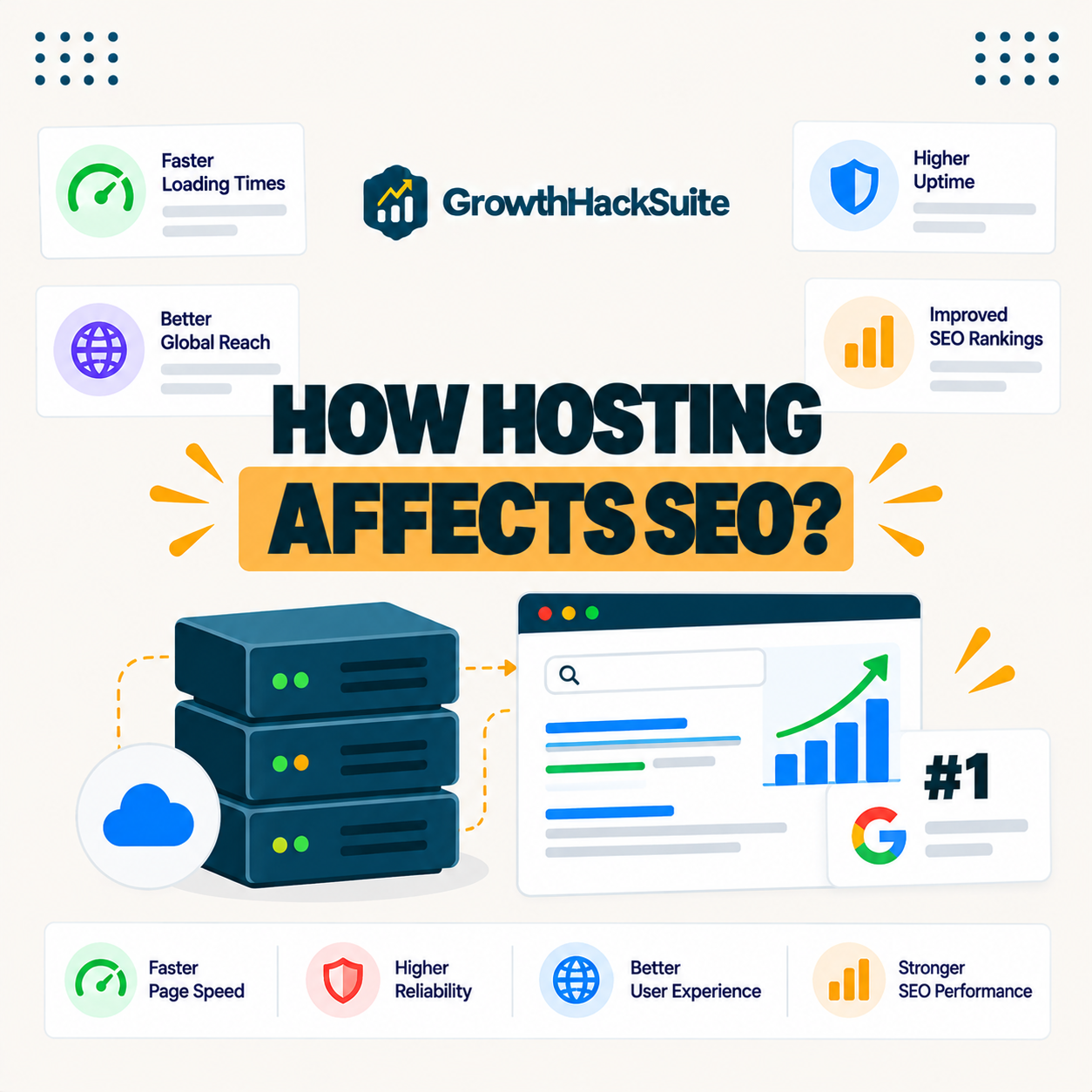
Hosting affects SEO through speed, uptime, security and server location, which influence Core Web Vitals, crawlability and user experience. While hosting is not a direct ranking factor by name, poor hosting undermines the page experience and reliability that search engines reward, so a fast, stable host supports better rankings. This guide explains how your web host influences search performance.
Last updated: August 2026. Written by the Growth Hack Suite editorial team, with details cross-checked against provider documentation. This page carries affiliate links to Kinsta.
How Hosting Affects SEO and Rankings
Hosting affects SEO through speed, uptime, security and server location, which influence Core Web Vitals, crawlability and user experience. While hosting is not a named ranking factor, poor hosting undermines the signals search engines reward, so the host quietly shapes a site’s ceiling.
“SEO is the process of improving the quality and quantity of website traffic.”
— Wikipedia, Search engine optimization
Hosting supports that quality by making pages fast, available and secure, which are the technical foundations SEO is built on before any content or link work.
How Hosting Affects SEO Through Speed
Hosting speed influences rankings because a fast server lowers TTFB and improves Core Web Vitals like Largest Contentful Paint. Since page experience is a ranking signal and speed reduces bounce rates, faster hosting indirectly supports better positions in search results.
Verdict: Hosting is not a named Google ranking factor, but it shapes the ones that are: speed feeds Core Web Vitals, uptime keeps pages crawlable, and SSL is a lightweight signal. The honest rule is that good hosting cannot rank thin content, but bad hosting can hold back great content, so a fast, reliable, secure host is a foundation rather than a shortcut.
In short, hosting is an enabler: it removes technical drag so content and links can do their job on a solid base.
Why Uptime Matters for SEO
Uptime matters for SEO because if search engine crawlers repeatedly hit a site that is down, they crawl it less and users lose trust. Reliable hosting keeps pages consistently available for both crawling and visitors, so uptime protects both indexing and reputation.
The honest point is that occasional brief outages are survivable, but frequent downtime signals unreliability to both crawlers and returning visitors.
Does Server Location Affect SEO?
Server location affects SEO through speed and, for local audiences, relevance. A server near your visitors responds faster, and while a CDN reduces distance for assets, the origin location still influences performance for uncached requests, so location matters most for dynamic pages.
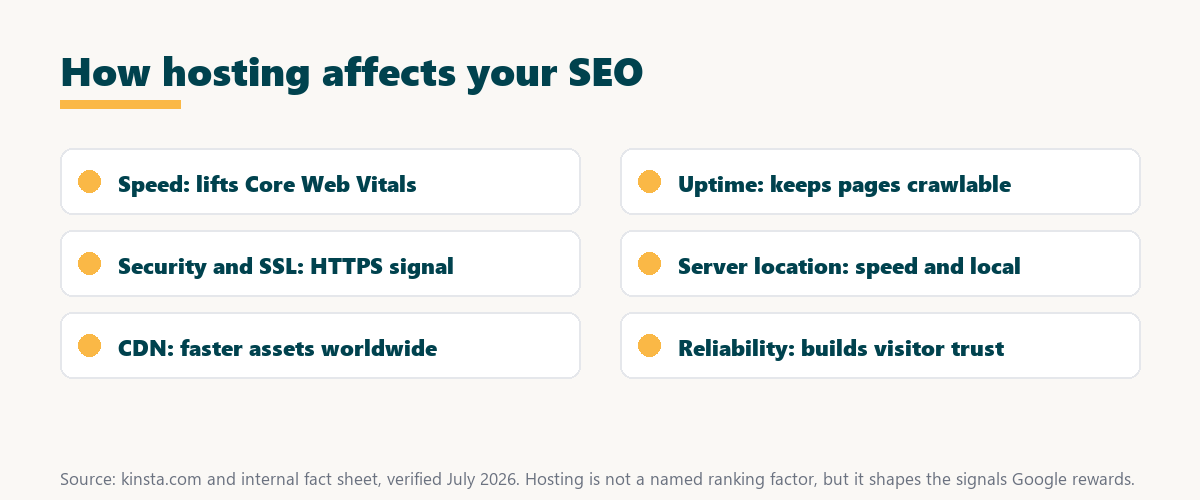
Source: provider documentation, verified August 2026. Each factor feeds a page-experience or trust signal.
Listing speed, uptime, security and location with how each influences rankings shows that hosting touches several page-experience and trust signals at once.
See how Kinsta gives content a fast base to rank on
Try Kinsta →Fast servers, uptime SLA and SSL, with a 30-day money-back guarantee.
How Security and SSL Affect SEO
Security and SSL affect SEO because HTTPS is a lightweight ranking signal and a hacked or malware-flagged site can be penalized or blocked. A secure host with SSL and protection preserves both rankings and visitor trust, so security is part of a site’s SEO foundation.
- Free SSL: HTTPS is a confirmed ranking signal, and managed hosts include SSL so every page is served securely.
- Malware protection: A firewall and malware scanning prevent the hacks that can get a site flagged or blocked.
- DDoS mitigation: Absorbing attacks keeps the site online, protecting the uptime that crawling depends on.
- Isolated resources: Isolation avoids the shared-IP risks that can come with cheap oversold hosting.
- Regular backups: Fast recovery after an incident limits the downtime that would otherwise hurt SEO.
The honest takeaway is that security rarely lifts rankings on its own, but a security failure can sink them, so it is insurance for SEO.
How Poor Hosting Affects SEO
Poor hosting hurts SEO by causing slow pages, frequent downtime, shared-IP security risks and crawl errors, all of which degrade page experience and reliability. Cheap oversold hosting can quietly hold back a site’s search performance no matter how good its content is.
“The first five seconds of page-load time have the highest impact on conversion rates.”
— HubSpot, page load time and conversion rates
Because slow, unreliable hosting hits those early seconds and the page-experience signals that follow, weak hosting suppresses both conversions and rankings at once.
Signs Your Hosting Is Holding Back SEO
Signs your hosting is holding back SEO include slow load times in PageSpeed Insights, failing Core Web Vitals, downtime alerts and crawl errors in Search Console. Together these suggest the server, rather than the content, is the bottleneck limiting search performance.
- Slow PageSpeed scores: Consistently low scores driven by server response point to hosting, not content.
- Failing Core Web Vitals: A poor LCP tied to a slow server signals the host is the limiting factor.
- Downtime alerts: Frequent outage notifications show the host cannot keep pages reliably available.
- Crawl errors: Server errors in Search Console reveal the site is unreachable when crawlers visit.
- Traffic dips after spikes: Rankings that slide after traffic surges suggest the host buckles under load.
The honest takeaway is that when these signs cluster, upgrading hosting often unblocks SEO that content changes alone could not fix.
What Makes Hosting SEO-Friendly
SEO-friendly hosting offers fast compute-optimized servers, reliable uptime, a CDN, SSL and security, and nearby data centers. These deliver the speed, availability and trust that underpin strong page experience signals, so the host actively supports rather than limits SEO.
Source: provider documentation, verified August 2026. Look for these features when SEO matters.
Listing fast servers, an uptime SLA, a CDN, SSL and data center choice gives a simple checklist for an SEO-friendly host. Owners weighing platform commitment can also read our note on SaaS vendor lock-in.
How to Choose Hosting for SEO
Choose hosting for SEO by prioritizing speed, uptime guarantees, security, a CDN and data center choice over the lowest price. These infrastructure factors shape the page experience and reliability that support rankings, so they matter more than a cheap headline rate.
Get SEO-friendly hosting handled on Kinsta
Start With Kinsta →Free migration and a 30-day money-back guarantee.
How Kinsta Supports SEO Performance
Kinsta supports SEO performance with fast Google Cloud servers, a 99.9 percent uptime SLA, a Cloudflare CDN and firewall, and free SSL, with data centers in Google Cloud regions worldwide. Content gets a fast, reliable, secure foundation to rank on, without the technical drag of weak hosting.
“A tool is only worth its premium when the hours or revenue it protects exceed the invoice.”
— Growth Hack Suite, on tool ROI
Applied to SEO, a fast, reliable host earns its premium when the rankings and traffic it protects are worth more than the difference over cheap hosting.
Is Hosting a Direct Google Ranking Factor?
Hosting is not a named direct ranking factor, but it shapes speed, uptime and security, which feed into page experience signals and the reliability search engines reward. So hosting influences rankings indirectly but meaningfully, by improving or degrading the factors Google measures.
The honest qualifier is that content and links still lead, so hosting is a supporting factor that removes drag rather than a lever that ranks a page on its own.
How Better Hosting Affects SEO Results
You improve SEO through better hosting by moving to a fast, reliable managed host, which lifts Core Web Vitals, reduces downtime and secures the site. Your content then competes on a stronger technical foundation, so gains from content and links are no longer held back by the server.
The honest summary is that better hosting rarely creates rankings by itself, but it removes the technical ceiling that weak hosting imposes on otherwise strong content.
Give your SEO a fast foundation risk-free
Try Kinsta Risk-Free →Fast hosting, uptime SLA and free migration, with a 30-day money-back guarantee.
Hosting and SEO: Frequently Asked Questions
The 12 most-asked questions about hosting and SEO.
Does hosting affect SEO?
Yes, hosting affects SEO through speed, uptime, security and server location, which shape Core Web Vitals and user experience, so poor hosting undermines the signals search engines reward.
How does hosting speed affect rankings?
Hosting speed affects rankings because a fast server improves Core Web Vitals and reduces bounce rates, and since page experience is a ranking signal, faster hosting indirectly supports better positions.
Does downtime hurt SEO?
Yes, downtime hurts SEO, because crawlers that repeatedly find a site down crawl it less and users lose trust, so reliable uptime keeps pages available for crawling and visitors.
Does server location matter for SEO?
Server location matters for SEO through speed and local relevance, since a nearby server responds faster, though a CDN reduces distance for cached assets.
Is HTTPS a ranking factor?
Yes, HTTPS is a lightweight ranking signal, and a secure host with SSL also protects against hacks and malware flags that can harm rankings and visitor trust.
Can cheap hosting hurt my SEO?
Yes, cheap oversold hosting can hurt SEO by causing slow pages, downtime and security risks, all of which degrade the page experience and reliability search engines reward.
How do I know if hosting is hurting my SEO?
Signs include slow PageSpeed scores, failing Core Web Vitals, downtime alerts and crawl errors in Search Console, which suggest the server rather than content is the bottleneck.
What makes hosting SEO-friendly?
SEO-friendly hosting offers fast servers, reliable uptime, a CDN, SSL and security, and nearby data centers, delivering the speed, availability and trust that support page experience.
Does a CDN help SEO?
Yes, a CDN helps SEO by serving assets from locations near visitors, improving speed and Core Web Vitals, which support the page experience signals used in ranking.
Will better hosting improve my rankings?
Better hosting can improve rankings indirectly by lifting Core Web Vitals, reducing downtime and securing the site, giving your content a stronger technical foundation to compete on.
Is hosting a direct Google ranking factor?
Hosting is not a named direct ranking factor, but it shapes speed, uptime and security, which feed into page experience signals and the reliability search engines reward.
How does Kinsta support SEO?
Kinsta supports SEO with fast Google Cloud servers, a 99.9 percent uptime SLA, a CDN and firewall, and free SSL, giving content a fast, reliable, secure base to rank on.
About this guide
Written by the Growth Hack Suite editorial team, drawing on hands-on experience running and optimizing sites for search. Details were cross-checked against provider documentation. This page carries affiliate links to Kinsta, so the position is stated plainly: hosting is not a named Google ranking factor, but it shapes speed, uptime, security and location, which feed the page-experience and trust signals Google rewards. Good hosting cannot rank thin content, but bad hosting can hold back great content, and Kinsta gives content a fast, reliable, secure foundation on Google Cloud.