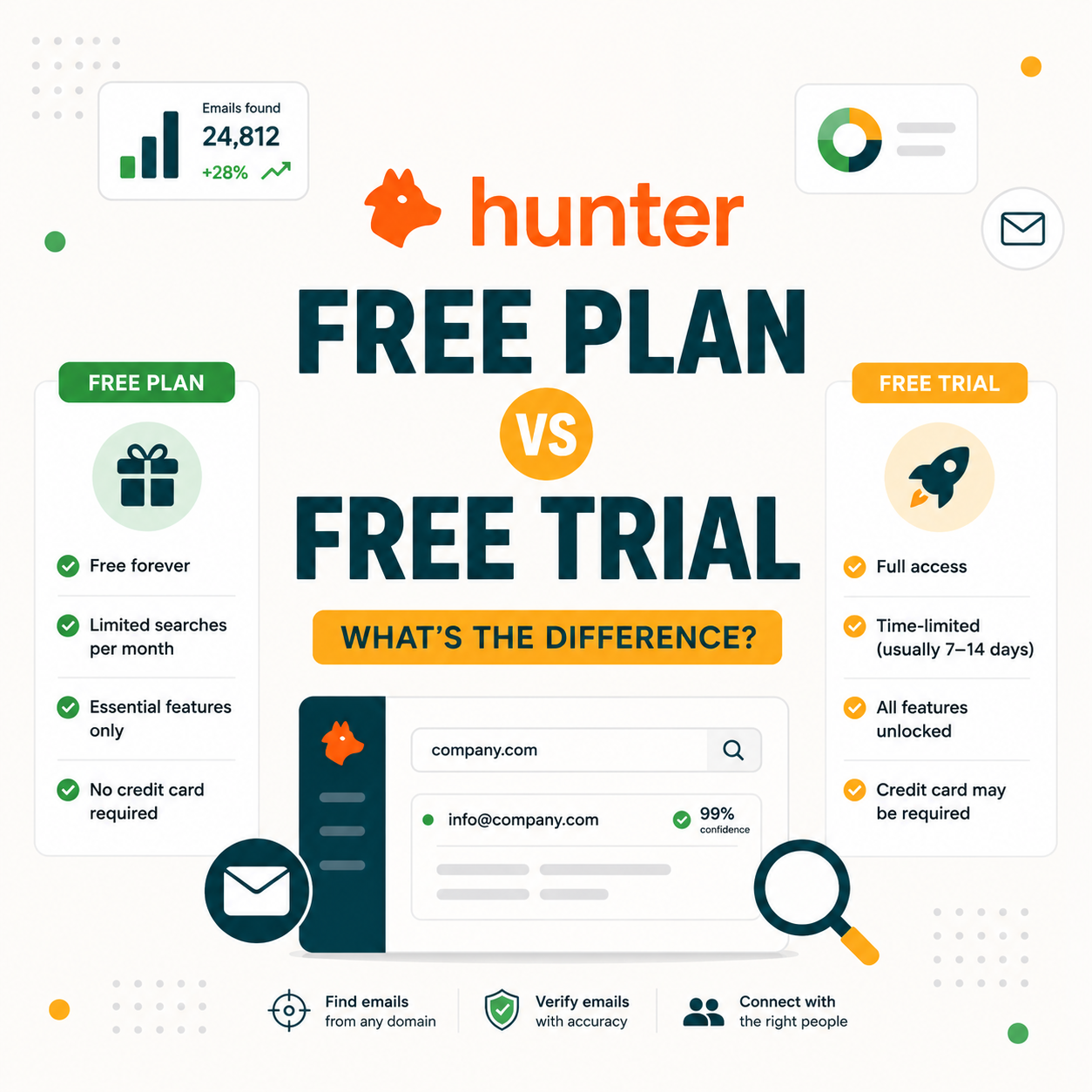
Hunter.io free plan vs free trial: Hunter uses a free plan, offering 50 credits a month indefinitely with no card, not a time-limited trial. A free plan gives limited access forever, while a free trial unlocks full features for a short period and then ends. Hunter.io uses a free plan: 50 credits a month, indefinitely, with no card. Knowing the difference matters because Hunter has no expiry pressure, so a buyer can evaluate at their own pace and upgrade only after outgrowing the free limits.
Table of Contents
Free Plan vs Free Trial: The Core Difference
The core difference is duration versus depth. A free plan offers a limited slice of the product permanently, while a free trial offers the full product for a fixed window before locking it. One trades features for time; the other trades time for features.
- Duration: A free plan lasts indefinitely, while a free trial ends on a fixed date after a set number of days.
- Feature scope: A trial usually unlocks the full feature set, while a free plan exposes a limited subset.
- Card required: Trials often require a card up front, while many free plans, including Hunter’s, do not.
- Expiry: A trial expires and locks the product, while a free plan keeps a limited version available.
- Conversion pressure: A trial pushes a deadline decision, while a free plan converts on growing usage.
Choosing between the two models is choosing between full features for a short time and limited features for an unlimited time.
Which One Does Hunter.io Offer?
Hunter.io offers a free plan, not a free trial. It provides 50 credits per month on a permanent basis, requires no credit card, and resets every cycle. The product is never locked behind an expiry date, which puts it firmly in the freemium category.
Because Hunter runs freemium, the evaluation has no deadline and no card requirement to navigate.
Pros and Cons of a Free Plan
A free plan’s strength is the absence of deadline pressure; its weakness is limited volume and features. It suits unhurried evaluation and light ongoing use, but cannot power sustained outreach because the monthly cap is intentionally small.
Source: Internal benchmark : general freemium plan characteristics applied to Hunter.io’s free tier.
A free plan rewards patient evaluation but caps the volume any campaign can run for free.
Pros and Cons of a Free Trial
A free trial’s strength is full-feature access; its weakness is the deadline and a frequent card requirement. It suits a fast, complete evaluation, but the clock forces a decision before the tool is woven into a workflow.
Source: Internal benchmark : general free-trial characteristics across SaaS tools.
A trial shows everything fast but forces the decision before usage habits have formed.
Which Is Better for Evaluating a Tool?
The better model depends on evaluation style. A free plan suits unhurried testing of core features over weeks, while a trial suits a fast, full-feature check. Both should end with the same step: measuring usable output against real needs before paying.
- Free plan, test core over time: Use the standing free credits to check accuracy across several cycles without a deadline.
- Trial, test full features fast: Use a time-limited trial to exercise advanced features inside the window.
- Measure usable output: In both cases, count the verified, deliverable results the tool actually produces.
- Compare to needs: Match that output against the workflow’s monthly volume before choosing a paid plan.
The model matters less than the discipline of measuring real output before committing budget.
Example: Evaluating Hunter With Its Free Plan
A founder evaluates Hunter using the free plan across two months, spending 50 credits each cycle on domain searches and verifications. With no deadline, the founder tests edge cases at leisure and only upgrades once a campaign clearly needs more than 50 credits a month.
Two unhurried cycles on the free plan deliver a thorough evaluation that a short trial could not match.
Why Free Plan Suits Hunter’s Model
A free plan fits Hunter’s usage-based, accuracy-focused product. Ongoing free access lets users build trust in match and deliverability rates over time, so the upgrade is driven by proven value and rising volume rather than a trial deadline.
Freemium models tend to suit products where ongoing value compounds with use, because sustained free access lets buyers build trust before the volume need triggers an upgrade.
HubSpot, Marketing statistics
The free plan aligns the upgrade moment with real need, which suits an accuracy-led tool better than a countdown.
Common Confusions to Clear Up
Several myths surround Hunter’s free access. It does not expire, it needs no card, it is not the full version, it is not unlimited, and it does include verification. Clearing these up sets the right expectation before signup.
- Hunter’s trial expires: Incorrect, because Hunter runs a free plan with no expiry, not a countdown trial.
- A card is needed: Incorrect, because the free plan starts without any payment method on file.
- Free is the full version: Incorrect, because the free plan exposes core features at a limited monthly volume.
- Free is unlimited: Incorrect, because the plan caps usage at 50 credits per cycle.
- Free cannot verify: Incorrect, because verification runs on the free plan at 0.5 credits each.
Clearing the myths leaves a simple truth: a permanent, no-card, limited plan that includes verification.
How to Choose Free Plan or Trial Tools
Choosing between free-plan and trial tools comes down to evaluation need. A short, full-feature test points to trial tools, while ongoing light use points to free-plan tools like Hunter. Measuring output and watching for the volume cap settle the rest.
- Need a full-feature short test: Choose a trial tool to exercise every feature within a fixed window.
- Need ongoing light use: Choose a free-plan tool to keep limited access without a deadline.
- Measure output either way: Count usable, verified results to judge real value before paying.
- Upgrade when capped: Move to a paid plan once free volume consistently falls short.
Match the model to the evaluation style, then let real output and the volume cap drive the upgrade.
How This Affects Your Hunter Plan Choice
Because Hunter uses a free plan, plan selection becomes data-driven. After evaluating accuracy across a cycle or two, the monthly credit need is clear, so the paid tier is a precise volume match made without any deadline pressure.
With a free plan, the upgrade decision reduces to a volume question answered by real usage data, not a deadline imposed by a trial clock.
Growth Hack Suite, Hunter.io pricing guide
Free-plan evaluation makes the tier choice a confident, data-backed volume decision.
Free Plan vs Trial Checklist
Before relying on any free access, run a five-point check: decide whether full or limited features matter, set the evaluation timeframe, confirm whether a card is needed, judge whether the output is usable, and map the upgrade path.
- Full or limited features: Decide whether the evaluation needs every feature or just the core tools.
- Time to evaluate: Estimate how long a fair test will take to pick plan versus trial.
- Card needed: Check whether signup requires a payment method before testing.
- Output usable: Confirm the free results are verified and deliverable, not just counts.
- Upgrade path: Map the step from free to paid so scaling up is friction-free.
The checklist clarifies which free model fits and what to confirm before depending on it.
Related: Free Access & Pricing Guides
Free access connects to plan sizing and the first paid step. The full Hunter.io pricing guide maps every tier, and the Starter plan guide covers the upgrade once the free cap is reached.
Freemium is a pricing strategy by which a basic product or service is provided free of charge, while more advanced features must be paid for.
Wikipedia, Freemium
Hunter’s free plan is freemium in action: a permanent basic tier with paid tiers above it for volume.
Free Plan vs Free Trial: Frequently Asked Questions
The 12 most-asked questions about Hunter.io free plan vs free trial.
What’s the difference between a free plan and a free trial?
A free plan gives limited access forever; a free trial unlocks full features for a short time, then ends.
Does Hunter.io have a free plan or a free trial?
A free plan: 50 credits a month, indefinitely, with no credit card required to start.
Does Hunter’s free access expire?
No. It is forever-free and resets monthly, so there is no trial countdown to beat.
Do I need a card for Hunter’s free plan?
No. No card is required; payment details are added only when upgrading to a paid tier.
Which is better for evaluating a tool?
A free plan lets a buyer test at their own pace; a trial is better for a fast, full-feature check.
Is the free plan the full version of Hunter?
No. It is limited in credits and features, designed for testing rather than full outreach campaigns.
Can I verify emails on the free plan?
Yes. Verification works on the free plan at 0.5 credits each, within the 50-credit monthly cap.
Why does Hunter use a free plan model?
Its usage-based, accuracy-focused product converts users better with ongoing free access than a short trial.
When should I upgrade from the free plan?
When the work consistently needs more than 50 credits a month. The Starter plan is the first step up.
Is a free trial ever better than a free plan?
For a fast, full-feature evaluation, yes. For ongoing light use without a deadline, a free plan wins.
Can I switch from free to paid anytime?
Yes. Upgrade whenever the free limits are outgrown, with no waiting. See the pricing guide.
Does the free plan pressure me to upgrade?
Only the 50-credit limit nudges an upgrade; there is no expiry deadline forcing the decision.
Free Plan, Not a Countdown Trial
Hunter.io offers a free plan, not a free trial: 50 monthly credits, no card, no expiry. Evaluate accuracy at your own pace across as many cycles as needed, then upgrade only when real volume outgrows the free cap.
Start free, then size to your volume.
Try Hunter.io Free → See Full Pricing →No card required for the free plan