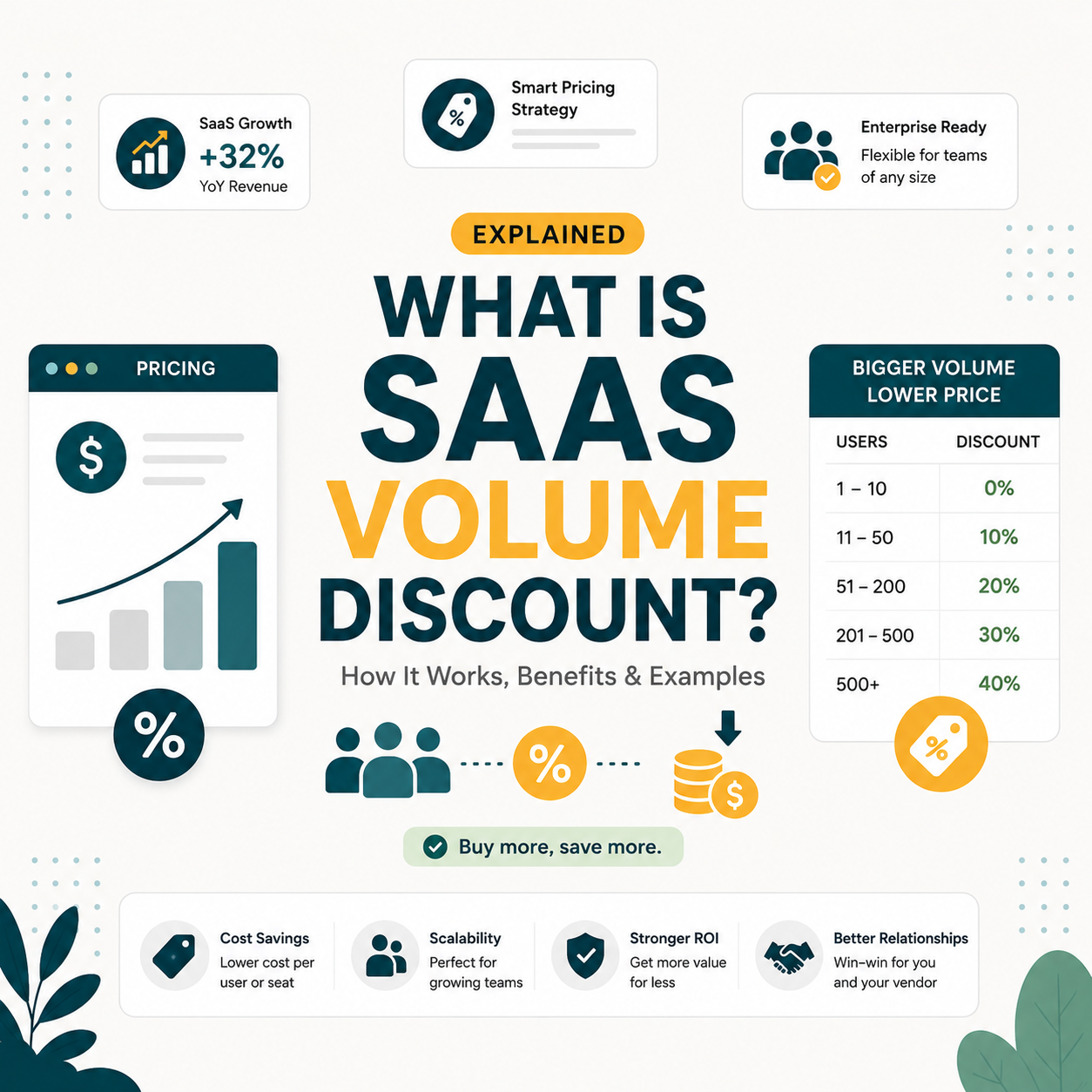
A SaaS volume discount is a pricing model that lowers the cost per unit once purchased volume crosses defined thresholds. Buyers unlock a cheaper per-credit rate at higher tiers instead of paying one flat rate for every lookup. For a B2B SDR team, moving from Hunter.io Starter to Scale drops the cost per email found from $0.0245 to $0.0120, a 51% reduction on monthly billing and 66% if annual billing is stacked on top. Hunter.io applies this model across its Free, Starter, Growth, Scale, and Enterprise plans.
Table of Contents
What Is a SaaS Volume Discount? Core Definition for B2B Sales and Marketing Teams
A SaaS volume discount is a pricing mechanism that reduces the cost per unit, whether that unit is a credit, an API call, or a seat, once purchase volume crosses a published threshold. Unlike flat-rate plans, volume pricing rewards scale: the more a team commits to, the less each unit costs. The model is now standard across email finder and verification tools. See our Hunter.io Email Finder review for how one vendor structures its tiers end to end.
Source: compiled from vendor pricing pages (Hunter.io, Snov.io, ZeroBounce), verified July 2026.
“Discounts are reductions applied to the basic sale price of goods or services.”
: Wikipedia, Discounts and allowances
A SaaS volume discount differs from a one-time bulk purchase in one important way: the discount is structural. It applies automatically based on the tier selected and renews with the billing cycle. Buyers do not negotiate each purchase, they simply choose a plan and the per-unit rate follows.
How a SaaS Volume Discount Works: The Billing Mechanism Explained
SaaS volume discounts operate through a tiered pricing table built into the vendor’s billing system. When a buyer selects a higher tier, the per-unit rate drops for every unit inside that tier. This creates a built-in incentive to commit upfront rather than repeatedly topping up small credit packs at retail rates.
Five components make the mechanism work across B2B SaaS billing systems.
- Tier threshold definition: Vendors publish fixed usage breakpoints where the per-unit price drops. Hunter.io uses 50, 2,000, 10,000, and 25,000 credits per month. ZeroBounce uses 2,000, 5,000, 10,000, 100,000, 250,000, 500,000, and 1,000,000 credits.
- Per-unit rate calculation: The effective rate is the plan price divided by the credits included. Hunter.io Starter delivers 2,000 credits at $49, or $0.0245 per credit. Growth delivers 10,000 at $149, or $0.0149.
- Non-uniform credit consumption: Not every action costs one credit. On Hunter.io, one credit finds one email through Domain Search or Email Finder, one credit covers up to ten emails through Bulk Domain Search, and half a credit verifies one email. Bulk workflows therefore carry a second, hidden volume discount on top of the tier discount.
- Billing-period discount stacking: Most vendors add a second discount layer for annual prepayment. Hunter.io applies a flat 30% reduction on annual billing, and Snov.io applies 25%. Combining tier selection with annual billing produces the lowest effective per-credit cost available.
- Shared credit pooling: Every Hunter.io plan, including Free, allows unlimited team members drawing from one pool. Pooling lets a small team reach a higher tier threshold together instead of fragmenting spend across individual subscriptions.
“You can invite as many team members as you’d like at no extra cost.”
: Hunter.io Pricing FAQ
The mechanism is simple in theory but requires accurate usage forecasting. Underestimation leads to mid-cycle top-ups at retail credit-pack rates. Overestimation wastes budget on credits the team never spends.
What Are the Top 5 Use Cases for SaaS Volume Discount Pricing in B2B Sales?
Volume discount pricing delivers the clearest return in five B2B workflows: bulk email verification, large-scale domain search, shared SDR credit pools, agency client campaigns, and automated enrichment pipelines. Each benefits from a lower per-unit cost at higher committed volume.
- Bulk email list verification: A marketing team verifying 100,000 contacts on ZeroBounce pay-as-you-go pays $0.00649 per verification instead of $0.0195 at the 2,000-credit minimum, a 67% reduction on the same work.
- Bulk domain search at scale: On Hunter.io, running Bulk Domain Search charges one credit for up to ten emails found, versus one credit per email in the standard Domain Search. Teams building company-level lists get materially more output from the same tier.
- Shared SDR credit pools: Hunter.io includes unlimited team members on every plan with one shared pool. Three reps on one Growth plan draw from 10,000 credits at $0.0149 each, rather than three Starter plans delivering 6,000 credits at $0.0245.
- Multi-client agency billing: Agencies aggregate usage across client accounts under a single subscription, reaching thresholds that no single client would justify alone. Snov.io and Hunter.io both include unlimited team seats, which makes this practical.
- Automated enrichment pipelines: Hunter.io sells API-only access separately through its Data Platform, where buyers choose their own search and verification credit volume and the credits stay valid for up to twelve months. This is volume discount pricing in its purest form, decoupled from seats and sequences.
Across all five, the common driver is predictable volume. Teams that can forecast monthly usage with reasonable accuracy capture the most value from pre-committing to a higher tier.
What Are the 5 Limitations of Volume Pricing Every SaaS Buyer Should Know?
Volume discount structures favour teams with steady, high-frequency usage. Buyers who overestimate pay for capacity they never touch. Buyers who underestimate miss the threshold entirely. Five limitations recur across B2B email tool purchasing decisions.
- Reset risk on monthly plans: On Hunter.io monthly plans, credits reset at the end of each billing period. A team that buys Growth for 10,000 credits and uses 4,000 has paid an effective $0.037 per credit, which erases the entire volume discount. Annual plans behave differently, covered below.
- Annual commitment lock-in: The steepest per-credit rates require annual prepayment. Hunter.io annual billing at 30% off means committing $408 to $2,508 upfront depending on tier. If team size or strategy changes mid-year, that capital is already deployed.
- Credit accounting is not uniform: A 10,000-credit plan does not mean 10,000 lookups. Verification costs half a credit on Hunter.io, Bulk Domain Search covers up to ten emails per credit, and on Snov.io a deliverability check costs 25 credits. Comparing headline credit counts across vendors without normalising the unit produces the wrong answer.
- Accuracy is domain-dependent, not tier-dependent: Catch-all domains limit what any SMTP-based verifier can confirm, at any volume. Hunter.io does not charge a credit when a verification returns Unknown, which softens the cost, but higher tiers do not improve match rates.
- Switching cost amplification: Higher tiers raise the cost of leaving. Teams that build sequences, integrations, and export formats around one vendor’s API face real re-tooling costs even when a competitor offers a better per-credit rate at their current volume.
Top 5 Tools Compared by SaaS Volume Discount Approach: Hunter, Snov, ZeroBounce, Apollo, and Clearbit
Five tools dominate the B2B email finder and verification category, and each applies volume discount logic differently. ZeroBounce publishes the deepest and most transparent volume ladder, seven price points from 2,000 to 1,000,000 credits. Hunter.io publishes the cleanest tier structure for combined finding, verification, and sending. Apollo prices per seat with credits layered on top, and Clearbit no longer exists as a standalone purchase.
Sources: hunter.io/pricing, zerobounce.net docs, snov.io/pricing, apollo.io/pricing. Verified July 2026. Credit units are not equivalent across vendors, see the caveat below.
Read this before comparing the numbers above. One Hunter.io credit finds one email, or verifies two emails, or returns up to ten emails through Bulk Domain Search. One Snov.io credit finds one prospect, verifies one email, or reveals one company profile. One ZeroBounce credit verifies one email, while its Email Finder consumes considerably more. Apollo separates email, mobile, and export credits entirely. A per-credit comparison is only meaningful once the unit is normalised to the specific action a team actually runs.
Clearbit note. Clearbit was acquired by HubSpot and folded into Breeze Intelligence. There is no standalone Clearbit subscription, no independent pricing page, and access requires a paid HubSpot subscription. Teams evaluating Clearbit for a non-HubSpot stack should treat it as unavailable rather than expensive.
Hunter.io: cost per email found by plan tier (monthly billing)
How Do You Apply a SaaS Volume Discount in 5 Steps With Hunter.io?
Applying volume discount logic starts with measuring real credit consumption before committing to a tier. Five steps cover baseline measurement, tier selection, pool configuration, integration, and review. Hunter.io’s free plan provides 50 credits per month with no credit card, which is enough to run the measurement step.
- Step 1, baseline actual usage: Run 30 days on the free plan and log every Domain Search, Email Finder lookup, and verification. Remember the accounting: one credit per email found, half a credit per verification, one credit for up to ten emails via Bulk Domain Search. Failed lookups and Unknown verification results cost nothing.
- Step 2, calculate the break-even tier: Divide each plan price by its credit pool to get the effective rate, then match it against forecast volume. Starter covers up to 2,000 credits at $0.0245. Growth covers 10,000 at $0.0149. The correct tier is the cheapest one that comfortably covers forecast usage, not the cheapest one overall.
- Step 3, configure the shared credit pool: Add every team member to one workspace. All Hunter.io plans include unlimited users sharing a single pool, so a three-person team on one Growth plan gets 10,000 credits at $149, versus three Starter plans delivering 6,000 credits at $147.
- Step 4, integrate the workflow: Connect Hunter.io to the CRM or sequencer through native integrations, the browser extension, the Google Sheets add-on, the API, or MCP. Credits are counted identically wherever the request originates, so routing does not change unit economics.
- Step 5, review the tier quarterly: Compare credits consumed against credits purchased each quarter. Consistent usage below 60% of the allocation means the tier is oversized. Consistent exhaustion before the cycle ends means it is undersized.
Not sure which Hunter.io tier fits your actual usage?
Try Hunter.io Free →Free plan includes 50 credits per month. No credit card required to start.
How Has SaaS Volume Discount Pricing Evolved Across the B2B Email Tool Category?
Volume pricing in B2B SaaS grew out of the per-seat models that dominated the early 2010s. Email tools originally charged per licence. As usage-based billing matured, credit-based volume tiers replaced seat counts as the primary pricing lever, because credits track the value delivered more closely than access does.
Hunter.io illustrates the arc. It launched in 2015 and long ran a split credit model, separate quotas for searches and verifications. In May 2024 it removed the monthly credit reset on yearly plans, making the full annual allocation available upfront for the entire 365-day term. In July 2025 it consolidated searches and verifications into a single unified credit pool, which is the structure on the pricing page today. Each change moved the product further toward pure volume-based economics and away from seat-based gating.
The wider category followed the same path. Snov.io and Hunter.io now both include unlimited team seats on every paid plan, which removes seats from the pricing conversation entirely and leaves credits and sending volume as the only real constraints. For the full tier-by-tier breakdown, see our Hunter.io pricing model explainer.
What Are the Real Cost Implications of a SaaS Volume Discount at SDR Team Scale?
For an SDR team scaling from a few hundred to several thousand lookups per month, tier selection changes the cost base significantly. Moving from Hunter.io Starter to Growth cuts the cost per email found from $0.0245 to $0.0149, a 39% reduction that compounds across every campaign. See the full Hunter.io pricing breakdown for per-plan detail.
Source: Hunter.io pricing page, verified July 2026. Annual billing applies a flat 30% reduction. Connected email accounts: 1, 3, 10, and 20 respectively. Additional accounts from $10 per month.
Hunter.io removed the monthly credit reset on yearly plans, so an annual buyer receives the full allocation upfront and can spend it across the entire 365-day term rather than losing the unused balance each month.
: Summarised from the Hunter.io Email Finder review, Growth Hack Suite
That single detail changes the volume discount calculation for seasonal teams. On monthly billing, unused credits are lost at the end of each cycle. On annual billing, the discount and the flexibility stack: 30% off the rate, plus the freedom to concentrate consumption in the months that matter.
What Are the 5 Common Mistakes B2B Teams Make With Volume Pricing?
Most teams approach volume discount purchasing reactively. They buy small, grow into constraints, then upgrade late and miss months of compounding savings. Five errors repeat across SDR, marketing, and agency teams, and all five are preventable with one usage audit.
- Guessing usage from headcount instead of cadence: A five-person SDR team running daily sequences consumes far more than five times a solo rep’s volume. Sizing from headcount rather than measured cadence causes mid-cycle exhaustion that pauses live sequences.
- Splitting usage across two vendors: Buying an entry plan at one vendor for finding and another for verification doubles the subscription base while missing the volume threshold at both. Consolidating onto one tool at a higher tier usually reduces total cost.
- Ignoring the annual billing layer: Hunter.io Growth costs $1,788 per year on monthly billing and $1,248 on annual, a difference of $540. Teams that never model twelve-month total cost leave that on the table.
- Running separate accounts instead of one pool: Three Hunter.io Starter plans cost $147 per month for 6,000 credits. One Growth plan costs $149 for 10,000. Since every plan includes unlimited team members, the pooled option delivers 67% more credits for two dollars more.
- Upgrading after exhaustion rather than before it: Waiting until credits run out mid-cycle forces a top-up at credit-pack rates on top of the plan already paid for. Upgrading on a 30-day usage trend avoids paying twice for the same month.
How Do SDRs, Email Marketers, and Founders Apply Volume Discounts Differently?
The right tier depends on the shape of usage, not just its size. SDRs need steady daily throughput. Email marketers need burst capacity around campaign sends. Founders need a small, reliable allocation for high-value manual outreach.
SDRs running daily prospecting sequences exhaust a 2,000-credit Starter allocation quickly once verification is layered in. Growth at 10,000 credits covers a full month of active cadence without interruption, and the drop from $0.0245 to $0.0149 per email found flows straight into cost per qualified lead. See our Hunter.io Growth plan breakdown for the ceilings on that tier.
Email marketers typically batch-verify before quarterly sends rather than consuming credits daily. For that shape, annual billing is the stronger lever than tier size, because the removal of monthly resets on yearly plans lets a marketer concentrate the entire allocation into the two or three months when campaigns actually ship.
Founders at sub-ten-person companies often start on the free plan’s 50 credits for direct outreach to a short list of high-value accounts. The Starter plan covers most founder-led motion, with Growth becoming relevant once a dedicated SDR function exists.
What Are the Best Practices for Implementing a SaaS Volume Discount in 2026?
Effective use of volume pricing means matching tier commitment to measured usage rather than aspirational targets. Five practices apply across tool categories and team sizes.
- Baseline before committing: Two full billing cycles on the free or entry tier produce a reliable consumption figure. Every vendor covered here offers a free allocation for exactly this purpose: Hunter.io 50 credits per month, Snov.io 50 credits, ZeroBounce 100 credits.
- Select the tier at roughly 80% utilisation: Upgrade when consumption consistently reaches about four-fifths of the current allocation. That buffer prevents mid-cycle exhaustion without paying for an oversized plan.
- Consolidate onto one shared pool: Where unlimited seats are included, as they are on every Hunter.io and Snov.io plan, one higher-tier subscription beats several entry plans on both credit volume and per-credit rate.
- Stack the billing-period discount: Hunter.io annual billing applies a flat 30% reduction and removes the monthly credit reset. Snov.io annual applies 25%. ZeroBounce ONE annual drops the monthly rate from $99 to $79.
- Check for eligibility discounts: Hunter.io offers a 30% discount on monthly plans for registered non-profit organisations with 501(c) status in the United States, applied after signup with documentation. These programmes are rarely surfaced in the pricing table.
What Industry Trends Are Reshaping SaaS Volume Discounts in Late 2026?
Three observable vendor moves are reshaping how B2B teams evaluate a SaaS volume discount: the consolidation of split credit systems into unified pools, the removal of seats as a pricing lever, and the arrival of AI-agent access as a standard plan inclusion.
Unified credit pools are replacing split quotas. Hunter.io consolidated separate search and verification quotas into one pool in July 2025, and ZeroBounce runs a single credit system across its validation tools. A unified pool makes tier comparison simpler for the buyer and removes the vendor’s ability to hide effective price behind two separate ladders.
Seats are disappearing from the pricing conversation. Hunter.io includes unlimited team members on every plan including Free, and Snov.io includes unlimited team seats on all paid plans. When seats are free, the only lever left is volume, which pushes the entire category further toward pure volume discount economics. Apollo remains the notable exception, still pricing per seat with credits layered on top.
AI-agent access is becoming a plan inclusion rather than an enterprise add-on. Hunter.io and Snov.io both now list MCP server access, which lets external AI assistants query the account directly. Credits are consumed identically whether the request comes from the web app, the API, or an AI agent, so agent-driven workflows inherit the same volume discount structure rather than sitting on separate pricing. Our Hunter.io advanced guide covers the free tools that sit outside the credit system entirely.
SaaS Volume Discount: Frequently Asked Questions
What is a SaaS volume discount?
A SaaS volume discount is a pricing model where the cost per unit, whether a credit, verification, API call, or seat, decreases as committed volume rises above published thresholds. Vendors build these thresholds into tiered plans, so buyers who commit to a higher volume tier receive a lower per-unit rate for the duration of the subscription. The discount is structural and automatic rather than negotiated case by case.
How does a SaaS volume discount work in practice?
The vendor publishes a tiered pricing table. The buyer selects a tier, for example Hunter.io Growth at $149 per month for 10,000 credits, pays for the billing period, and consumes credits as the team works. The effective per-unit price is the tier price divided by the credits included, which gives $0.0149 in that example. On monthly billing, unused credits typically reset. On Hunter.io yearly plans, the monthly reset was removed, so the full annual allocation stays available for 365 days.
Which email tool offers the best SaaS volume discount for B2B SDRs?
It depends on the workload. For verification-only work, ZeroBounce publishes the deepest ladder, from $0.0195 per credit at the 2,000-credit minimum down to $0.003199 at 1,000,000 credits, and its credits never expire. For combined finding, verification, and sending in one pool, Hunter.io runs from $0.0245 per email found on Starter to $0.0084 on Scale with annual billing. Snov.io sits between the two on price and adds multichannel outreach.
How much does the Hunter.io Growth tier actually cost?
Hunter.io Growth costs $149 per month on monthly billing or $104 per month on annual billing, which works out to $1,788 versus $1,248 per year. Both deliver 10,000 credits per month, 120,000 per year, 10 connected email accounts, and unlimited team members. The effective rate is $0.0149 per email found on monthly billing and $0.0104 on annual.
Do unused credits roll over on a volume discount plan?
It varies by vendor and by billing period, and this is the single most expensive assumption to get wrong. Hunter.io monthly plans reset credits at the end of each billing cycle, while yearly plans no longer reset monthly and make the full allocation available for the whole term. ZeroBounce pay-as-you-go credits never expire at all. Snov.io states that unused credits roll over to the next month with plan autorenewal on premium plans.
Does upgrading to a higher volume tier improve email find rates?
No. The database and verification logic are identical across paid plans. What changes is throughput: more credits allow larger target lists, which increases total emails found even when the find-rate percentage stays flat. Hunter.io does not charge a credit when no email is found, and does not charge a verification credit when the result is Unknown, so unsuccessful attempts do not erode the allocation.
Can I test a volume discount workflow on a free plan?
Yes, and it is the correct first step. Hunter.io’s free plan provides 50 credits per month with no credit card, plus one connected email account, 500 recipients per sequence, and unlimited team members. Snov.io’s Trial provides 50 credits that renew every 30 days. ZeroBounce provides 100 free verification credits per month. Free tiers are sufficient to measure consumption, though Hunter.io restricts add-on credit packs to paid plans.
What is the difference between a SaaS volume discount and a freemium plan?
A freemium plan provides limited access at zero cost as an acquisition mechanism. A SaaS volume discount is a structural incentive that lowers per-unit cost as paid usage scales. Hunter.io offers both: 50 free credits per month as the freemium entry, and a descending per-credit ladder across Starter, Growth, Scale, and Enterprise.
Does Hunter.io volume pricing include team members?
Yes, on every plan including Free. Hunter.io states that users can invite as many team members as they like at no extra cost, with everyone sharing the same credit pool included in the plan. This makes pooling the single most reliable way to reach a higher volume tier, because adding people costs nothing while their combined usage justifies a cheaper per-credit rate.
How long does it take to move to a higher volume discount tier?
The upgrade itself takes a few minutes through the subscription settings, and the new credit allocation becomes available immediately. Adding team members to the shared workspace takes a few minutes more. Connecting a CRM, the Google Sheets add-on, the browser extension, or an API integration adds the longest step, though credits are counted identically regardless of which surface the request comes from.
Is there a volume discount on the Hunter.io free plan?
No. The free plan provides 50 credits per month at no cost, which is a freemium access tier rather than a volume discount tier, since no payment threshold is involved. Volume discounts begin at Starter, $49 per month for 2,000 credits at $0.0245 each, and scale down to Scale at $299 for 25,000 credits at $0.0120. Free plan users also cannot purchase add-on credit packs.
Which features are gated behind higher volume tiers?
Fewer than most buyers expect. Auto-verification, lead enrichment, advanced Discover filters, and the AI Writing Assistant are included on every paid Hunter.io tier. What scales with tier is quantity: connected email accounts move from 1 to 3 to 10 to 20, recipients per sequence from 500 to 2,500 to 5,000 to 15,000, Signals from 10 to 20 to 200 to 10,000, and saved leads from 100,000 to 30,000,000. TechLookup sits outside the plan structure entirely as a free tool.
Start on the free plan, measure 30 days, then pick the volume tier your data supports.
Try Hunter.io Free →50 free credits per month. No credit card required. Upgrade only when usage data supports it.