
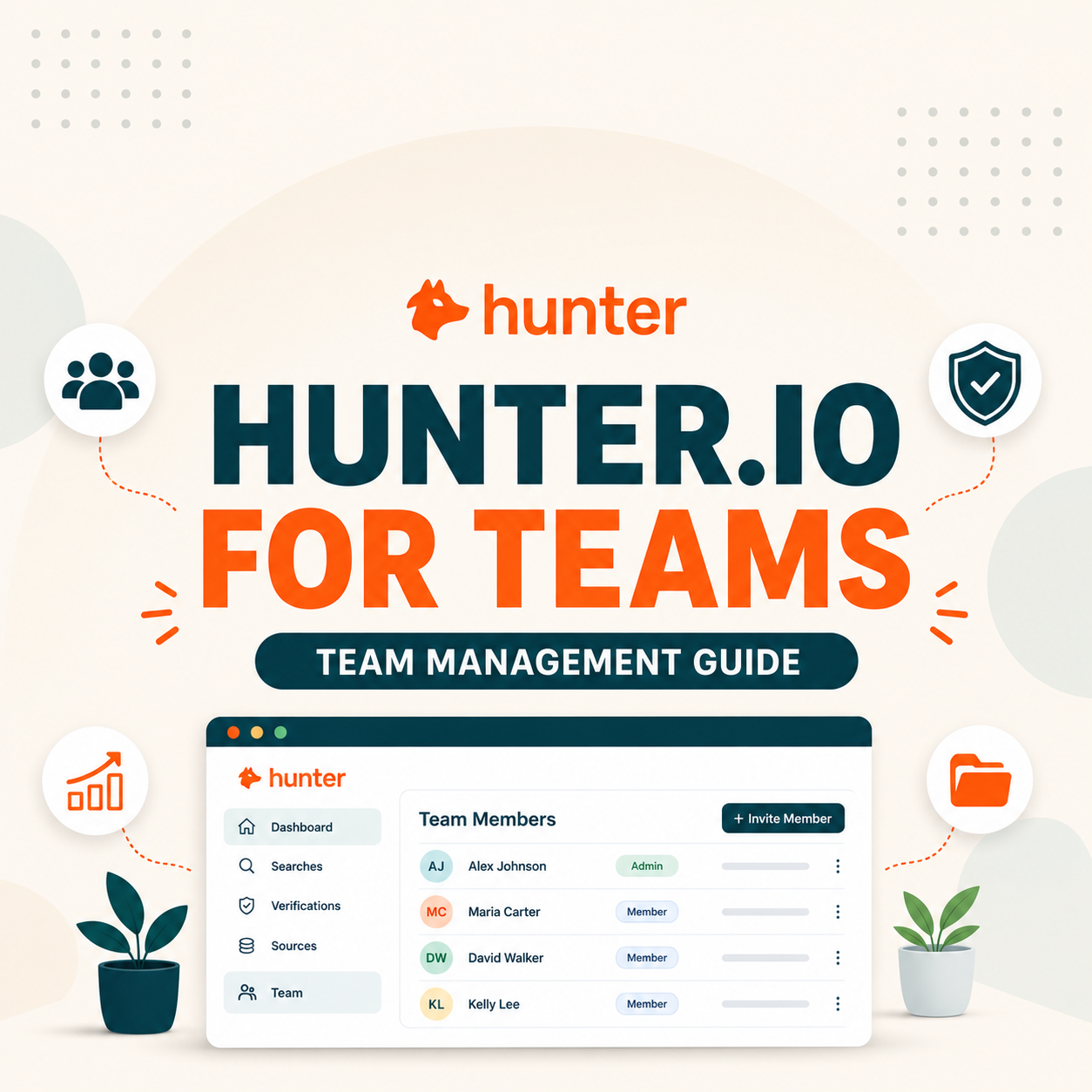
Hunter.io for teams works on a shared model, not a separate Team Plan and not a per-seat fee. Every Hunter plan, from Free to Enterprise, includes unlimited team members at no extra cost, and the collaboration layer is built into all of them: shared Lead lists, one shared credit pool, and shared Sequence assets. What actually changes as you move up from Starter ($34/month billed annually) to Growth ($104) to Scale ($209) is the monthly credit allowance, the number of connected email accounts, and feature depth, not the number of users on your account.
Table of Contents
Hunter.io for Teams: Is There a Team Plan and What’s Included?
There is no standalone Hunter Team Plan and no per-seat charge. Team collaboration is built into every Hunter plan, and every plan includes unlimited team members who share one credit pool, shared Lead lists, and shared Sequence assets. Starter costs 49 dollars a month (34 billed annually) with 2,000 monthly credits and 3 connected email accounts. Growth costs 149 (104 annually) with 10,000 credits and 10 email accounts. Scale costs 299 (209 annually) with 25,000 credits and 20 email accounts. See the full Hunter io pricing 2026 breakdown across every plan tier for per-plan feature details.
Source: Hunter.io official pricing page (hunter.io/pricing). Annual billing is 30 percent cheaper than monthly across all paid plans.
“Collaboration is a process where two or more people work together to complete a task or achieve a goal.”
Wikipedia, Collaboration : the shared workspace model Hunter applies through pooled credits, Lead lists, and Sequence assets across SDR and Sales Ops teams.
Hunter team features are built into every plan, not sold as a separate product. Choose a tier by monthly credit volume and connected email accounts, not by how many people you add. Starter fits light use, Growth fits most active teams, Scale fits heavy senders.
How Does Hunter.io for Teams Work: Shared Credits and Collaboration
Hunter team collaboration runs on shared resources at the account level. Every member draws from one monthly credit pool rather than a per-seat allocation. Lead lists are shared so the whole team sees and enriches the same contacts. Connected email accounts and Sequence templates are shared for coordinated outreach. The account owner invites unlimited teammates at no extra cost and everyone shares the same quota, so collaboration scales with credits, not with headcount.
- Shared credit pool: every team member draws from one monthly credit allocation (2,000 on Starter, 10,000 on Growth, 25,000 on Scale); credits are never split per seat, so a small team and a large team on the same plan share the same quota.
- Shared Lead lists: members save and enrich verified contacts into common Lead lists the whole team can access, which prevents duplicate research and keeps territory and account coverage coordinated across SDRs.
- Shared Sequence assets: connected email accounts (3 on Starter, 10 on Growth, 20 on Scale) and Sequence templates live at the account level, so the team reuses subject lines, copy, and cadences without rebuilding from scratch.
- Unlimited member management: the account owner invites as many teammates as needed at no extra cost and removes them anytime; every plan from Free to Enterprise carries unlimited users sharing the common credit pool.
Source: Hunter.io official pricing page (hunter.io/pricing).
The Hunter workspace is built around a shared pool plus shared lists and Sequence assets. The team-size decision disappears because users are unlimited; the real decision is how many credits and sending inboxes the team needs each month.
What Are the Top 5 Use Cases Where Hunter Team Collaboration Pays Off?
Five team workflows show where Hunter’s shared workspace delivers clear ROI over solo usage. SDR pods sharing target account lists and splitting outreach by persona. Account executive and SDR handoff where the AE inherits the verified contact list. Multi-territory teams coordinating outreach without duplicate research. Marketing and Sales sharing a list of verified MQLs before enrollment. Agencies running multiple client engagements from one workspace with separate Lead lists per client.
Because every plan carries unlimited members, these workflows cost the same whether the team is two people or twenty. See our Hunter cold email workflow team coordination patterns for step-by-step examples.
- SDR pod ABM motion: several SDRs share target account lists and split outreach by persona (CEO, VP Marketing, Director of Sales); shared Lead lists prevent duplicate work or coverage gaps across accounts.
- AE plus SDR handoff workflow: the Account Executive inherits the verified contact list from SDR research at handoff, with full Lead list context transferring automatically, reducing ramp time from days to hours.
- Multi-territory coordination: teams covering geographic segments (US East, US West, EMEA, APAC) use the shared workspace to prevent duplicate prospect research; territory tags on Lead lists keep reps from crossing.
- Marketing-Sales alignment: a shared list of MQLs verified through Hunter before enrollment, tagged with campaign source, lets SDRs see context before outreach and cuts alignment friction.
- Agency multi-client work: one Hunter workspace serves several client engagements with separate Lead lists per client while sharing a common Sequence template library across the team.
“You can invite as many team members as you’d like at no extra cost. Everyone added will share the same pool of credits included in your plan.”
Hunter.io Pricing FAQ : the official confirmation that all Hunter plans carry unlimited users on a shared credit pool.
Team workflows compound time savings versus solo usage. The shared workspace eliminates duplicate research and speeds new-rep onboarding through inheritable templates and Lead lists, at no per-seat premium.
What Are the 5 Hunter Team Scaling Levers Sales Managers Should Plan For?
Five levers decide when a Hunter team upgrades, and none of them is seat count. The shared credit pool can deplete before month-end if usage is not monitored. Connected email account limits cap how many sending inboxes the team runs. Recipients-per-sequence ceilings constrain large campaigns. Credit volume, not headcount, drives every upgrade because users are unlimited. And monthly versus annual billing changes effective cost by 30 percent.
The five scaling levers below shape when Sales Managers move up a Hunter tier for a growing team. See the Hunter plan tier upgrade decision framework for the full comparison.
- Shared credit pool depletion: all members consume from one monthly pool; a busy team can burn 10,000 Growth credits before month-end, so monitor per-member usage to prevent mid-cycle exhaustion or unplanned upgrades.
- Connected email account limits: Starter allows 3 connected accounts, Growth 10, Scale 20; teams running more sending inboxes add accounts from 10 dollars per month each or move up a tier for headroom.
- Recipients-per-sequence ceiling: Starter caps a sequence at 2,500 recipients, Growth at 5,000, Scale at 15,000; large outbound pushes hit this ceiling before they hit any user limit.
- Credit volume drives upgrades, not headcount: because every plan includes unlimited users, teams upgrade only when they need more credits, more email accounts, or higher-tier features, never simply because they added a person.
- Monthly versus annual billing: monthly billing costs roughly 30 percent more; annual billing locks Starter at 34 dollars, Growth at 104, and Scale at 209 effective per month, a material saving for teams committing for a year.
“As covered in our Hunter.io Email Finder review, Hunter never charges per seat: every plan includes unlimited team members, so the real cost lever for a growing team is monthly credit volume, not headcount.”
Growth Hack Suite, Hunter.io Email Finder review
Scaling levers are predictable. Upgrades happen when credit demand, sending inboxes, or sequence size outgrow the current tier, and annual billing is the simplest way to cut cost without changing tier.
How Do Hunter Plans Compare for Teams: Starter, Growth, Scale, and Enterprise?
Four paid tiers span the Hunter team decision, all with unlimited users. Starter at 49 dollars a month (34 annually) covers light use with 2,000 credits. Growth at 149 (104 annually) covers most active teams with 10,000 credits and 10 email accounts. Scale at 299 (209 annually) covers heavy senders with 25,000 credits and 20 email accounts. Enterprise is custom-quoted with an account manager. Apollo, by contrast, prices per user, so its cost rises with every rep added.
The table below compares Hunter team tiers. For how Hunter’s flat, unlimited-seat pricing stacks against Apollo’s per-user model, see the full Hunter vs Apollo pricing comparison.
Source: Hunter.io official pricing page (hunter.io/pricing). Every tier includes unlimited team members.
Hunter scales by plan tier with unlimited seats on every tier, while Apollo scales by per-user pricing. For any multi-person team, Hunter’s flat price means cost stays the same as you add reps, whereas a per-seat tool grows more expensive with every hire.
On Growth or Scale? Annual billing cuts every paid Hunter plan by 30 percent.
Hunter bills monthly or yearly, and switching to annual billing locks a flat 30 percent off every paid tier: Starter drops to 34 dollars a month, Growth to 104, Scale to 209. We track the current annual rates and any active Hunter deal in one place so your team locks the lowest price before checkout.
See current Hunter.io discounts and deals →How Do You Set Up Hunter.io for Teams in 5 Steps?
Five steps activate a Hunter team workspace in about 15 minutes. Choose a plan tier matching your monthly credit volume and email-account needs. Sign up a new account or upgrade an existing solo account. Configure the workspace name plus the shared Lead list structure and Sequence template library. Invite team members by email at no extra cost. Run a short onboarding session covering shared Lead lists and credit-usage best practices to prevent monthly quota exhaustion across the pooled team.
The five steps below activate a Hunter team workspace for any team size, since seats are unlimited. See the Hunter.io getting started full walkthrough for initial account setup guidance.
- Step 1, choose a tier by credit volume: Starter (2,000 credits, 3 email accounts) for light use, Growth (10,000 credits, 10 accounts) for most active teams, Scale (25,000 credits, 20 accounts) for heavy senders; match the tier to monthly demand, not team size.
- Step 2, sign up or upgrade: create an account on Hunter or upgrade an existing solo account from billing settings; choose annual billing to lock the 30 percent discount, and payment activates the plan immediately.
- Step 3, configure the workspace structure: set a workspace name, create a shared Lead list structure (by territory, persona, or campaign), and build a Sequence template library with your brand-voice templates.
- Step 4, invite team members: from the team settings page, invite teammates by email at no extra cost; each member confirms via an email link and immediately shares the common credit pool and Lead lists.
- Step 5, run an onboarding session: walk the team through the shared workspace, Lead list conventions, Sequence template usage, and credit-usage best practices so a single member does not drain the monthly pool.
Set up your Hunter workspace today. Every Hunter plan includes unlimited team members on a shared credit pool. Starter starts at 34 dollars a month billed annually, Growth at 104 with 10,000 credits, and Scale at 209 with 25,000 credits.
Try Hunter.io Free →Shared Lead lists + templates • Unlimited team members • Shared credit pool
Five steps, 15 minutes, a full Hunter team workspace ready. Match the tier to monthly credit volume at signup and choose annual billing to avoid paying the monthly premium.
Hunter.io for Teams: Frequently Asked Questions
The 12 most-asked questions about Hunter’s team setup, pricing, and shared credits.
Which Hunter plan is best for a 5-person SDR team?
Because every Hunter plan includes unlimited users, all 5 reps share one subscription, so you pick a tier by credit volume, not seat count. Growth at 104 dollars a month billed annually (149 monthly) gives 10,000 shared credits and 10 connected email accounts, the typical fit for an active 5-rep team. Starter (2,000 credits) suits lighter use; Scale (25,000) suits heavy senders. See the Hunter pricing breakdown for full tier comparison.
Does Hunter have a separate Team Plan?
No. There is no separate Team Plan and no per-seat fee. Team collaboration is built into every Hunter plan from Free to Enterprise, and all of them include unlimited team members who share one credit pool and shared Lead lists. You choose a tier by credits, connected email accounts, and features, not by how many people you add.
How does Hunter pricing compare to Apollo for teams?
Hunter charges a flat plan price with unlimited seats, while Apollo prices per user. That means Apollo’s cost rises with each rep you add, whereas Hunter’s stays the same as the team grows. For multi-person teams, Hunter usually gets cheaper relative to Apollo as headcount increases. See our Hunter vs Apollo full comparison for detailed analysis.
Can I add users to my Hunter plan without upgrading the tier?
Yes. Every Hunter plan includes unlimited team members at no extra cost, so adding people never requires a tier upgrade. You upgrade only when you need more monthly credits, more connected email accounts, or higher-tier features. Adding a teammate simply lets them draw from the same shared credit pool.
How do Hunter team credits work across members?
All members share one monthly credit pool (2,000 on Starter, 10,000 on Growth, 25,000 on Scale). One credit equals one email found via Domain Search or Email Finder, and 0.5 credit equals one verification. The same search or verification is counted only once per billing period. Monitor usage so one member does not drain the pool before month-end.
Will a shared Hunter workspace save my team time?
Yes. Shared Lead lists eliminate duplicate prospect research across reps, shared Sequence templates speed onboarding for new SDRs, and a common workspace keeps territory coverage coordinated. Because seats are unlimited, the whole team gets these benefits without any per-user fee.
Can my whole team use one Hunter subscription?
Yes. You can invite as many team members as you like at no extra cost, and everyone shares the same credit quota and Lead lists. This applies to every plan, including Free. The account owner manages invitations and can remove members at any time.
How many sending inboxes can a Hunter team connect?
Connected email accounts scale by tier: 3 on Starter, 10 on Growth, 20 on Scale, and custom on Enterprise. You can add more accounts from 10 dollars per month each. The number of connected accounts drives Sequences sending capacity and inbox rotation for deliverability across the team.
What is the Hunter.io Team Plan?
It is not a separate product. Team features (unlimited members, a shared credit pool, shared Lead lists, and shared Sequence assets) are built into every Hunter plan. You select Starter, Growth, Scale, or Enterprise based on credit volume and email-account needs, and the whole team works inside that one subscription.
How does Hunter.io team collaboration work?
Members share three things at the account level: one monthly credit pool, common Lead lists with the contacts everyone enriches, and shared Sequence assets including connected email accounts and templates. Unlimited users can be invited at no extra cost, all drawing from the same plan quota.
How much does Hunter cost for a 5-user team?
Because users are unlimited, the cost equals the plan price regardless of headcount. A 5-person team on Growth pays 104 dollars a month billed annually (149 monthly) total, not per user, for 10,000 shared credits and 10 connected email accounts. The same plan would cost the same for a 2-person or a 20-person team.
Does Hunter integrate with my CRM?
Yes. Hunter offers CRM integrations alongside its API, browser extension, and Google Sheets add-on, so contact data can flow into the tools your team already uses, such as Salesforce, HubSpot, and Pipedrive. Check the integrations section of the pricing page for the current list and any plan-specific availability.
Hunter team features are built into every plan with unlimited seats. Match the tier (Starter, Growth, or Scale) to monthly credit volume and connected email accounts, and choose annual billing to cut 30 percent off the price.
Try Hunter.io free, with unlimited team members on every plan
Hunter includes unlimited team members on a shared credit pool across every plan. Starter starts at 34 dollars a month billed annually, Growth at 104 with 10,000 credits, and Scale at 209 with 25,000 credits. Annual billing saves 30 percent.
Try Hunter.io Free →7M+ professionals use Hunter. No card. Cancel anytime.