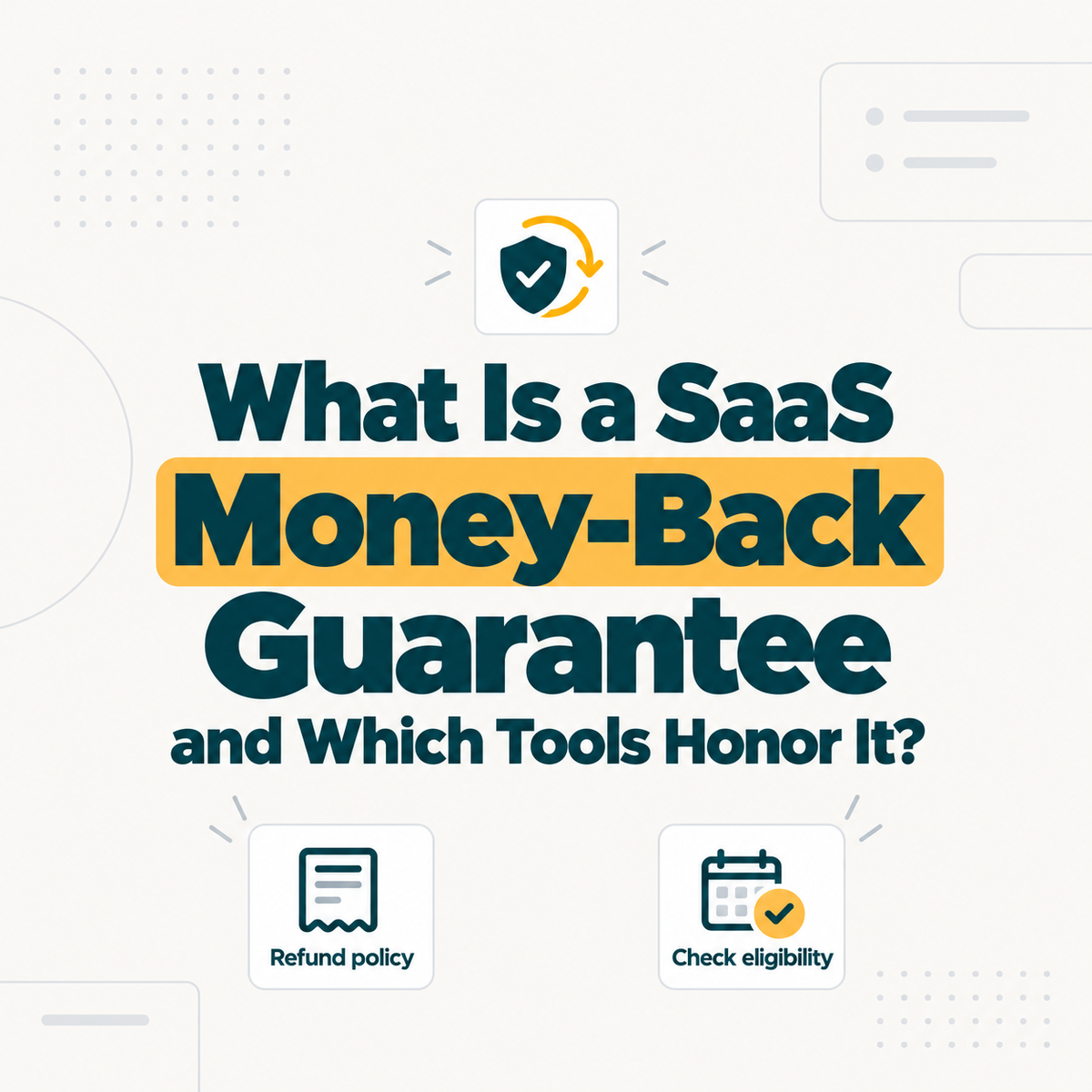
A SaaS money-back guarantee is a vendor promise to refund the full subscription fee when a paying customer cancels inside a stated window, with no proof of failure required. Most B2B email data tools do not offer one: Hunter.io and Snov.io call their fees non-refundable, while ZeroBounce and NeverBounce limit refunds to missed accuracy targets under strict conditions.
Refund policies in this guide were verified against each vendor’s official terms and help center in October 2026.
Table of Contents
What Is a SaaS Money-Back Guarantee?
A SaaS money-back guarantee is a written promise that a software vendor will return the full subscription fee if a paying customer asks for it within a stated window, usually counted from the first charge. The trigger is the buyer’s dissatisfaction, not a proven defect, which separates it from performance guarantees, credits and pro-rated refunds.
“if a buyer is not satisfied with a product or service”
Wikipedia, Money-back guarantee
Wikipedia frames the concept as a simple promise: when that condition is met, the buyer gets a refund. In SaaS, the same idea applies to a recurring subscription instead of a physical product, which raises questions a retail return never faces, such as what happens to data already exported or credits already spent.
Source: Growth Hack Suite definitions; vendor examples verified against official terms, October 2026.
Only a full refund on request qualifies as a money-back guarantee. Every other mechanism in the table shifts part of the risk back to the buyer or removes the payment before risk exists.
How Does a SaaS Money-Back Guarantee Work From Purchase to Refund?
A SaaS money-back guarantee works as a five-stage process: the window opens at the first charge, the buyer requests a refund through the named channel, the vendor checks eligibility, the money returns to the original payment method, and paid access ends. Each stage has its own failure point.
Five stages below show where a refund request succeeds or fails.
- Window opens at first charge: Most published guarantees count days from the first successful payment, so the evaluation clock runs from billing rather than from account sign-up or onboarding.
- Request through the stated channel: Guarantee terms name a channel, such as a billing page or support address, and a request sent elsewhere can land after the window closes.
- Eligibility check against exclusions: The vendor confirms the request date, account history and listed exclusions, such as renewals, add-ons or accounts that already received a refund once.
- Refund to the original payment method: Approved refunds return to the card or account used at checkout, and the issuing bank adds its own processing time before the credit appears.
- Paid access ends or downgrades: Once refunded, the paid plan stops and the account either closes or drops to a free tier, depending on how the vendor writes its terms.
The guarantee is only as strong as its least visible stage, which is usually the exclusion list or the request channel rather than the headline number of days.
What Are the Three Types of Refund Promises in SaaS?
SaaS refund promises fall into three types: an unconditional money-back guarantee that refunds the full fee on request, a conditional performance guarantee that refunds part of the fee when the vendor misses a metric, and no refund at all, where risk is handled before purchase through a free plan.
1. Unconditional
Full fee back on request inside a window. Common in hosting, for example Kinsta for first-time customers.
2. Performance-based
Partial refund if a published accuracy or bounce target is missed. Used by ZeroBounce and NeverBounce.
3. No refund, test first
Fees are non-refundable; a free plan and cancel-before-renewal carry the risk. Used by Hunter.io and Snov.io.
Unconditional guarantees appear most often where the vendor can take the product back, such as hosting, where an account can be closed with nothing of lasting value left with the buyer. Performance guarantees suit services whose output can be measured afterwards, such as email verification. The no-refund model dominates tools that deliver data the instant a credit is spent.
Knowing which of the three types a vendor uses matters more than the word “guarantee” in its marketing, because each type protects a different moment of the purchase.
Why Do Most B2B Email Data Tools Skip Money-Back Guarantees?
Most B2B email data tools skip money-back guarantees because their product is delivered the moment it is used. A found or verified email address cannot be returned, so a full refund after use would hand back the fee while the buyer keeps the data. Vendors handle buying risk with free plans instead.
Five structural reasons explain why email finders and verifiers rarely offer a refund window.
- Data delivered on use: An email search or verification hands over its result the moment a credit is spent, so a refund cannot take the delivered contact data back.
- Credits consumed instantly: Credit-based plans meter every lookup, which means a large share of a month’s value can be used within days, well before any refund window would end.
- Bulk export exposure: A blanket guarantee on a data tool would allow buying a plan, exporting a large list, and then reclaiming the fee after the data is already in hand.
- Free tiers replace trials: Permanent free plans let buyers test real results before paying anything, so vendors treat the free tier as the evaluation step instead of a refund window.
- Accuracy is measurable: Verification output can be checked against real bounces after sending, which is why some verifiers guarantee an accuracy threshold rather than general satisfaction.
For data tools, the absence of a guarantee is a design choice tied to how the product is consumed, not a sign that the vendor lacks confidence in its results.
Which Email Finder and Verifier Tools Honor a Money-Back Guarantee?
None of the five major email finders and verifiers reviewed here offers an unconditional money-back guarantee. Hunter.io, Snov.io and Apollo.io treat subscription fees as non-refundable or decline refunds for unused time, while ZeroBounce and NeverBounce publish performance guarantees that refund part of the cost when accuracy targets are missed.
Source: Hunter.io Terms of Service, Snov.io Knowledge Base, Apollo.io pricing FAQ, ZeroBounce docs, NeverBounce Help Desk. Checked October 2026; confirm current terms before buying.
The table shows two camps: finders that sell access to data and refuse refunds, and verifiers that sell a measurable outcome and refund part of the cost when that outcome falls short.
For buyers comparing these tools, the practical question is not “which one refunds” but “which one lets real results be tested before money changes hands.”
Does Hunter.io Offer a Money-Back Guarantee?
Hunter.io does not offer a money-back guarantee. Its Terms of Service state that upgrade fees are non-refundable and that cancelling stops future renewals instead of returning past payments, for monthly and yearly plans alike. The one stated exception covers unauthorized or fraudulent charges, which support can review case by case.
“Upgrade fees are non-refundable.”
Hunter.io Terms of Service, Payment and Renewal
Hunter’s help center adds a practical detail: a renewal charge that processes before the cancellation is completed, even by a few minutes, is treated as paid for. The terms also include one vendor-side commitment: if Hunter itself terminates a paid account, it refunds the unused prepaid portion within 30 days.
The step-by-step cancellation process is covered in the Hunter.io refund policy guide, and the narrower question of guarantees is answered in whether Hunter.io offers any money-back guarantee.
Hunter.io sits firmly in the no-refund camp, so any evaluation has to happen on the free plan or within a single monthly cycle.
How Does Hunter.io Reduce Buying Risk Without a Guarantee?
Hunter.io reduces buying risk before payment rather than after it. A permanent free plan, cancellation that keeps paid access until the period ends, a pause option on monthly plans, and data that survives a downgrade together limit the downside of a paid month to one billing cycle.
Five risk controls below replace the role a money-back guarantee would play.
- Permanent free plan: The free plan includes 50 credits per month with no time limit, enough to test the Hunter email finder and verifier on real target domains before any payment.
- Cancel before renewal: Cancelling stops the next charge while paid features and credits stay available until the billing period ends, after which the account returns to the free plan.
- Pause on monthly plans: Monthly All-in-one Outreach subscribers can pause renewal for one, two or three months, and the first payment after resuming carries a 30% discount.
- Monthly billing first: Starter costs $49 billed monthly or $34 per month billed annually, so starting monthly caps exposure at one cycle while real volume needs become clear.
- Data kept after downgrade: Contacts, leads, sequences and saved data stay on the account after cancellation, so testing a paid month does not erase the work already done.
“Annual plans save ~30% but are non-refundable”
Hunter.io Email Finder review, Growth Hack Suite
No refund needed when nothing is paid: test Hunter.io on the free plan first.
Try Hunter.io Free →Free plan: 50 credits per month, no time limit.
These controls move the evaluation in front of the payment, which is the only point where a no-refund tool can be tested without financial risk.
Money-Back Guarantee vs Free Plan: Which Protects B2B Buyers Better?
A money-back guarantee protects the buyer after payment, while a free plan protects the buyer before payment. For data tools, a free plan usually protects better because nothing is at stake during testing, but its usage cap means production volume can only be tested in a paid cycle.
A guarantee lets a team test at full paid capacity, yet it brings deadlines, exclusions and the effort of filing a claim. A free plan removes those frictions entirely but limits volume: Hunter.io’s 50 monthly credits prove accuracy on a sample, not throughput on a full prospect list. The two models are explained side by side in Hunter.io free plan vs free trial and in the broader guide to what a SaaS free trial is.
For most B2B buyers, the free plan followed by one monthly paid cycle delivers the same protection a guarantee promises, with the cost of a disappointing test capped at a single month.
What Clauses Should Buyers Read Before Trusting a Money-Back Guarantee?
Buyers should read six clauses before trusting a SaaS money-back guarantee: when the window starts, what purchases it covers, any usage limits, how the refund is paid, which channel accepts requests, and whether repeat customers qualify. These details decide whether the headline promise holds up when a refund is actually requested.
US advertising guidance sets a useful baseline. The FTC’s Guides for the Advertising of Warranties and Guarantees (16 CFR 239.3) say a seller should use the phrase “money back guarantee” only if it refunds the full purchase price when the purchaser asks. A guarantee that quietly pays in credit or pro-rates the amount falls short of that standard.
Source: Growth Hack Suite buyer checklist based on FTC 16 CFR 239.3 and vendor terms reviewed October 2026.
A guarantee that passes all six checks is a real safety net; a guarantee that fails two or more behaves more like a conditional refund policy, whatever its marketing says.
What Are the Limits of Performance Guarantees in Email Verification?
Performance guarantees in email verification refund only part of the cost, and only when the buyer can prove the vendor missed its threshold under tightly defined conditions. ZeroBounce and NeverBounce both require minimum list sizes, a 72-hour sending window, and full bounce logs before a claim is reviewed.
Five conditions below decide whether a verification guarantee pays out.
- Minimum list size: ZeroBounce requires a list of at least 1,000 emails and NeverBounce at least 500 unique addresses before a guarantee claim qualifies for review.
- 72-hour sending window: Both vendors require the cleaned list to be mailed within 72 hours, so lists cleaned now and stored for later campaigns fall outside the guarantee.
- Valid results only: Claims cover addresses marked valid or deliverable; sending to accept-all, unknown or risky results removes those bounces from the guarantee calculation entirely.
- Hard bounces with proof: Buyers must export send logs with the actual bounce responses, and bounces caused by spam content, blacklisted IPs or server setup do not count.
- Partial refunds by design: ZeroBounce refunds five times the shortfall per percentage point, and NeverBounce refunds the difference above 3%, never the full purchase price of the list.
ZeroBounce also limits its guarantee to opt-in lists the sender collected, not purchased lists. Performance guarantees are useful accountability signals, but they compensate for a measured shortfall rather than reversing a purchase.
What Are 5 Common Mistakes Buyers Make About SaaS Refunds?
The five most common SaaS refund mistakes are confusing a free plan with a free trial, cancelling after the renewal has already charged, assuming annual plans are refundable, treating credit packs as a trial, and filing a chargeback before contacting billing support. Each one turns a recoverable situation into a lost payment.
Five mistakes below account for most failed refund requests on non-refundable tools.
- Confusing free plan and free trial: A free plan has no end date and takes no payment, while a free trial converts into billing, so treating them alike leads to unexpected renewals.
- Cancelling after the renewal charge: Hunter.io states that a renewal processed even minutes before cancelling is paid for and non-refundable, which makes the renewal date the real deadline.
- Assuming annual plans are refundable: Annual billing trades flexibility for a discount, and Hunter.io keeps access until the yearly term ends without refunding the unused months.
- Buying credit packs as a trial: Hunter.io credit packs start at $10, stay valid for three months, and are non-refundable, so they extend usage rather than reduce purchase risk.
- Filing a chargeback first: A card dispute against a charge that matches published terms can be contested by the vendor with the accepted terms as evidence, so billing support comes first.
When a dispute is genuinely justified, the guide to SaaS chargebacks explains when a card dispute is the right path. Avoiding these five mistakes protects more money than any guarantee clause.
How Do You Evaluate an Email Tool Risk-Free in 5 Steps Without a Guarantee?
An email tool without a money-back guarantee can be evaluated risk-free in five steps: build a benchmark list, test it on the free plan, send a small valid-only batch, buy one monthly cycle only if results hold, and decide before the renewal date. The workflow below uses Hunter.io as the example.
Five steps below replace a refund window with measured results.
- Shortlist 20 target domains: Pick domains from the real ideal customer profile, including a few contacts already known to be correct, to create a fair accuracy benchmark for the test.
- Test on the free plan: Run the domains through Hunter.io Domain Search and Email Verifier using the 50 free monthly credits, then record the share of valid, accept-all and invalid results.
- Send a small valid-only batch: Email only addresses marked valid and check hard bounces in the sending tool, which shows real deliverability on the target market before any payment.
- Buy one monthly cycle: If results hold, choose monthly billing instead of annual, so the maximum loss is one billing period if production-volume testing disappoints.
- Decide before renewal: Set a reminder a few days before the renewal date, then keep, pause or cancel the plan based on measured results rather than on the original expectation.
Run step 2 today: 50 free credits, no payment needed.
Try Hunter.io Free →Paid plans start at $49 per month, or $34 per month billed annually.
Once a paid month is running, the guide on how to cancel or downgrade Hunter.io covers the exact steps. The workflow caps the cost of a wrong choice at one monthly payment, which is close to what a money-back guarantee would deliver in practice.
How Do SDRs, Email Marketers, and Founders Weigh Refund Terms Differently?
SDRs, email marketers and founders weigh refund terms differently because each carries a different risk. SDRs care about accuracy on a target vertical, email marketers care about bounce rates on an existing list, and founders care about total commitment and lock-in across the whole tool stack.
SDRs rarely control the budget, so the question is whether a tool finds verified contacts in the target vertical. A free plan answers that faster than any refund window, because the test needs a sample of domains rather than a full month of volume.
Email marketers verify lists they already own, which is where performance guarantees from verifiers such as ZeroBounce and NeverBounce become relevant. The 72-hour sending window and minimum list sizes need to fit the campaign calendar before the guarantee carries any weight.
Founders look at the whole contract: monthly versus annual billing, renewal dates, and how easily data can leave. The broader risk is covered in the guide to SaaS vendor lock-in, and the trade-off between billing cycles in Hunter.io annual vs monthly billing.
Matching refund terms to the role that carries the risk keeps evaluations focused on the one outcome each buyer actually needs to prove.
SaaS Money-Back Guarantee: Frequently Asked Questions
The 12 most-asked questions about SaaS money-back guarantees.
What is a SaaS money-back guarantee?
A SaaS money-back guarantee is a vendor promise to refund the full subscription fee when a paying customer asks for it within a stated window. The buyer does not need to prove a defect; dissatisfaction is enough. That makes it different from performance guarantees, pro-rated refunds and account credits, which all return less than the full price or require proof.
Is a money-back guarantee the same as a refund policy?
No. A refund policy is the full set of rules for every refund scenario, including the rule that no refunds are given. A money-back guarantee is one specific promise that may or may not sit inside that policy. Hunter.io, for example, has a refund policy whose core rule is that subscription fees are non-refundable.
Does Hunter.io have a money-back guarantee?
No. Hunter.io’s Terms of Service state that upgrade fees are non-refundable, for monthly and yearly plans. Cancelling stops the next renewal and keeps paid access until the period ends. The only stated exception is an unauthorized or fraudulent charge reported to support. The free plan, with 50 credits per month, is the intended way to test before paying.
Can I get a refund if I cancel Hunter.io early?
No. Hunter.io does not refund unused or partially used subscription time once a payment has processed. After cancelling, paid features and credits remain available until the end of the billing period, and the account then moves to the free plan. Cancelling before the renewal date is the only way to avoid the next charge.
Which email verification tools guarantee their accuracy?
ZeroBounce guarantees 99.6% accuracy (96% on AOL, Yahoo and Office 365) and refunds five times the shortfall per percentage point. NeverBounce guarantees bounces stay at or below 3% after sending only valid emails and refunds the difference. Both require minimum list sizes, sending within 72 hours, and full bounce logs.
Does Snov.io refund unused subscriptions?
Snov.io’s knowledge base says it does not offer partial or full refunds on monthly, annual or add-on purchases. It lists exceptions it may consider, such as a request within 14 days of an automatic renewal when no quota has been used, a double charge, or a technical issue that blocked access.
Is a free plan better than a money-back guarantee?
For data tools, usually yes. A free plan removes risk before any payment, so there is no claim to file and no deadline to miss. Its limit is volume: a free plan proves accuracy on a sample, not throughput at full scale. Pairing the free plan with one monthly paid cycle covers both questions.
When does a money-back guarantee window start?
The vendor’s terms decide. Some windows start at the first successful charge, others at sign-up or at the end of a trial. Buyers should confirm the start date in writing before subscribing, because a window that opens at sign-up can be half over by the time billing begins.
Can a SaaS vendor refuse a money-back guarantee request?
Yes, when the request falls outside the published terms, for example after the window closes or for an excluded purchase. In US advertising guidance, the FTC says the phrase “money back guarantee” should only be used when the seller refunds the full purchase price on request, so conditions should be disclosed clearly up front.
What happens to my data after cancelling Hunter.io?
The data stays. Hunter.io keeps contacts, leads, sequences and saved data on the account after cancellation. When the paid period ends, the account moves to the free plan with 50 monthly credits, and active sequences pause until a paid plan is restarted.
Can a Hunter.io subscription be paused instead of cancelled?
Yes, on monthly All-in-one Outreach plans. The renewal can be paused for one, two or three months, the subscription resumes automatically, and the first payment after resuming carries a 30% discount. Pausing is not available on yearly, Enterprise or Data Platform plans.
Is a chargeback a substitute for a money-back guarantee?
No. A chargeback is a bank-run dispute meant for unauthorized charges or services not delivered. Disputing a charge that matches published non-refundable terms invites the vendor to contest it with those terms as evidence. Billing support is the right first step for any refund question.
Skip the Refund Question Entirely
Hunter.io has no money-back guarantee, so test accuracy on the free plan before any payment.
Try Hunter.io Free →50 credits per month on the free plan. Cancel or pause paid monthly plans before renewal.